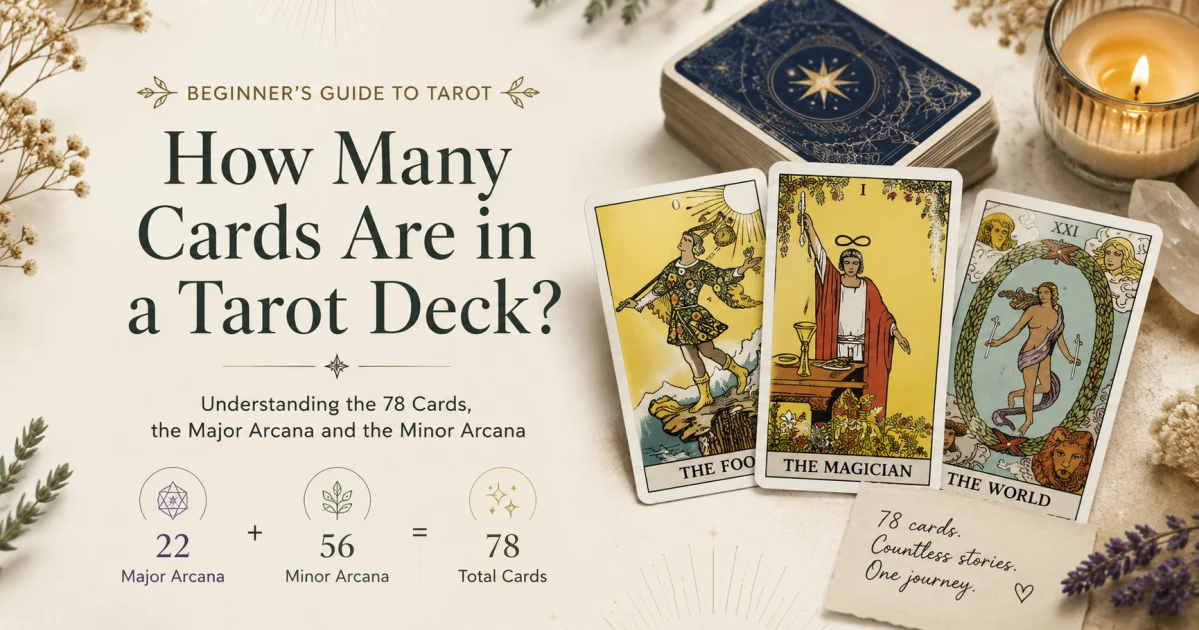
Wondering how many cards are in a tarot deck? Learn why a standard deck has 78 cards, how they’re organized, and why understanding the deck’s structure makes learning tarot much easier.
If you’ve recently become interested in tarot, one of the first questions you might ask is:
How many cards are in a tarot deck?
The answer is simple: a standard tarot deck contains 78 cards.
But that number is only the beginning of the story.
When you first open a tarot deck, it can feel overwhelming. There are dozens of beautifully illustrated cards, unfamiliar names, and symbols that seem full of hidden meaning. Many beginners worry that they need to memorize all 78 cards before they can start reading tarot.
Fortunately, that’s not how learning tarot works.
Once you understand how the deck is organized, the cards become much easier to learn. Rather than seeing 78 separate images, you’ll begin to recognize a carefully structured system that has developed over centuries.
A Standard Tarot Deck Has 78 Cards
Most modern tarot decks contain 78 cards.
These cards are traditionally divided into two groups:
- 22 Major Arcana cards
- 56 Minor Arcana cards
This structure is used by the vast majority of tarot decks published today, including the influential Rider-Waite-Smith Tarot, first published in 1909.
While today’s beginner decks are often based on the Rider-Waite-Smith tradition, the 78-card structure itself dates back much earlier to the earliest tarot decks created in Renaissance Italy, including the famous Visconti-Sforza Tarot.
Although artists continue to create new interpretations with different artwork and themes, most modern decks still follow this traditional structure that has been preserved for centuries.
Why Are There 78 Cards?
Unlike many inventions, tarot wasn’t created by one person at one moment in history.
Historians generally agree that tarot developed gradually in 15th-century northern Italy. Rather than inventing an entirely new type of card game, people expanded existing playing cards by adding a set of illustrated trump cards, known in Italian as trionfi.
Early luxury decks, including the famous Visconti-Sforza Tarot, already contained many of the symbolic figures that are still familiar today.
Although historians cannot point to a single document explaining why the final deck contained exactly 78 cards, this combination of 22 trump cards and 56 suit cards gradually became the standard. Over time, it spread across Europe and remained remarkably consistent, forming the foundation of most tarot decks used today.
Understanding this history reminds us that the structure of tarot wasn’t chosen at random—it evolved over generations as the game itself developed.
Breaking Down the 78 Cards
The easiest way to understand tarot is to think of the deck as having two main parts, each with its own role.
The Major Arcana (22 Cards)
The Major Arcana contains 22 cards, beginning with The Fool (0) and ending with The World (XXI).
These cards are often associated with life’s bigger themes, significant decisions, personal growth, and transformation. They include some of tarot’s most recognizable images, such as The Magician, The Lovers, Death, and The Star.
For many readers, the Major Arcana highlights the experiences that shape us over time rather than the smaller details of everyday life.
The Minor Arcana (56 Cards)
The remaining 56 cards form the Minor Arcana.
They are divided into four suits:
- Cups
- Pentacles
- Swords
- Wands
Each suit contains 14 cards:
- Ace through Ten
- Page
- Knight
- Queen
- King
Together, these cards often focus on daily experiences, relationships, work, emotions, and the ordinary moments that make up everyday life.
Why Is the Deck Divided into Two Parts?
At first, separating the deck into the Major and Minor Arcana may seem unnecessary. After all, they’re all tarot cards—so why divide them?
One helpful way to think about it is to compare the deck to a story.
The Major Arcana introduces the larger themes of the story: growth, change, challenges, and important life lessons.
The Minor Arcana fills in the details by showing the conversations, decisions, emotions, and everyday experiences that shape those larger themes.
Neither group is more important than the other.
Instead, they work together to create a fuller picture. A tarot reading often combines both, allowing readers to consider not only the bigger lesson but also the practical circumstances surrounding it.
Understanding this distinction makes learning tarot much less intimidating because you’re no longer trying to memorize 78 unrelated cards. Instead, you’re learning two connected parts of the same system.
Do All Tarot Decks Have 78 Cards?
Most tarot decks do, but there are a few exceptions.
Some contemporary artists include an extra card or redesign the structure for creative purposes. Certain historical decks also differ slightly from today’s standard.
However, if you’re buying your first tarot deck or following a beginner’s guide, you can safely expect it to contain 78 cards. This is the format used by the vast majority of books, courses, and tarot readers around the world.
Why Does Knowing This Matter?
Many beginners think they should memorize all 78 cards immediately.
In reality, most experienced readers recommend learning the structure of the deck first.
Think of it like learning a new language. You wouldn’t begin by memorizing every word in the dictionary. Instead, you would first understand the alphabet, grammar, and how sentences are organized.
Tarot works in a similar way.
Once you understand how the Major Arcana and Minor Arcana fit together, learning the meanings of individual cards becomes much more natural.
Every experienced tarot reader started with the same simple question:
“How many cards are in a tarot deck?”
The answer is 78, but the number itself is only one small part of the story.
Behind those 78 cards lies a system that has evolved over more than five centuries—one that combines history, art, symbolism, and human experience into a single deck.
As you continue learning, don’t worry about memorizing everything at once. Begin by understanding how the deck is organized, and let your knowledge grow one step at a time. Like any meaningful journey, learning tarot starts with understanding the path before exploring each individual card.
Continue Exploring
Now that you know how a tarot deck is organized, continue with these beginner-friendly guides:
Each guide builds on the last, helping you understand tarot’s history, structure, and symbolism with confidence!💕