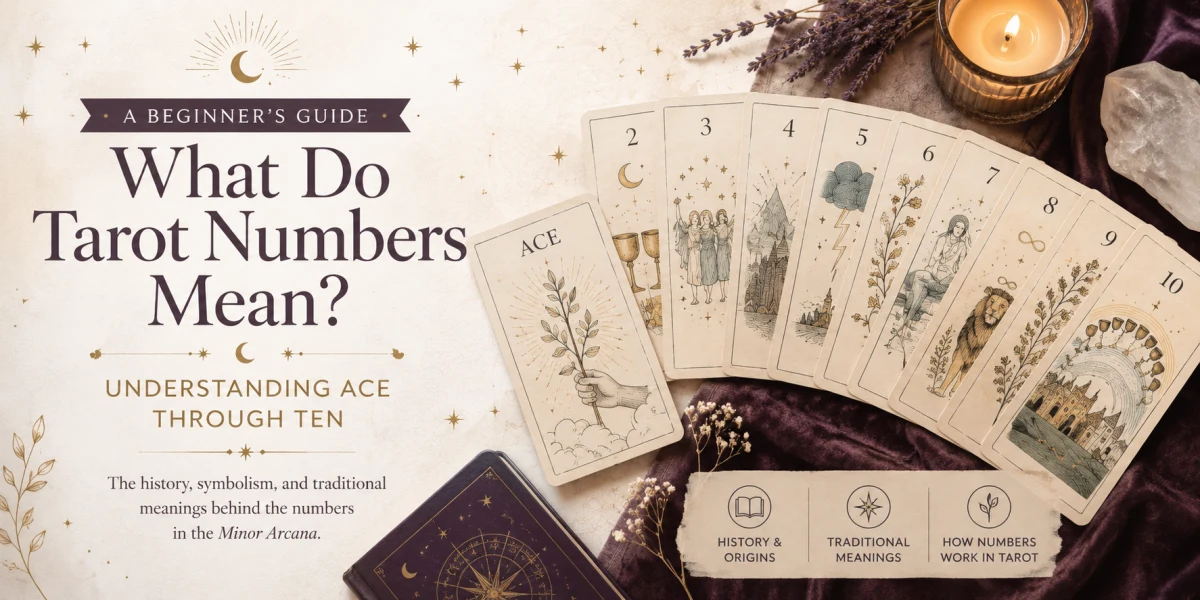
The numbers on tarot cards are more than simple labels, but they were not always understood symbolically. Discover how tarot numbers became part of modern tarot interpretation and learn the traditional themes associated with Ace through Ten.
When learning tarot, it’s natural to notice the illustrations, the four suits, and the Court Cards. Another important part of the Minor Arcana is the number on each card.
Today, many tarot readers associate numbers with broad themes such as beginnings, balance, growth, or completion. However, these symbolic meanings were not part of the earliest known tarot decks.
Understanding how tarot numbers came to be interpreted symbolically helps place modern tarot reading within its historical context and makes the Minor Arcana easier to study.
Why Do Tarot Cards Have Numbers?
The earliest surviving tarot decks were created in fifteenth-century Italy as playing cards.
Like other playing-card decks of the period, the numbered cards helped organise the deck and establish its structure. Each suit contained cards from Ace through Ten, followed by four Court Cards.
Based on the historical evidence available today, these numbers were originally part of the game’s design rather than a symbolic system with fixed spiritual meanings.
In other words, the cards had numbers long before readers began assigning broader symbolic interpretations to them.
When Did Tarot Numbers Become Symbolic?
The symbolic interpretation of tarot numbers developed gradually over time.
During the eighteenth and nineteenth centuries, several writers and esoteric traditions began exploring tarot as more than a card game. In doing so, they connected tarot with broader systems of symbolism, including numerology, Kabbalah, and other philosophical traditions.
These influences helped shape many of the number associations that appear in modern tarot books today.
It is important to remember, however, that different tarot traditions do not always interpret the numbers in exactly the same way.
The themes below represent commonly recognised traditional associations, not universal rules.
Is Tarot Numerology?
Not exactly.
Tarot and numerology are related, but they are not the same system.
Numerology is a broader practice that studies the symbolic significance of numbers in different contexts.
Tarot, on the other hand, combines several elements—including the suits, numbers, Court Cards, imagery, and the context of a reading—to build meaning.
Because of this, a tarot card is never interpreted by its number alone.
Instead, the number works together with the other elements of the card.
Why Do Tarot Numbers Matter?
Every numbered Minor Arcana card combines two important layers:
- the traditional themes associated with its number
- the symbolism of its suit
For example, both the Three of Cups and the Three of Pentacles share the number three.
Many readers associate the number three with growth or development, but each card expresses that theme differently because the suits represent different aspects of experience.
Learning both the numbers and the suits helps reveal connections across the Minor Arcana instead of treating every card as a completely separate definition.
Traditional Themes of Ace Through Ten
Although interpretations vary between traditions, many modern tarot readers recognise the following broad themes.
Ace – Beginnings and Potential
Aces are commonly associated with new beginnings, opportunities, and the first appearance of a suit’s energy.
Rather than representing a completed outcome, they often suggest potential waiting to develop.
Two – Balance and Relationship
Twos often explore the interaction between two elements.
Depending on the card, they may suggest partnership, cooperation, comparison, balance, or an important decision.
Three – Growth and Development
Many readers connect threes with expansion.
Ideas begin to develop, relationships grow, and collaboration often becomes more visible.
Four – Stability and Structure
Fours frequently represent stability, organisation, and creating a secure foundation.
Depending on the card, this stability may feel supportive or may encourage reflection on whether growth has slowed.
Five – Challenge and Change
Fives often introduce disruption, tension, or change.
Rather than representing failure, they frequently describe moments that encourage adaptation and learning.
Six – Balance Restored
Many tarot traditions associate sixes with movement toward harmony after the challenges represented by five.
This may appear as cooperation, recovery, generosity, or gradual progress.
Seven – Reflection and Evaluation
Sevens often encourage patience and careful thought.
They may invite reflection before moving forward or suggest testing what has already been built.
Eight – Skill and Progress
Eights commonly emphasise focused effort, discipline, and purposeful movement.
Many readers see them as cards of continued development through action.
Nine – Nearing Completion
Nines often suggest that a cycle is approaching completion.
Experience has accumulated, and the results of previous choices become increasingly visible.
Ten – Completion and Transition
Tens usually represent the completion of one cycle while also pointing toward the beginning of another.
Rather than marking a final ending, they often suggest that one stage has reached its fullest expression before something new begins.
Should You Memorise Tarot Numbers?
Learning the traditional themes associated with each number is worthwhile because they provide a useful framework for understanding the Minor Arcana.
At the same time, the number is only one part of a card’s meaning.
The suit, the imagery, the Court Cards, and the context of the reading all contribute to interpretation.
As you continue studying tarot, you’ll likely find that these elements begin to support one another.
Instead of memorising forty separate numbered cards, you start to recognise patterns that connect the entire Minor Arcana.
Continue Exploring
The numbers are one of several building blocks that shape the Minor Arcana.
Understanding how they developed historically—and how they work alongside the suits, Court Cards, and imagery—can make the cards feel much more connected.
If you’d like to continue exploring, you may also enjoy:
As you become more familiar with these different elements, you’ll begin to see how each Minor Arcana card combines them in its own unique way.