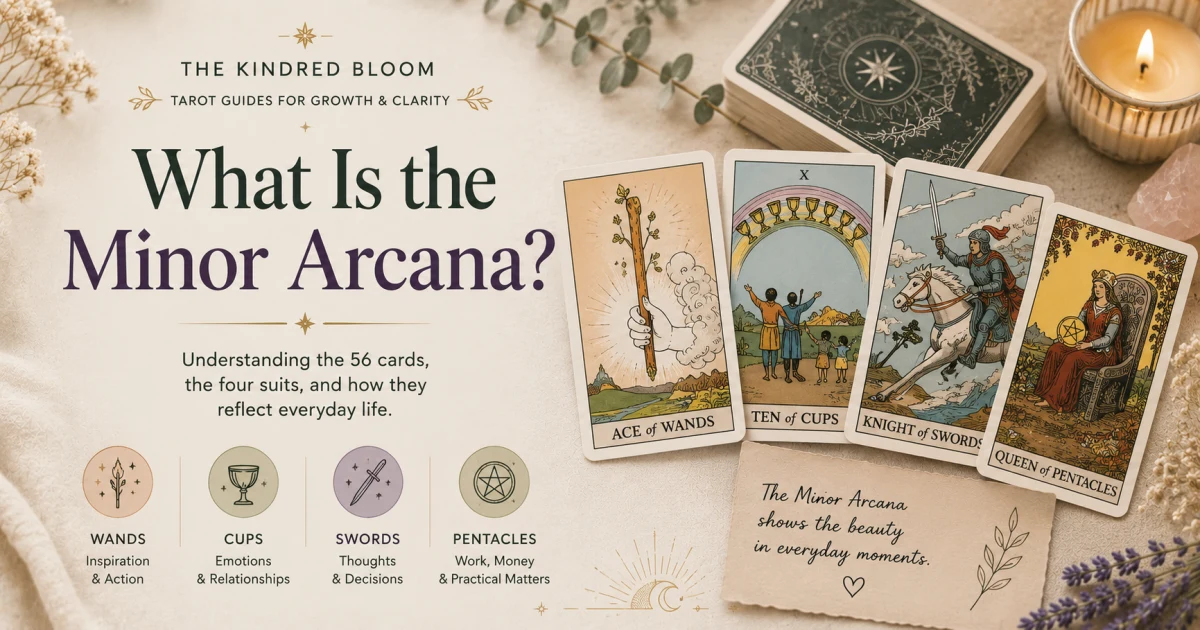
Learn what the Minor Arcana is, why it contains 56 cards, and how it represents the everyday experiences that shape our lives.
After exploring the Major Arcana, you may notice something surprising.
Although the Major Arcana often receives the most attention, it makes up only 22 of the 78 cards in a standard tarot deck.
The remaining 56 cards belong to the Minor Arcana.
At first glance, these cards may seem less important because they don’t feature famous figures like The Fool or The World. In reality, however, the Minor Arcana forms the majority of the deck and plays an essential role in nearly every tarot reading.
Rather than focusing on life’s biggest turning points, the Minor Arcana explores the everyday moments that gradually shape who we become.
What Is the Minor Arcana?
The Minor Arcana is the larger section of a standard tarot deck, consisting of 56 cards divided into four suits.
Like the Major Arcana, the word arcana comes from the Latin arcanum, meaning “mystery.” The word minor simply distinguishes these cards from the Major Arcana—it does not mean they are less meaningful or less valuable.
Together, the Major and Minor Arcana create a complete tarot deck, each serving a different purpose.
While the Major Arcana often explores significant themes and personal transformation, the Minor Arcana brings those larger themes into everyday life.
How Is the Minor Arcana Organized?
The Minor Arcana is divided into four suits:
- Wands
- Cups
- Swords
- Pentacles
Each suit contains 14 cards:
- Ace
- Cards Two through Ten
- Page
- Knight
- Queen
- King
If this structure feels familiar, there’s a good reason.
Modern playing cards share a common ancestor with tarot cards. Although today’s playing cards developed into a separate deck, historians generally agree that tarot preserved an earlier four-suit structure while adding the Major Arcana as a unique feature.
This historical connection explains why tarot can sometimes feel both familiar and distinctive at the same time.
What Do the Four Suits Represent?
Today, many tarot readers associate each suit with a different area of human experience.
Although interpretations vary slightly between traditions, a common approach is:
- Wands – inspiration, creativity, ambition, and action
- Cups – emotions, relationships, compassion, and intuition
- Swords – thoughts, communication, conflict, and decisions
- Pentacles – work, money, health, and the physical world
These associations developed gradually through centuries of symbolic interpretation. They are part of modern tarot practice rather than the original purpose of Renaissance tarot cards.
Understanding this distinction helps place today’s meanings within their historical context.
Why Is the Minor Arcana Important?
Because the Minor Arcana makes up most of the deck, these cards appear frequently in readings.
Many readers think of the Major Arcana as highlighting broader life themes, while the Minor Arcana describes how those themes unfold through ordinary experiences.
For example, a Major Arcana card might point toward an important period of personal growth. The surrounding Minor Arcana cards may then reveal the conversations, relationships, responsibilities, or daily choices connected with that journey.
In this way, the two sections complement one another rather than compete for importance.
Without the Minor Arcana, a tarot reading would often lack the everyday details that give larger themes meaning.
Do You Need to Learn All Four Suits at Once?
Not at all.
The four suits become much easier to understand when you study them one at a time.
Instead of trying to memorize every card immediately, begin by becoming familiar with the general character of each suit. Notice the recurring symbols, the types of situations they often describe, and how the cards within a suit gradually develop from the Ace to the King.
As your understanding grows, you’ll begin to recognize patterns rather than isolated meanings.
Many experienced readers continue discovering new connections between the suits even after years of study, making the Minor Arcana one of the richest parts of the tarot deck.
Continue Exploring
Now that you’ve learned how the Minor Arcana is organized, the next step is to explore each suit in greater detail.
You might enjoy reading:
- What Do the Four Tarot Suits Mean?
- What Does the Suit of Wands Represent?
- Major Arcana vs. Minor Arcana: What’s the Difference?
As you continue learning, you’ll discover that the Major Arcana tells the larger story, while the Minor Arcana reveals the everyday moments that bring that story to life.