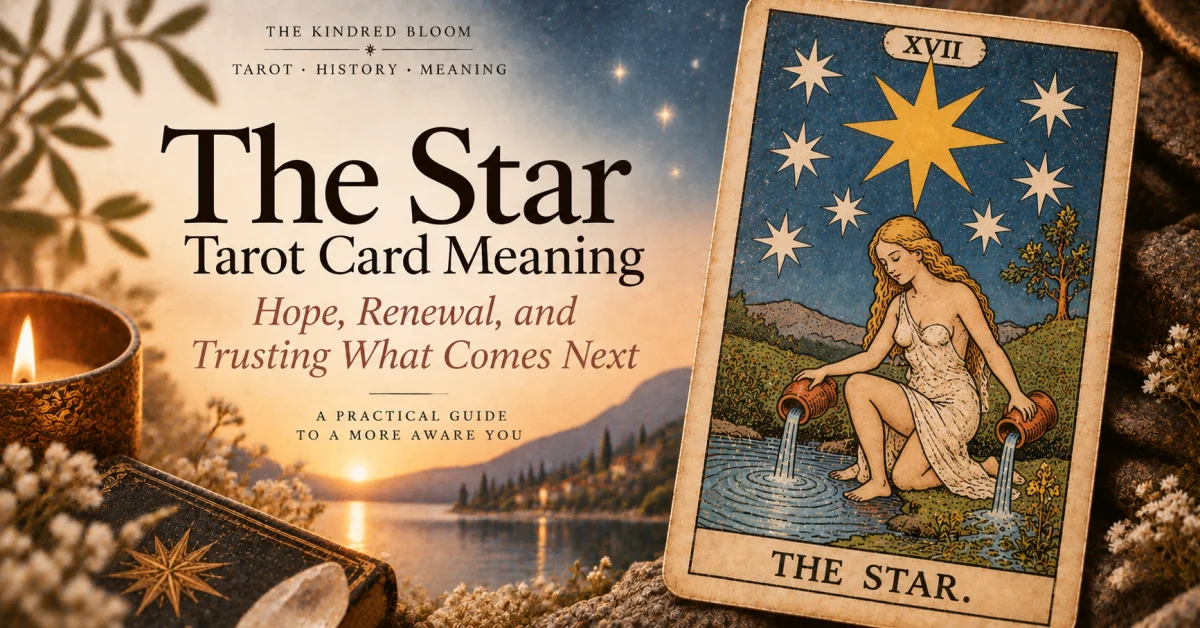
After the chaos of The Tower, The Star feels almost impossibly quiet. There is no lightning, no falling structure, and no one trying to escape. Instead, a nude woman kneels beside a pool beneath an open sky, pouring water onto both the land and the water. The whole scene feels open and calm, especially after the card that comes before it.
The Star is usually described with words like hope, healing, renewal, and inspiration. They all fit, but hope can easily become another vague tarot keyword. Does The Star mean everything will work out? Does it promise that something better is coming? I don’t think it needs to promise either. The Star can represent hope without certainty—the willingness to keep going even when we don’t yet know how things will turn out.
The Star Before Modern Tarot Reading
The Star has been part of the Major Arcana tradition for centuries, although early tarot was created for card games rather than the kind of personal readings we associate with tarot today. Stars already carried many cultural and religious associations of their own, including guidance, distant light, and the idea of something visible even in darkness.
By the time the Rider–Waite–Smith Tarot appeared in 1909, The Star had developed into the image most readers recognise today. Pamela Colman Smith shows a nude woman kneeling beside water beneath one large star and seven smaller ones. She holds two vessels, pouring water from one into the pool and from the other onto the land. The image is peaceful, but she isn’t simply sitting and waiting. She is still doing something, and I think that small detail makes the card more interesting than the simple keyword hope.
What Kind of Hope Does The Star Show?
When we say that we hope for something, we usually have a particular outcome in mind. I hope I get the job. I hope this relationship works. I hope everything goes according to plan. The Star can certainly appear around those feelings, but the card itself doesn’t show us an outcome. There is no finish line, reward, celebration, or obvious sign that the woman has received what she wanted.
That gives us another way to think about hope. It doesn’t always have to mean believing that a specific outcome will happen. Sometimes it is simply believing that there is still a reason to continue, even when the outcome is uncertain. This can be especially meaningful after a difficult period. We may have no idea exactly what comes next, but not knowing doesn’t mean that nothing good is possible.
Why Is the Figure Naked?
The woman’s nudity is one of the most noticeable features of the Rider–Waite–Smith image. Unlike many figures in the Major Arcana, she has no elaborate clothing, armour, crown, or obvious sign of status. We could attach all kinds of complicated symbolism to this, but the simplest observation may be enough: there is very little separating her from her surroundings. She appears exposed, but she doesn’t appear frightened or ashamed.
I like this detail when thinking about The Star after a difficult experience. Sometimes when a plan, identity, or expectation falls apart, we are left without the things that previously made us feel secure. There is vulnerability in that, but there can also be honesty. The Star doesn’t necessarily say, You are healed now. It can simply show the point where we begin again without pretending that nothing happened.
The Water Goes in Two Directions
The woman holds two vessels. Water from one returns to the pool, while water from the other spreads across the land. At first glance, this may remind us of Temperance, where liquid also moves between vessels, but the feeling is quite different. Temperance carefully transfers liquid from one cup to another; in The Star, the water is being released into the surrounding world.
I think of this less as control and more as circulation. Something is moving rather than being held tightly. In a reading, that can be a useful image after a period when we have been protecting our energy, emotions, ideas, or hopes because we were afraid of losing them. Recovery isn’t always about holding on more tightly. Sometimes it starts when we feel safe enough to let something move again.
Healing Does Not Mean Going Back to Who You Were
Healing is probably one of the most common modern meanings of The Star, but the word can be a little misleading. It can sound as though healing means returning to exactly who we were before something difficult happened. Real life doesn’t always work that way, and sometimes we wouldn’t even want it to.
A breakup, career failure, loss, or major disappointment can change the way we understand ourselves. Feeling better afterward doesn’t require us to erase that change. We can recover without becoming the same person we were before.
That’s the kind of healing I associate with The Star. Healing doesn’t always restore the old version of us. Sometimes it allows a new version to grow around what we have learned. And it doesn’t mean everything suddenly feels fine. Hope, sadness, uncertainty, and exhaustion can exist together for quite a while.
The Star Is Not a Guarantee
Because The Star is considered one of the more positive cards in tarot, it is tempting to treat it as confirmation that a wish will come true. I would be careful with that. There is nothing in the image that guarantees a particular external result.
If someone asks whether they will get a specific job and draws The Star, the card might reflect optimism, renewed confidence, inspiration, or a feeling that they are moving toward something meaningful. That isn’t the same as saying the employer will definitely choose them. The same applies to relationships, money, and other future-focused questions. Hope and prediction are not the same thing.
In a way, I find The Star more comforting when we stop asking it to guarantee outcomes. A guarantee depends on the future turning out a certain way. Hope doesn’t have to.
The Large Star and the Smaller Stars
Above the woman is one large star surrounded by seven smaller ones. There are plenty of esoteric systems that give these stars additional meanings, and those traditions can be interesting to explore. But we don’t need a complicated correspondence system to begin understanding the image. Our attention naturally goes to the largest star, giving the scene a clear point of orientation.
That makes me think about what we actually need after a period of confusion. It isn’t always a complete plan. Sometimes we just need something clear enough to move toward—a value, a small goal, someone we trust, a direction that feels more honest, or simply the sense that our current situation isn’t the only possibility. We don’t need to see the entire road before we can choose which direction to face.
Hope Can Be Quiet
We often imagine hope as something uplifting and powerful. We picture feeling inspired, confident, and excited about the future, but hope doesn’t always feel like that. Sometimes it is almost unnoticeable at first.
It might look like sending one more application after several rejections, going back to a hobby after months of having no interest in it, or making plans again after a period when planning felt pointless. Sometimes it is simply noticing that you are curious about the future when, for a while, you were only trying to get through the present.
None of those moments is particularly dramatic, which is one reason I like the quietness of The Star. Hope doesn’t always arrive as confidence. Sometimes it starts as willingness.
What Does The Star Mean in a Tarot Reading?
In contemporary tarot, The Star is commonly associated with hope, renewal, healing, inspiration, openness, and trust. When it appears, I wouldn’t only ask What good thing is coming? I would also pay attention to what is starting to feel possible again.
In a work reading, The Star might reflect renewed motivation after disappointment or a clearer sense of direction. In a relationship reading, it can point toward openness, honesty, or the gradual rebuilding of trust, but it doesn’t guarantee reconciliation or any particular outcome. In a personal reading, it may appear when someone is slowly reconnecting with a part of themselves that had become difficult to access.
Sometimes the card can be understood through a very simple question: What are you ready to believe in again? The answer doesn’t have to be life-changing. One small reason to continue can be enough.
The Star After The Tower
The contrast between The Tower and The Star is hard to miss. The Tower is full of disruption—lightning, fire, falling people, and a structure breaking apart. The Star gives us open space, water, stillness, and a single person beneath the sky.
It would be easy to turn that sequence into a neat story where everything falls apart and then everything heals. Real life is rarely that tidy. The Star doesn’t erase The Tower, and hope doesn’t undo what happened before it. What changes is our relationship with uncertainty.
The Tower shows what happens when something we relied on can no longer support the same assumptions. The Star doesn’t immediately replace those assumptions with new certainty. Instead, it leaves us in a quieter place where we can begin moving forward without knowing exactly how the story ends. This is a modern way of comparing the cards rather than proof that the earliest tarot makers intended them as stages of a psychological journey, but I think the contrast is useful when learning the Major Arcana.
Understanding The Star Beyond “Hope”
If we reduce The Star to hope, it can sound almost too simple. For me, the card becomes more meaningful when hope doesn’t depend on certainty. We don’t have to pretend disappointment never happened, and we don’t have to believe that every difficult experience happened for a reason. We can simply allow ourselves to imagine that the future may still contain possibilities we can’t see yet.
That’s what I see when I look at the woman beneath the stars. She is exposed, she is still working with what she has, and there is no obvious reward waiting in front of her. Yet the image doesn’t feel empty or defeated.
The Star doesn’t promise that everything will turn out exactly as we want. It reminds us that uncertainty and hope can exist at the same time.
Continue Exploring
The Star follows The Tower (XVI) in the Rider–Waite–Smith Major Arcana. The Tower explores disrupted certainty and structures that can no longer remain unchanged. The Star brings a quieter question: what can we begin to trust again when we don’t yet have all the answers?
You can also explore The Major Arcana Explained for a broader introduction to the Major Arcana.
Next comes The Moon (XVIII). Rather than simply treating it as a card of intuition, fear, or illusion, The Moon gives us a chance to explore something more interesting: how do we read a situation when our feelings are real, but the information we have is incomplete?