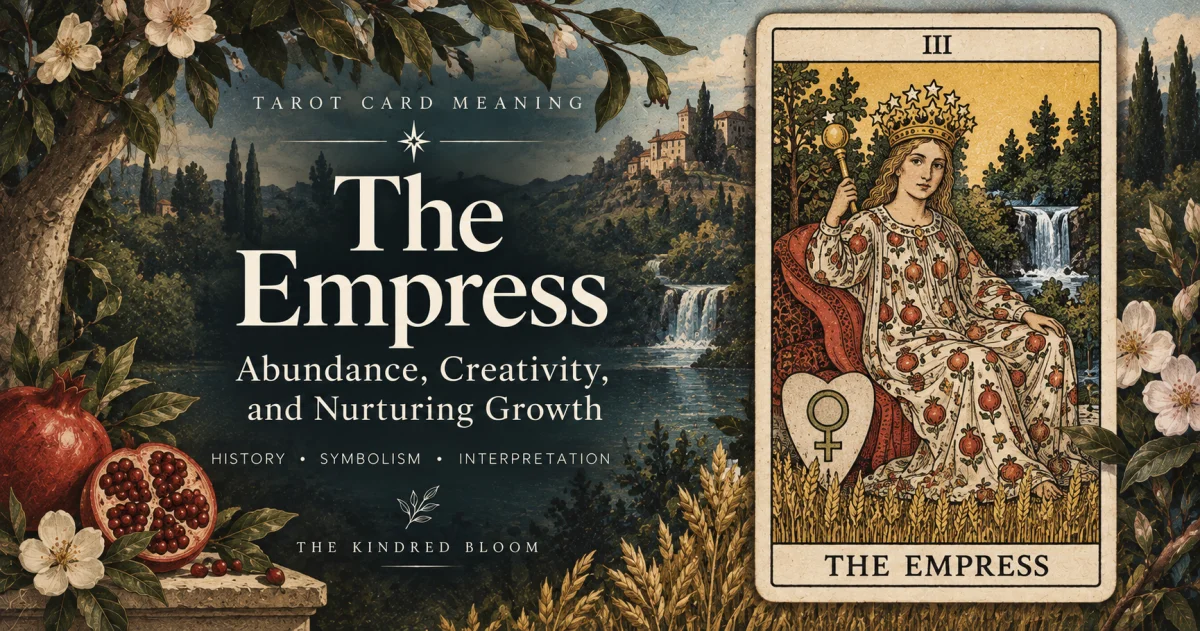
The Empress is associated with abundance, creativity, fertility, and care. But look closely at the Rider–Waite–Smith card: her wealth is not displayed as a collection of possessions. It grows around her. The wheat, flowing water, and fertile landscape offer a way to understand abundance as something that develops under supportive conditions.
The Empress sits in a landscape filled with life. Wheat ripens in the foreground, trees grow behind her, and water flows through the scene. Her gown is decorated with pomegranates, while a heart-shaped shield bearing the symbol of Venus rests nearby.
Unlike The High Priestess, whose veil conceals part of the background, The Empress occupies a setting where growth is visible. The image invites us to notice not only the abundance surrounding her, but also the environment that makes it possible.
This is a useful starting point for interpreting the card. The Empress is not simply about having more. She can also draw attention to what allows something to flourish.
Her history, however, begins with a very different kind of abundance: the status and authority of an imperial figure.
The Empress in Early Tarot: A Figure of Imperial Rank
The Empress appears in surviving Italian tarot traditions dating to the fifteenth century. She belonged to a group of trump cards depicting recognisable figures of social and religious authority, including the Emperor, Pope, and Papess.
For early tarot players, an empress would have been identifiable through her imperial status. The card belonged to a visual world shaped by political and religious hierarchy, rather than one originally organised around modern concepts of self-care or personal creativity.
Early tarot was primarily used for card games. Although its imagery could draw on familiar cultural and symbolic traditions, we should not assume that its creators intended The Empress to carry every meaning found in contemporary tarot.
The card’s historical identity gives us an important foundation: before she became a modern symbol of nurturing and growth, The Empress was a recognisable figure of worldly authority.
How Did an Imperial Figure Become a Symbol of Abundance?
As tarot developed into a practice of divination and esoteric interpretation, its cards acquired meanings extending beyond their earlier identities.
The transformation is especially visible in the Rider–Waite–Smith Tarot, published in 1909 and illustrated by Pamela Colman Smith under the direction of Arthur Edward Waite.
The Empress still wears a crown, but her surroundings are no longer defined primarily by the conventional objects of rulership. Instead, she sits within a fertile landscape, with ripening wheat in front of her and flowing water behind her.
This change in visual emphasis matters. The image presents a ruler whose presence is closely associated with a thriving natural environment. Modern readers can therefore interpret her abundance through nourishment, development, pleasure, and the conditions that sustain life.
That is an interpretation of the Rider–Waite–Smith image, not proof that fifteenth-century tarot makers originally intended the card to represent those same ideas.
The distinction allows us to appreciate both versions without treating tarot’s history as though its meanings had remained unchanged for centuries.
The Wheat: Abundance as the Result of Growth
Golden wheat fills the foreground of The Empress card. Its association with food and harvest makes it an accessible symbol of nourishment and agricultural abundance.
But the wheat offers something more specific than the general idea of wealth. It shows growth that has reached a visible stage of development.
A field of wheat does not appear simply because someone wishes for a harvest. It depends on suitable conditions, time, and the processes that allow a crop to grow.
This makes the wheat useful when interpreting The Empress in a reading about a long-term goal. The card may draw attention to work that is beginning to produce results, or to the resources that have supported progress so far.
Imagine someone asking about a creative project they have been developing for several months. Rather than interpreting The Empress as a promise of success, we might look at the wheat and ask what has already taken shape. Is the project producing something tangible? Which parts are developing well, and which still need attention?
The wheat shifts the focus from wishing for abundance to recognising how growth becomes possible.
The Water and Trees: What Sustains the Landscape?
Behind The Empress, water flows through a landscape filled with trees. These details create a setting that appears capable of supporting continued growth.
The wheat shows a visible result; the wider landscape draws attention to the environment surrounding it.
This distinction can help readers move beyond memorised keywords. If a question concerns a relationship, for example, The Empress might encourage us to examine the conditions that allow affection and trust to develop. Are there opportunities for meaningful connection? Is care being expressed in ways that both people can receive?
For a creative project, the same imagery might direct attention toward time, materials, encouragement, or a workspace that makes sustained effort possible.
These are not fixed predictions hidden inside the water or trees. They are ways of using the image to explore the question more thoughtfully.
The Empress does not always ask someone to push harder. Sometimes the more relevant issue is whether the surrounding conditions support the growth they hope to see.
The Venus Symbol: Beauty, Pleasure, and the Physical World
A heart-shaped shield bearing the symbol of Venus rests near The Empress. The symbol connects the card with the astrological correspondences used in later esoteric tarot traditions.
Venus is traditionally associated with love, beauty, attraction, pleasure, and fertility. In the Rider–Waite–Smith image, this reference complements the comfortable figure and fertile surroundings.
It also adds a dimension that can disappear when The Empress is reduced to productivity or motherhood.
Growth is not only about producing something useful. The card can also invite attention to the experience of living within what has been created: enjoying a meal, appreciating art, feeling comfortable in a space, or finding pleasure in the natural world.
In a reading, the Venus symbol may therefore broaden the question from What am I creating? to Am I able to enjoy and appreciate what is already here?
This astrological association belongs to later tarot traditions and should not be assumed to explain the original intention behind the earliest Empress cards.
The Pomegranates: A Symbol Shared with The High Priestess
The Empress’s gown is decorated with pomegranates. Across different cultural and mythological contexts, pomegranates have been associated with fertility, abundance, and other themes, although their meanings are not universal.
The fruit also appears on the veil behind The High Priestess in the Rider–Waite–Smith deck.
Comparing the two cards reveals an interesting difference in composition. On The High Priestess, pomegranates decorate a veil that limits what the viewer can see. On The Empress, they appear on the clothing of a figure surrounded by visible growth.
The repeated motif does not prove that the cards were originally designed as consecutive stages of a spiritual journey. It does, however, offer a useful way to observe how similar imagery can contribute to different visual settings.
In The Empress, the pomegranates participate in a larger scene of fertility and abundance. Their meaning becomes clearer when considered alongside the wheat, water, and surrounding vegetation rather than interpreted in isolation.
What Does The Empress Mean in a Tarot Reading?
In contemporary tarot, The Empress is commonly associated with abundance, creativity, nurturing, fertility, growth, comfort, beauty, and connection with nature.
These meanings become easier to understand when we connect them to the card’s imagery. The wheat suggests visible development, the landscape points toward supportive conditions, and Venus introduces pleasure and appreciation.
Together, they offer a way to examine three aspects of a situation: what is growing, what sustains it, and whether there is room to enjoy the results.
Consider a reading about someone who has recently started a small business. The Empress might draw attention to an idea that is developing, the resources needed to support it, or the importance of maintaining a workable pace.
The card does not guarantee financial success. Instead, it can help frame practical questions about development and sustainability.
In a relationship reading, the focus may shift toward affection, care, and the environment both people create together. In a personal reading, it may concern rest, creativity, or reconnecting with experiences that feel nourishing.
The specific interpretation depends on the question. The image provides a starting point, not a predetermined answer.
Does The Empress Mean Pregnancy?
The Empress is frequently associated with pregnancy and fertility in modern tarot, but drawing this card does not establish or predict a pregnancy.
The card’s imagery allows fertility to be understood more broadly as the capacity for growth and creation. A project, relationship, idea, or personal goal can develop without the symbolism referring to reproduction.
If a reading concerns pregnancy, The Empress may reflect the subject of the question, but it cannot provide medical confirmation. Pregnancy testing and appropriate medical care are the reliable ways to address that uncertainty.
Keeping this distinction clear makes the interpretation more responsible without removing the card’s historical and modern associations with fertility.
Is The Empress Only About Motherhood or Women?
The Empress is depicted as a female imperial figure, and motherhood has become an important part of her modern interpretive tradition. However, her symbolic qualities are not limited to women or parents.
Anyone can provide care, create something, appreciate beauty, or help establish an environment in which another person or project can grow.
The card also does not need to represent a person. Depending on the question, it may describe a creative process, a supportive relationship, a home environment, or the conditions surrounding a developing goal.
Rather than immediately identifying The Empress as a mother or female figure, it is often more useful to consider what kind of nourishment or development the image brings into focus.
Abundance Is Not Always Financial Wealth
The Empress is sometimes interpreted as a sign of material prosperity. That can be relevant when a reading concerns money, but the card’s image expresses richness primarily through living things rather than possessions.
The wheat, trees, and water suggest resources that support life and development. The Venus symbol adds pleasure and beauty, while the seated figure appears comfortable within her surroundings.
Abundance might therefore mean having enough time for a creative pursuit, receiving support from others, enjoying a comfortable home, or recognising progress that has already been made.
This does not mean financial concerns should be ignored. It means the card offers a broader way to examine what a person considers valuable.
The Empress invites us to look at abundance as something experienced and sustained, not merely accumulated.
When Nurturing Becomes Unsustainable
The Empress’s fertile landscape offers an image of care that produces visible growth. Yet nurturing requires resources, and those resources are not unlimited.
Someone may devote time and energy to supporting a family member, relationship, or project while overlooking their own need for rest and support. In another situation, care may become overprotection, leaving little room for independence.
These possibilities do not require a reversed card. They arise from examining how the central theme of nurturing operates in a particular context.
The landscape provides a useful comparison: healthy growth depends on conditions that can continue to support it. If those conditions are neglected, even something that has flourished may become difficult to maintain.
When The Empress appears in a reading about responsibility or caregiving, consider whether the care being provided is sustainable for everyone involved.
The High Priestess and The Empress: From Concealment to Visible Growth
The High Priestess and The Empress appear next to each other in the modern Major Arcana sequence, and their Rider–Waite–Smith imagery offers a useful comparison.
The High Priestess sits before a veil with a partially concealed scroll. Her image encourages attention to what remains unknown or not yet fully understood.
The Empress sits in an open, fertile landscape where growth is already visible. Her image draws attention to development and the conditions that support it.
In a reading about a new idea, The High Priestess might prompt someone to gather information or reflect before deciding what to do. The Empress could then offer a different perspective: what environment would allow that idea to develop?
This comparison helps distinguish the cards without suggesting that they were originally created as fixed stages in a single spiritual narrative.
Understanding The Empress Beyond the Keywords
The Empress is often summarised through abundance, fertility, creativity, and nurturing. These are useful associations, but the image offers a more connected way to understand them.
The wheat shows development that has become visible. The water and trees draw attention to the conditions supporting it. The Venus symbol adds beauty and pleasure, while the pomegranates contribute to the wider imagery of fertility.
Rather than treating abundance as an automatic promise, The Empress encourages us to examine the relationship between growth and its environment.
What has already begun to flourish? What allows it to continue? Is the care being provided sustainable, and is there room to appreciate what has been created?
The Empress is not simply an image of having more. She offers a way to think about what it takes for something valuable to grow—and remain alive.
Continue Exploring
The Empress follows The High Priestess in the modern Major Arcana sequence, moving from hidden and inward knowledge toward visible growth, creativity, and abundance.
If you’d like to follow the series in order, explore The Fool Tarot Card Meaning, The Magician Tarot Card Meaning, and The High Priestess Tarot Card Meaning.
You may also enjoy The Major Arcana Explained for a broader introduction to the structure and role of the Major Arcana.
Next, we’ll explore The Emperor, whose themes of structure, authority, stability, and order create a striking contrast with The Empress’s organic world of growth.