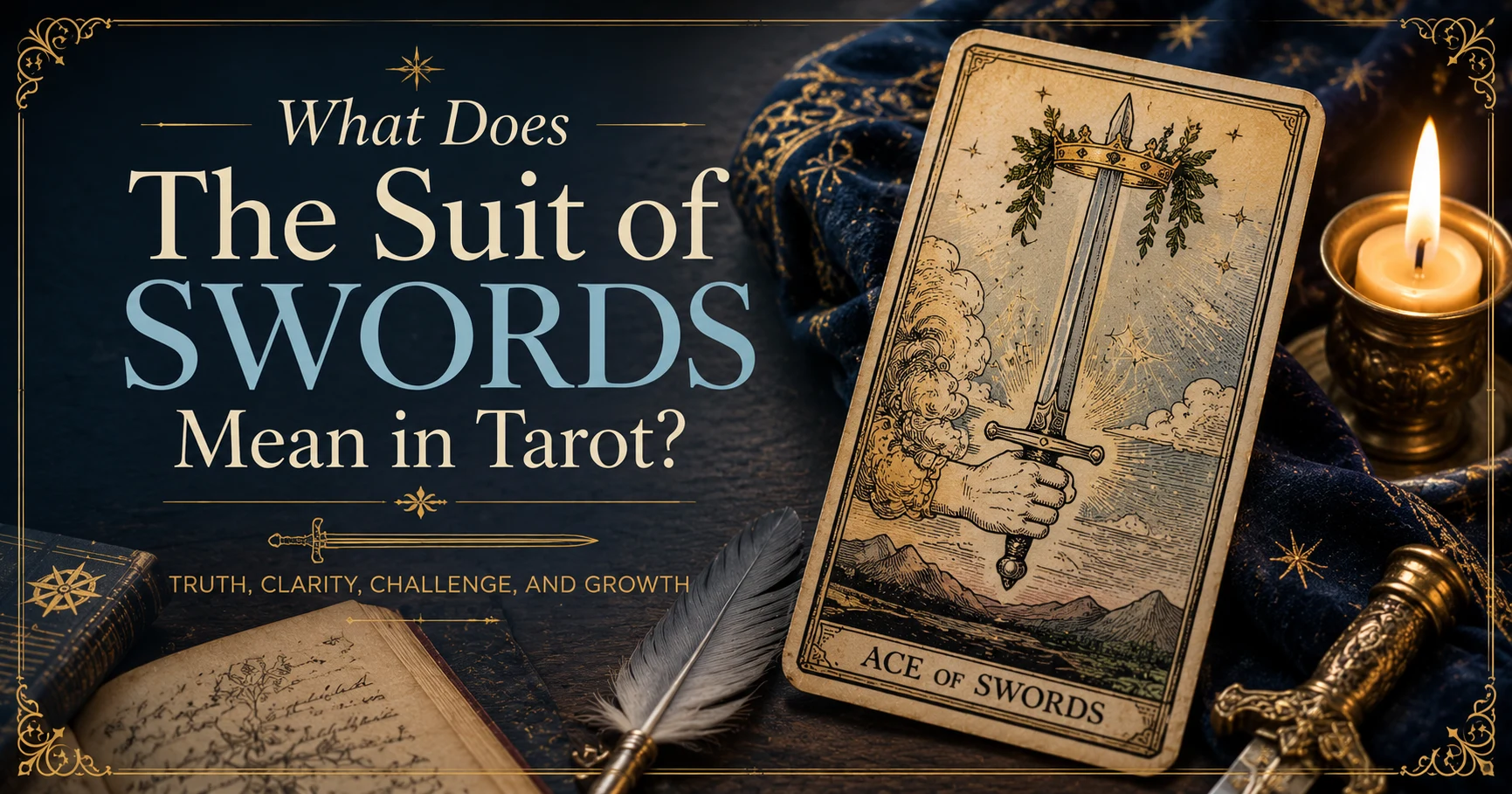
The Suit of Swords is commonly associated with thoughts, communication, truth, decisions, and conflict. Explore where the suit came from, why it is connected with Air in many modern tarot traditions, and how understanding its symbolism can help you read the Minor Arcana.
Among the four suits of the Minor Arcana, Swords often brings our attention to the world of thought. Its cards can appear around decisions, conversations, disagreements, difficult realizations, and moments when clarity matters.
In many modern tarot traditions, Swords are associated with thoughts, communication, truth, intellect, and conflict. The suit is also commonly connected with the classical element of Air.
Yet, as with the other tarot suits, these meanings developed over time. Swords existed as a playing-card suit long before tarot became widely used for divination, while many of the symbolic associations familiar to readers today emerged through later tarot and esoteric traditions.
Looking at both its history and symbolism gives us a more grounded way to understand what the Suit of Swords can represent.
What Is the Suit of Swords?
Swords is one of the four suits of the Minor Arcana, alongside Wands, Cups, and Pentacles. It contains 14 cards: the Ace, cards numbered Two through Ten, and four Court Cards—the Page, Knight, Queen, and King.
In modern tarot reading, the suit is frequently connected with our mental and intellectual experiences. A Swords card may relate to the way we think about a situation, the choices we face, the conversations we have, or the beliefs influencing our decisions.
Conflict is also an important theme within the suit, but it is only one part of a broader picture.
Swords can point toward discernment, honesty, strategy, communication, curiosity, and the ability to see a situation more clearly. At other times, the cards may explore worry, confusion, painful thoughts, disagreements, or the consequences of difficult decisions.
In this sense, Swords can show both the power and the difficulty of the mind.
Where Did the Suit of Swords Come From?
The sword symbol is much older than modern tarot interpretation.
When tarot developed in fifteenth-century Italy, its suited cards belonged to an existing European playing-card tradition. Early Italian tarot decks used four Latin suits: Cups, Coins, Batons, and Swords.
Swords therefore did not originally appear because tarot creators wanted a symbol for thoughts, logic, or communication. They were part of the playing-card structure inherited by early tarot decks.
The suit remained recognizable in later traditions, including the Tarot de Marseille, where swords often appear in highly stylized arrangements on the numbered cards.
Over the centuries, tarot gradually acquired new layers of interpretation. Particularly through later occult and esoteric traditions, the suits became connected with elements, psychological qualities, and different areas of human experience.
This distinction helps us separate two related ideas: Swords as a historical card suit and Swords as a modern symbolic system.
Why Are Swords Associated With Air?
In many modern tarot systems, Swords correspond to the classical element of Air.
Air is commonly used symbolically to represent thought, intellect, communication, and mental activity. Although we cannot see air itself, we can observe its effects—much like thoughts and ideas, which are invisible but can strongly influence our actions.
A sword also provides another useful layer of symbolism. Its blade can divide one thing from another, creating associations with discernment, analysis, and decision-making. A sharp blade can metaphorically suggest a sharp mind or the ability to cut through confusion.
At the same time, a sword is a weapon. This allows the suit to explore the consequences of conflict, harsh words, difficult truths, or ideas used without compassion.
These associations are useful for modern tarot reading, but they should not be projected backward onto tarot’s earliest history. The systematic relationship between tarot suits and classical elements belongs primarily to later esoteric traditions rather than the original fifteenth-century card games.
What Does Swords Represent in a Tarot Reading?
When Swords appear in a reading, they may invite us to examine what is happening in the mind.
What are you thinking about the situation? Is there a decision that needs to be made? Is communication clear? Are assumptions influencing what you believe to be true?
Depending on the card and context, Swords can highlight a need for clarity, careful reasoning, or an honest conversation. They may also reflect mental pressure, uncertainty, disagreement, or thoughts that have become difficult to manage.
For example, in a relationship reading, a Swords card does not necessarily indicate that the relationship is ending or that conflict is inevitable. It might instead draw attention to communication, boundaries, an unresolved decision, or the way two people understand a situation differently.
In a career reading, Swords might relate to strategy, negotiations, difficult choices, intellectual work, or workplace communication.
The meaning becomes clearer when the individual card, surrounding cards, and question are considered together.
Why Do Some Swords Cards Show Difficult Scenes?
If you are familiar with the Rider-Waite-Smith Tarot, you may have noticed that several Swords cards contain striking or uncomfortable imagery.
The Three of Swords shows a heart pierced by swords. The Nine depicts a figure sitting upright in bed with their face in their hands. The Ten shows a figure lying on the ground beneath a dark sky.
These images contribute to the suit’s reputation for difficult themes, but they don’t mean that every Swords card should be interpreted negatively.
One reason the Rider-Waite-Smith deck became so influential is that Pamela Colman Smith created illustrated scenes for the numbered Minor Arcana cards, allowing situations and emotions to become part of the visual language of the deck.
Within Swords, those scenes often explore what can happen when thought, conflict, communication, fear, or difficult truths become central to an experience.
Other cards in the suit offer different perspectives. Some emphasize clarity, movement, curiosity, rest, or the ability to make careful judgments.
Rather than labeling the entire suit as positive or negative, it is more useful to ask what kind of mental experience the card is describing.
Swords Can Be About Clarity as Well as Conflict
Because several well-known Swords cards depict challenging situations, it can be easy to focus primarily on the suit’s themes of tension and difficulty.
But clarity is equally important to understanding Swords.
Thinking allows us to analyze situations, communicate ideas, establish boundaries, solve problems, and make decisions. The same mental ability that can produce anxiety or conflict can also help us recognize what is true and decide what to do next.
This dual quality appears throughout the suit.
A sword can defend or harm. A thought can clarify or confuse. Words can resolve a misunderstanding or deepen one.
For this reason, Swords can be understood as exploring not only what we think, but also how we use our minds and communicate those thoughts to the world around us.
How the Swords Develop From Ace to King
The fourteen Swords cards explore different expressions of the suit’s central themes.
The Ace of Swords is commonly associated with clarity, insight, truth, or a new way of understanding something. As the numbered cards progress, we encounter situations involving decisions, conflict, transition, strategy, rest, worry, and endings.
The Court Cards—the Page, Knight, Queen, and King—can add another dimension by showing different ways intellectual or communicative qualities may be expressed.
As with the other suits, it is best not to assume that Ace through King forms one perfectly linear story. Each card has its own traditional meanings and context.
Still, recognizing the shared character of Swords makes it easier to understand why these cards belong together.
What If Many Swords Appear in a Reading?
When several Swords appear in the same spread, the reading may place greater emphasis on thoughts, decisions, communication, or mental challenges.
The exact meaning depends on the cards themselves.
Several Swords could reflect a period requiring careful analysis and clear communication. In another reading, they might suggest that worry, disagreement, or difficult decisions are taking up considerable mental space.
Rather than assuming that many Swords automatically predict something negative, look at the pattern they create.
Which cards appear? What is happening in their imagery? How do they interact with Cups, Wands, Pentacles, or Major Arcana cards nearby?
The suit provides a theme, while the individual cards and reading context provide the detail.
How to Learn the Swords Cards
Learning the traditional meanings of the Swords cards gives you an important foundation for interpreting the suit.
Begin with its broader themes—thought, communication, truth, decisions, and conflict—and then learn the key meanings associated with each of the fourteen cards. This helps you understand both what the cards have in common and where they differ.
Once you have that foundation, the imagery can add greater depth.
In the Rider-Waite-Smith Tarot, notice how the swords are positioned. Are they being held, carried, crossed, or left behind? Look at the expressions and posture of the figures, the weather, the landscape, and whether the scene appears still or active.
These visual details do not replace the traditional meanings. Instead, they can help you understand why those meanings developed and how they might apply within a particular reading.
With repeated study and practice, the meanings become more familiar, allowing knowledge, observation, and context to work together.
Continue Exploring
The Suit of Swords brings us into the realm of thoughts, words, decisions, and truth. Some of its cards explore difficult mental experiences, while others remind us of the value of clarity, communication, and careful judgment.
If you’d like to continue exploring the Minor Arcana, you may also be interested in:
- What Does the Suit of Cups Mean in Tarot?
- What Do the Four Tarot Suits Mean?
- What Does the Suit of Pentacles Mean in Tarot?
After exploring the movement of Wands, the emotional world of Cups, and the mental landscape of Swords, our final suit brings us back to something more tangible: the material and practical world of Pentacles.