
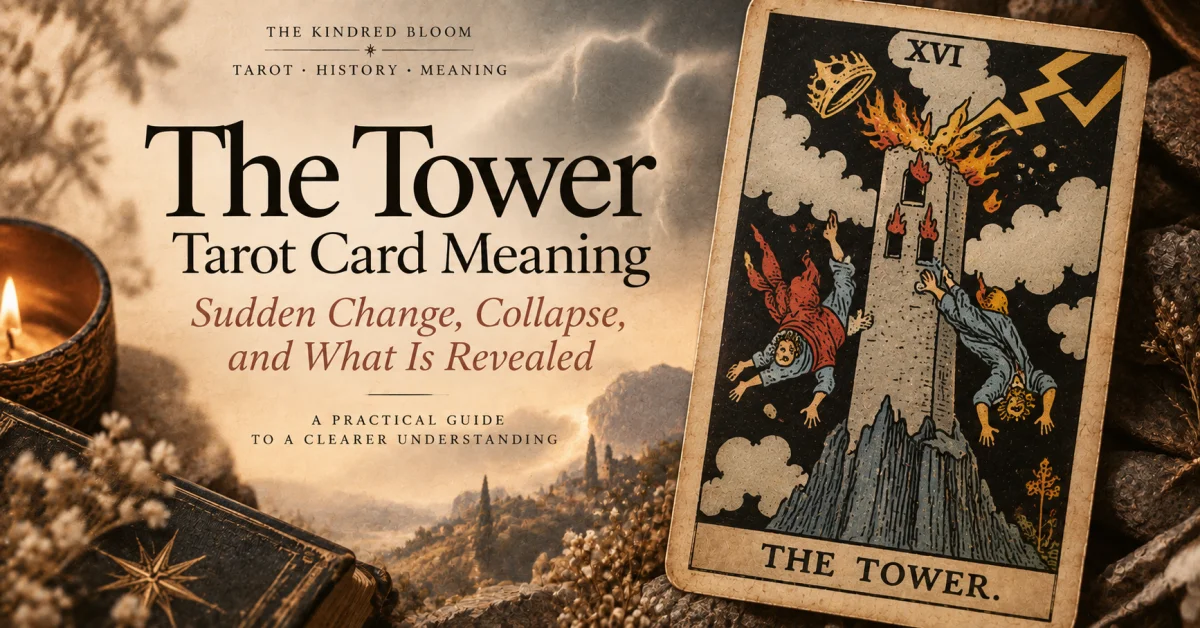
Few tarot cards look as dramatic as The Tower. Lightning strikes a tall building, flames burst from its windows, a crown is thrown from the top, and two people fall toward the ground. Nothing about the scene feels calm or gradual, so it is easy to understand why The Tower is often associated with disaster, chaos, and sudden change.
But not every unexpected event is a Tower moment. A cancelled plan or a last-minute change can be sudden without changing anything important about the way we see our lives. The Tower feels bigger than that. It shows what happens when something we thought was stable can no longer remain standing in the same way.
The Tower Before Modern Tarot Reading
Tarot began as a card game in fifteenth-century northern Italy, long before it became strongly associated with divination. The earliest surviving decks are incomplete, which makes it difficult to draw a perfectly straight line from every modern Major Arcana image back to the first tarot cards.
The card we now know as The Tower also appeared under different names and with different imagery in later tarot traditions. Over time, the image of a damaged or burning structure became closely associated with it. By the time the Rider–Waite–Smith Tarot appeared in 1909, the scene had become unmistakably dramatic: a tower is struck from above, its crown is thrown away, flames break out, and people fall from the building.
Waite connected the card with destruction and the collapse of false structures and beliefs. But we do not need to follow his entire esoteric interpretation to understand why the image is powerful. Something that looked strong enough to rely on has suddenly been shown to be less secure than it seemed.
Why Is the Tower Struck by Lightning?
Lightning arrives without warning. Unlike the slow adjustment we saw in Temperance or the steady movement of Death, there is no gradual transition here. One moment the tower is standing, and the next the whole situation has changed.
That makes the image useful for experiences that suddenly interrupt our understanding of something. You discover information you did not know. A plan becomes impossible. Someone says something that changes how you see a relationship. An assumption you have relied on turns out to be wrong.
The important part is not simply the surprise. Plenty of surprises are harmless. The Tower becomes more relevant when what happens changes the structure of what you believed before it happened.
Think about believing for years that your job is completely secure and then learning that your department is closing. The practical problem matters, of course, but something else has also disappeared: the assumption that this job would continue to be there. That combination of an external event and a disrupted sense of certainty feels much closer to The Tower.
Not Every Sudden Change Is a Tower Moment
Because sudden change is one of the most common Tower keywords, it can easily become too broad. A friend unexpectedly inviting you on holiday is sudden. A meeting being cancelled at the last minute is sudden too. Neither situation necessarily has the deeper disruption we see in the card.
The Tower tends to make more sense when something forces us to reconsider what we thought was settled. Sometimes that comes from an obvious external event, but it does not always have to look dramatic from the outside. You might finally admit that a relationship has not been working for a long time, realise that an old goal no longer means what it once did, or discover that a belief you have organised years of decisions around no longer makes sense to you.
Nothing visible has to fall apart for your understanding of a situation to change completely. Sometimes the tower that collapses is simply the story you had been telling yourself about what was certain.
What Was the Tower Built On?
There is a popular way of reading The Tower that says whatever falls must have been built on a weak foundation. Sometimes that makes sense. A business based on unsustainable debt, a relationship maintained through dishonesty, or a plan based on unrealistic assumptions may eventually become impossible to maintain.
But I would not make that a rule. Real structures can collapse even when nobody did anything obviously wrong. Companies close, circumstances change, relationships end despite genuine effort, and unexpected events happen to people who prepared carefully.
So I would be cautious about seeing The Tower and immediately asking, What did I build incorrectly? That can turn an already difficult experience into unnecessary blame. A more useful question may be: What did I believe was stable, and what do I understand differently now?
Sometimes the answer will reveal a weak foundation. Sometimes it will simply remind us that stability was never entirely under our control.
The Falling Crown
At the top of the Rider–Waite–Smith Tower is a crown being knocked away by the lightning strike. It is a small detail compared with the burning building and falling figures, but it is difficult to miss.
We could attach a complicated symbolic meaning to it, but we do not really need to. A crown naturally suggests importance, authority, or something occupying the highest position. In this image, even that position offers no protection from what is happening.
In a reading, this can make us think about the things we have placed beyond question. It might be an idea about success, a relationship we assumed would always exist, a plan we considered certain, or even an idea about the person we thought we were supposed to become. The Tower does not necessarily tell us that believing in these things was foolish. It shows us what happens when certainty itself gets interrupted.
Collapse and Revelation Are Not the Same Thing
The Tower is sometimes described as a card of revelation, and that can fit beautifully. When a structure breaks open, something that was previously hidden may become visible. But collapse and revelation are not always the same event.
Sometimes the revelation comes first. You discover a serious lie, and that information changes your understanding of a relationship. Other times, the collapse happens first and the realisation comes later. A plan fails, and only afterward do you recognise how much of your identity had become attached to that one outcome.
And sometimes there is no hidden truth waiting underneath at all. Something simply goes wrong. The Tower can reveal something, but we do not need to force every painful experience into a story about a truth that “needed” to come out.
The Tower Does Not Mean “Everything Happens for a Reason”
There is a comforting interpretation of The Tower that says whatever collapses was meant to collapse so that something better could take its place. Sometimes people genuinely look back on difficult experiences and feel that way. A painful ending can eventually lead somewhere they value more, and a failed plan can open possibilities they had never considered.
But The Tower cannot promise that. If someone loses something important, immediately telling them that it happened because the universe is clearing the way for something better can make a very real loss sound simpler than it is.
The card does not have to turn destruction into a blessing before we can learn something from it. Sometimes the most useful place to begin is simply: Something has changed. The old structure may no longer work. What is true now?
What happens after that is still open.
When the Tower Is Internal
The dramatic illustration can make us expect an equally dramatic external event, but some Tower experiences happen almost entirely inside us.
You might spend years working toward a career because you genuinely believe it is what you want. Eventually, you reach the position you imagined, only to discover that you do not actually want the life that comes with it. The job still exists. The salary still arrives. From the outside, nothing appears to have collapsed.
But something important has changed. The belief that gave all of that effort meaning is no longer there, and suddenly the plan you had been following does not feel as solid as it once did.
That can be a Tower experience too. The difficult question becomes not simply What happened? but What do I build my decisions around now?
What Does The Tower Mean in a Tarot Reading?
In contemporary tarot, The Tower is commonly associated with disruption, sudden change, collapse, shock, revelation, and instability. Instead of reaching immediately for the most dramatic interpretation, I would start by looking for the structure involved. What seemed secure before? What information has changed? What can no longer be assumed?
In a relationship reading, The Tower could point toward information or an event that changes the existing dynamic, but it does not automatically predict a breakup. In a work reading, it could describe an unexpected organisational change, a failed plan, or a realisation that changes how someone views their career. Sometimes the card reflects something happening around us; sometimes the bigger change is in the way we understand what is happening.
That is why I do not find something bad will happen particularly useful as a Tower interpretation. The more interesting question is: If the old assumption no longer holds, what are you working with now?
The Tower After The Devil
The Devil and The Tower look dramatic for very different reasons. The Devil is about attachment. Something continues to hold influence through desire, fear, comfort, responsibility, or habit. The structure is still there, and we are looking at our relationship with the chain.
The Tower changes the situation. Now the structure itself is being disrupted, whether we wanted that disruption or not. Something we relied on may no longer be available in the same form, or an assumption supporting it may have changed.
That makes the two cards interesting to study together. The Devil asks what keeps us attached. The Tower asks what happens when the thing we were attached to—or the assumptions holding it in place—can no longer stay the same.
This is a modern way of comparing the cards rather than a claim that the earliest tarot makers intentionally designed them as consecutive stages of a psychological journey. But as a way of learning the Major Arcana, the contrast is useful.
Understanding The Tower Beyond “Disaster”
The Tower looks frightening because it captures a moment when certainty disappears very quickly. But reducing the card to disaster misses what makes the image so useful.
A tower is a structure, and structures give us something to rely on. We build less visible structures too: plans, beliefs, identities, expectations, and ideas about how our lives are supposed to work. Most of the time, those structures help us make decisions and move through the world.
The difficulty comes when reality changes and the old structure no longer fits it. That is where The Tower becomes more interesting than a prediction of chaos. What no longer feels as certain as it did before? What has this disruption shown you? And what is still standing once the initial shock has passed?
The Tower does not promise that everything falls apart for a reason, and it does not guarantee that whatever comes next will be better.
It simply brings us to the moment when we can no longer pretend that everything is still standing exactly as it was.
Continue Exploring
The Tower follows The Devil (XV) in the Rider–Waite–Smith Major Arcana. The Devil explores attachment and the forces that can narrow our choices, while The Tower turns toward disruption and what happens when an existing structure, expectation, or belief can no longer remain untouched.
You can also explore The Major Arcana Explained for a broader introduction to the Major Arcana.
Next comes The Star (XVII). After the intensity of The Tower, The Star looks almost surprisingly quiet. Rather than reducing it to the keyword hope, we can look at something more interesting: what hope actually looks like after certainty has already been broken.