Discover what the four tarot suits represent, why each suit has a different meaning, and how understanding them can make reading the Minor Arcana much easier.
If you’ve learned that the Minor Arcana is divided into four suits, you may be wondering what those suits actually mean.
Why are some cards part of Wands, while others belong to Cups, Swords, or Pentacles? Is there a reason each group represents different parts of life?
The answer has two layers. Historically, the four suits were inherited from earlier playing cards. Over time, tarot readers and scholars developed symbolic meanings for each suit, creating the system that many people use today.
Understanding this distinction helps us appreciate both the history of tarot and the way it is commonly interpreted in modern practice.
The Four Suits Organize Everyday Life
Unlike the Major Arcana, which is often associated with significant life lessons or major turning points, the Minor Arcana focuses on everyday experiences.
Rather than treating all fifty-six cards as one large group, the four suits organize them into different themes. This makes the deck easier to understand and reveals patterns that appear again and again in tarot readings.
Although different traditions sometimes emphasize different ideas, modern tarot generally associates each suit with a particular aspect of human life.
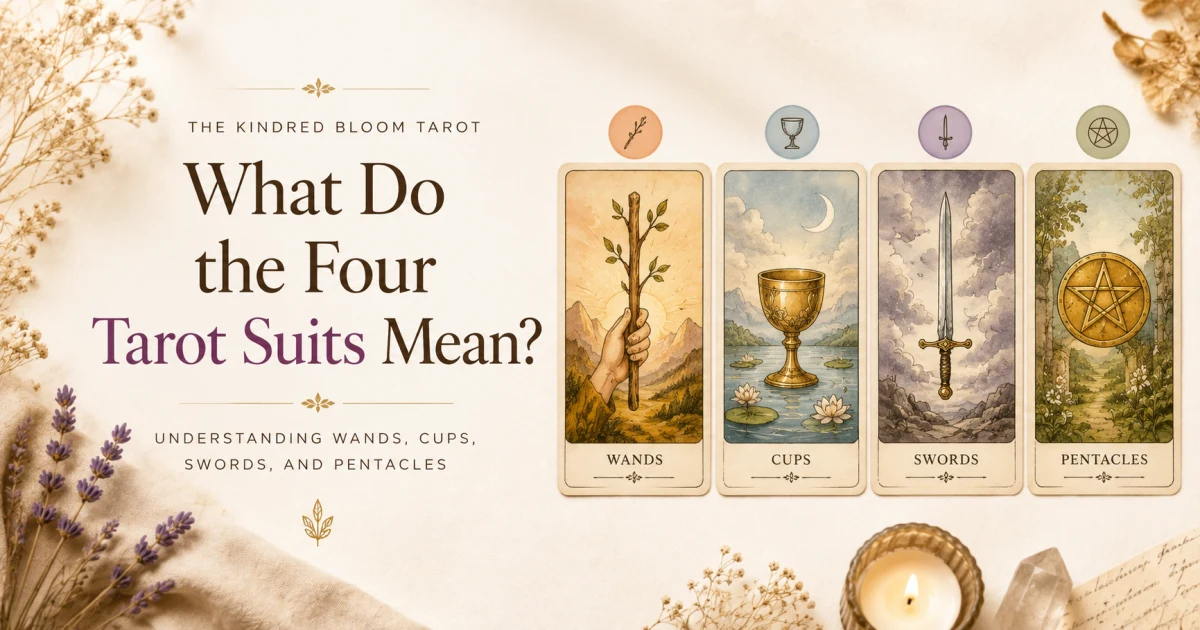
Wands: Passion, Creativity, and Action
Wands are commonly connected with energy and inspiration.
They often appear in readings about creative projects, ambitions, personal growth, motivation, and taking action. Many readers also associate Wands with confidence, enthusiasm, and the courage to begin something new.
Historically, this suit was known as Batons or Staves in older European tarot decks. The name Wands became widely recognized after the publication of the Rider–Waite–Smith Tarot in 1909.
Cups: Emotions and Relationships
Cups are traditionally linked to feelings, relationships, and emotional experiences.
Cards from this suit often appear when a reading explores love, friendships, family, compassion, or personal well-being. Rather than focusing on external achievements, Cups encourage us to pay attention to our inner emotional world.
Because cups naturally hold water, many modern tarot traditions also associate this suit with the element of water and the emotional qualities it symbolizes.
Swords: Thoughts, Decisions, and Challenges
Swords are commonly associated with the mind.
This suit often represents communication, beliefs, difficult choices, truth, and intellectual challenges. Swords can also appear during periods of conflict, reminding us that our thoughts and words have the power to shape our experiences.
Although many beginners see the Swords as a “negative” suit because several cards depict struggle or tension, they also encourage honesty, clarity, and thoughtful decision-making.
Pentacles: The Physical World
Pentacles are connected with the practical side of life.
This suit frequently appears in readings about work, finances, education, health, home, and long-term stability. It reminds us of the resources we build through patience, responsibility, and consistent effort.
Earlier tarot decks often called this suit Coins, reflecting its historical origins. The Rider–Waite–Smith deck later adopted the name Pentacles, while keeping the same position within the structure of the Minor Arcana.
Are These Meanings Historical?
This is an important question.
The four suits themselves are historical. They have existed since the earliest tarot decks of fifteenth-century Italy.
The symbolic meanings we use today, however, developed gradually over time. Much of the modern system was shaped by nineteenth- and twentieth-century occult writers and became especially influential through the Rider–Waite–Smith Tarot.
In other words, historians can tell us where the suits came from, while modern tarot traditions help explain what many readers believe they represent today. Both perspectives are valuable, but they answer different questions.
A Helpful Way to Remember the Four Suits
You don’t need to memorize dozens of keywords to begin understanding the Minor Arcana.
Instead, it can be helpful to think of each suit as focusing on one broad area of life:
- Wands – Passion, creativity, and action
- Cups – Emotions and relationships
- Swords – Thoughts and communication
- Pentacles – Work, resources, and the physical world
As you become more familiar with tarot, you’ll discover that every card adds its own unique meaning while still reflecting the theme of its suit.
Continue Exploring
If you’d like to learn more about the Minor Arcana, you may also enjoy:
- Why Do Tarot Cards Have Four Suits?
- What Is the Minor Arcana?
- What Does the Suit of Wands Represent? (Coming soon)
The four suits give structure to the Minor Arcana, but they also invite us to look at life from different perspectives. Rather than separating our experiences into neat categories, they remind us that our actions, emotions, thoughts, and practical responsibilities are all connected—and that understanding each one helps us better understand ourselves.