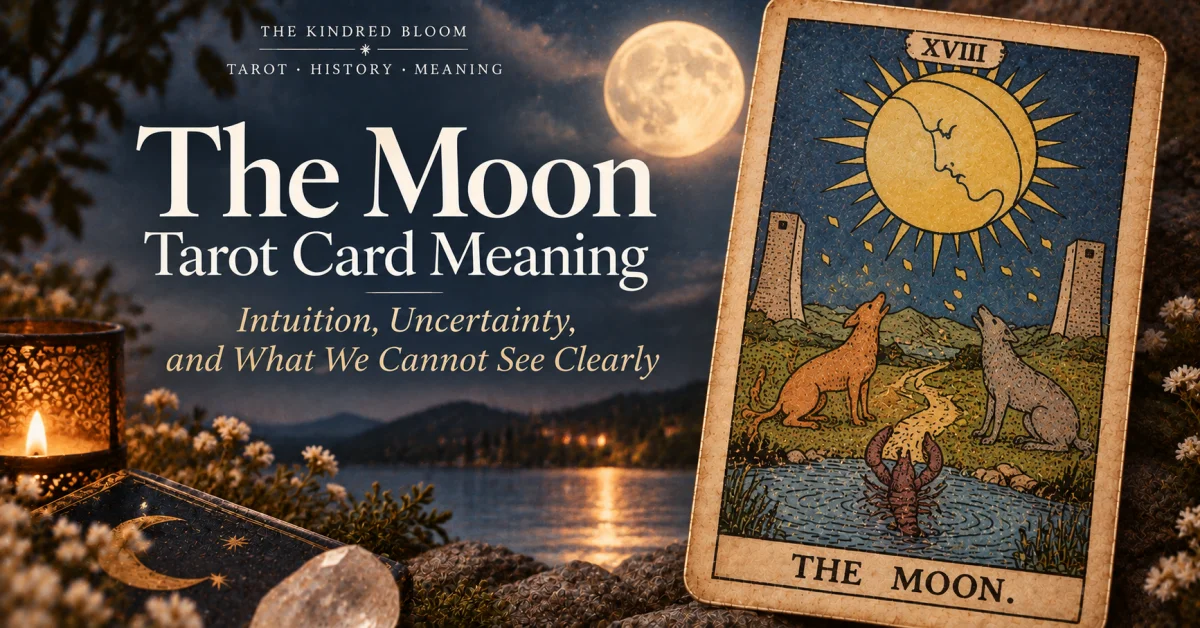
The Moon is one of those tarot cards that feels strange before we even try to interpret it. A moon hangs above two towers, a dog and a wolf stand on either side of a path, and a crayfish crawls out of the water below. The road continues into the distance, but we cannot see where it eventually leads.
The Moon is often associated with intuition, illusion, fear, dreams, and the subconscious. I have always found that combination interesting because some of those meanings seem almost contradictory. If The Moon represents intuition, are we supposed to trust what we feel? If it represents illusion, should we question it instead? For me, the card makes more sense when we allow both possibilities to exist. Our feelings can be real even when our understanding of a situation is incomplete.
The Moon Before Modern Tarot Reading
The Moon has appeared in tarot for centuries, although early tarot was created for card games rather than the personal readings we commonly associate with it today. Earlier versions of the card did not always look exactly like the Rider–Waite–Smith image either, so I would be careful about treating every detail in the modern card as an ancient symbol with one fixed meaning.
The Rider–Waite–Smith Tarot, published in 1909, gives us the scene most readers now recognise. Pamela Colman Smith shows a long path running between two towers, a dog and a wolf beneath the moon, and a crayfish emerging from a pool. One thing I find particularly interesting is that there is no human figure here to show us how to respond. We are simply looking down the path ourselves.
Moonlight Is Still Light
The Moon is sometimes described as a card of darkness, but the image is not actually dark. There is light; it just doesn’t show the landscape as clearly as daylight would.
That feels like a useful way to approach the card. We may have clues, observations, memories, or a strong feeling about what is happening. We are not completely in the dark, but we may not have enough information to understand the whole situation yet.
Think about waiting for a reply after an important conversation. The other person has been unusually quiet and you immediately feel that something is wrong. That feeling may be worth paying attention to, but something feels different and I know exactly what they are thinking are not the same thing. Somewhere between those two statements, our minds start filling in the missing information.
Intuition and Assumption Are Not the Same Thing
The Moon is frequently called an intuition card, and I understand why. The problem is that trust your intuition can become too easy an answer. Intuition does not arrive in isolation; previous experiences, expectations, fear, and desire can all affect the way we read a situation.
Someone you care about takes much longer than usual to reply to a message, for example. You feel uneasy immediately. Maybe you really have noticed a change in their behaviour. Maybe an earlier experience of rejection makes silence particularly uncomfortable for you. Often, there is no way to know which explanation is correct from the feeling alone.
I don’t think that makes the feeling meaningless. It simply means that a feeling can contain useful information without giving us the entire answer. When The Moon appears, I like to separate two things: what am I actually noticing, and what am I adding to it?
The Dog and the Wolf
On either side of the path stand a dog and a wolf. They look similar enough to belong together, but one is domesticated while the other belongs to a wilder world. There are plenty of symbolic systems we could use to explain them, but sometimes it is more interesting to stay with what the image actually gives us.
They are two related creatures responding to the same moon. For a modern reader, I think they work nicely as an image of the different reactions that can exist inside us at once. One part of us looks for something familiar and reassuring, while another reacts more instinctively. Neither reaction necessarily tells us exactly what is true; they may simply be different responses to the same uncertain situation.
The Crayfish Emerging From the Water
The crayfish at the bottom of the card is probably one of the stranger details in the Major Arcana. It is coming out of the water and beginning to move toward the path. Before assigning a complicated symbolic system to it, I think the basic image is already interesting: something that was beneath the surface is starting to become visible.
Sometimes emotions work like that. We know we are uncomfortable before we know why. A dream stays with us longer than expected, something small makes us unexpectedly emotional, or we find ourselves reacting strongly to a situation that seems ordinary on the surface.
The first reaction does not necessarily explain what is happening. It may simply tell us that there is something there worth noticing.
When Fear Fills in the Missing Information
Uncertainty is uncomfortable, and our minds are surprisingly good at filling empty spaces. If we don’t know why someone is quiet, we create a reason. If we don’t know whether a plan will work, we imagine an outcome. If we cannot tell what another person thinks of us, small details suddenly start to feel much more important.
Sometimes those guesses turn out to be right. Sometimes they don’t. That’s why I hesitate to read The Moon as simply trust your feelings. Our feelings deserve attention, but when information is missing, imagination can quietly turn possibilities into conclusions.
There is a difference between thinking I have a bad feeling about this and therefore I know what is happening. The first leaves room to learn more. The second closes the story before we actually have the ending.
The Path Continues Even When We Cannot See the End
The path runs from the water, between the dog and wolf, past the two towers and into the distant landscape. We can see enough of it to continue, but we cannot see where it eventually ends.
That is actually a pretty normal part of life. We start relationships without knowing how they will develop, change jobs without knowing whether we will enjoy them, and make plans without knowing what our circumstances will look like months from now. Complete certainty is rarely available before we have to make a decision.
I don’t see The Moon as a command to stop until everything becomes clear. Sometimes the better approach is simply to move a little more carefully—to notice what we know, listen to what we feel, and remain honest about what we are still guessing.
The Moon Is Not Automatically a Warning
Because The Moon is connected with illusion and uncertainty, it sometimes gets interpreted as deception, secrets, or someone hiding something. Those meanings can fit a particular reading, especially when other cards point in the same direction, but The Moon by itself does not prove that someone is lying.
If you are confused about someone’s behaviour, the card may be describing exactly that: you are confused. There isn’t enough information yet to understand what is happening. Turning that uncertainty immediately into someone is deceiving me just replaces the unknown with a story.
Sometimes I don’t know yet is a perfectly valid tarot interpretation. It may not be as dramatic, but it can be much more useful.
What Does The Moon Mean in a Tarot Reading?
In contemporary tarot, The Moon is commonly associated with intuition, uncertainty, illusion, dreams, fear, subconscious feelings, and incomplete information. When it appears, I pay attention to the gap between what is known and what is being inferred.
In a relationship reading, that might mean mixed signals, anxiety about someone’s feelings, or a situation that has not become clear yet. It does not automatically mean dishonesty or betrayal. At work, The Moon can fit a situation where expectations are unclear, circumstances are still developing, or worry about what might happen is beginning to feel as important as what is actually happening. On a more personal level, it can appear when emotions are strong but difficult to explain.
Rather than immediately deciding whether those emotions are right or wrong, it can help to separate the situation into three parts: What do I know? What do I feel? What am I assuming? The answers may overlap, but they are not necessarily identical.
The Moon After The Star
The Star and The Moon both take place beneath an open sky, but they don’t feel the same at all. The Star gives us a clear point of orientation. Its large central star stands out, and the scene feels calm and open. The Moon gives us a path too, but the landscape ahead is much harder to read.
In the previous card, we looked at the idea that hope can exist without certainty. The Moon takes us into the less comfortable side of that uncertainty. We still want to move forward, but now feelings, instincts, fear, imagination, and limited information are all mixed together.
We don’t have to choose between blindly trusting every feeling and ignoring our feelings until we have proof. There is plenty of room between those extremes. We can listen to ourselves while also admitting when we don’t know enough yet. As with the other card comparisons in this series, I use this as a modern way of learning the Major Arcana rather than as evidence that early tarot makers deliberately created a psychological journey from one card to the next.
Understanding The Moon Beyond “Illusion”
Calling The Moon a card of illusion can make it sound as though whatever we experience under it is false. I don’t find that very helpful. Fear can be genuine even when the thing we fear never happens. Intuition can draw our attention to something important without explaining exactly what it means. And sometimes uncertainty exists simply because we don’t have enough information yet.
Maybe that’s why The Moon can feel uncomfortable. It doesn’t give us the satisfaction of a clear answer. We can observe, ask questions, pay attention to patterns, and listen to our reactions, but sometimes we still have to leave part of the picture unfinished.
The Moon doesn’t ask us to distrust ourselves. It reminds us that listening to ourselves and knowing something for certain are not quite the same thing.
Continue Exploring
The Moon follows The Star (XVII) in the Rider–Waite–Smith Major Arcana. The Star explores hope without certainty, while The Moon moves further into what uncertainty feels like when intuition, fear, imagination, and incomplete information begin to overlap.
You can also explore The Major Arcana Explained for a broader introduction to the Major Arcana.
Next comes The Sun (XIX). It is usually described through words like happiness, optimism, and success, but I think there is another interesting way into the card: what changes when we can finally see clearly enough that we no longer have to keep filling in the blanks?