
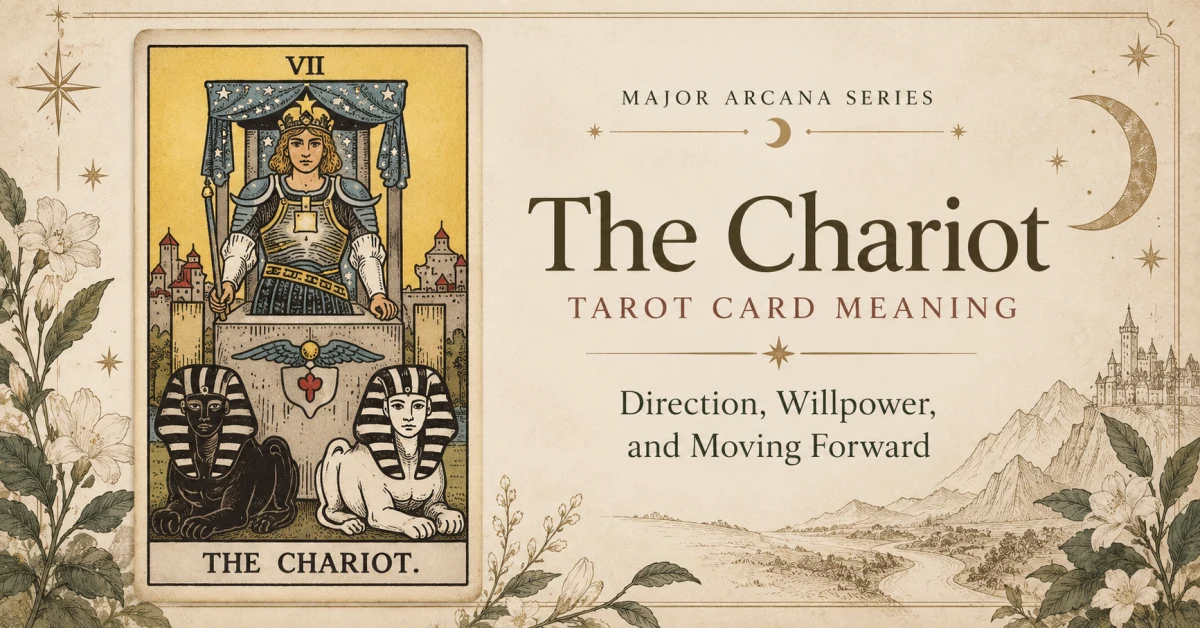
The Chariot is a card of movement—but movement alone does not fully explain its meaning.
In the Rider-Waite-Smith tarot, a figure stands confidently in a chariot while two sphinxes rest in front of him. At first, the card may look like a straightforward image of victory and forward progress. Yet there is something unusual about the scene: the sphinxes face different directions, and there are no visible reins connecting them to the charioteer.
So what is actually driving the chariot forward?
This detail gives us an important clue to understanding The Chariot. The card is often associated with determination, direction, self-control, and the ability to bring opposing forces under one purpose.
Rather than simply telling us to “move forward,” The Chariot asks whether we know where we are going—and whether we can maintain control long enough to get there.
The Chariot at a Glance
- Number: VII (7)
- Arcana: Major Arcana
- Common themes: Willpower, determination, direction, control, progress
- Reversed themes: Lack of direction, loss of control, conflicting motivations, obstacles
- Key symbols: The charioteer, black and white sphinxes, armor, canopy of stars, city
These keywords are useful to remember, but as always, they are a foundation. The imagery can tell us much more.
Look Closely at The Chariot
The central figure in the Rider-Waite-Smith Chariot appears composed and powerful. He wears armor and stands beneath a canopy decorated with stars.
In front of him are two sphinxes—one black and one white.
Their contrasting colors immediately create a sense of duality. They may be read as opposing tendencies, competing desires, or different forces that need to move together.
Yet the charioteer does not appear to hold ordinary reins.
This is one of the most useful details to notice when reading the card.
The Chariot’s control is not simply physical. The image can suggest discipline, intention, and the ability to maintain direction even when different forces pull against one another.
Behind the chariot lies a city. The figure has moved beyond it, giving the scene a sense of departure and purpose. He is not simply standing still and feeling determined. He is going somewhere.
Where Did The Chariot Come From?
The Chariot has much older roots than the Rider-Waite-Smith deck.
Chariot imagery appeared in early Italian tarot decks, where the card often depicted a triumphal figure riding in a decorated vehicle. Such imagery was connected to the visual tradition of the triumph, including ceremonial processions associated with victory, status, and achievement.
The details and symbolism of the card changed over the centuries.
By the time Arthur Edward Waite and Pamela Colman Smith created the Rider-Waite-Smith deck in the early twentieth century, The Chariot had acquired a more elaborate symbolic composition.
This distinction is useful when studying tarot: the modern meanings we use today developed over time. They should not automatically be projected backward onto every historical version of the card.
What Does The Chariot Mean in a Reading?
When The Chariot appears upright, something may be asking for focused action.
You may already know what you want. The challenge is maintaining enough discipline and direction to reach it.
Imagine asking about a career goal and drawing The Chariot. The card might encourage persistence and decisive action—but it can also ask whether your efforts are actually moving in one direction.
Working harder is not necessarily the same as moving forward.
In a relationship reading, The Chariot might describe two people trying to move toward a shared goal, or it may highlight the need to decide where a relationship is going.
In a personal reading, the opposing sphinxes can be particularly interesting. Perhaps one part of you wants security while another wants change. The card does not necessarily tell you that one side must disappear. Instead, it may ask whether you can direct those competing impulses rather than allowing them to direct you.
When The Chariot Is Reversed
A reversed Chariot can suggest that forward movement has become difficult.
You might be putting in considerable effort without having a clear destination. Different priorities may be pulling you in opposite directions, or circumstances may make it difficult to maintain control.
Sometimes the reversed card can also point toward trying to control too much.
That distinction matters.
There is a difference between having direction and forcing everything to happen exactly as planned.
Rather than automatically reading the reversed Chariot as “failure,” look at where the movement has broken down:
Is the destination unclear?
Are competing priorities pulling against each other?
Is more discipline needed—or less control?
The surrounding cards can help answer that question.
Reading the Symbols Instead of Only the Keywords
If you memorize only:
The Chariot = victory and determination
you will have a useful starting point—but you may miss much of what the card can say.
Look at the sphinxes.
Look at the charioteer’s posture.
Notice the absence of ordinary reins and the city behind him.
Then ask which part of the image resembles the situation in front of you.
For example, in one reading the black and white sphinxes might make you think about two competing choices. In another, the city behind the charioteer might feel more important and suggest leaving something familiar behind.
Neither observation requires you to abandon the traditional meaning of the card.
Instead, the traditional meaning gives you a foundation, while the symbols help you decide how that meaning applies to this particular reading.
That is a much more useful way to learn tarot than trying to memorize one perfect sentence for every card.
A Simple Way to Read The Chariot
When The Chariot appears, start with three questions:
Where am I trying to go?
What is pulling me in different directions?
What would help me move forward with intention?
The Chariot is powerful because it is not simply a card about winning.
It is a card about having a direction—and being able to hold that direction even when the forces around or within you do not naturally move together.
You may also be interested in:
What Is the Major Arcana?
The Lovers Tarot Card Meaning
What Do Tarot Numbers Mean? Understanding Ace Through Ten