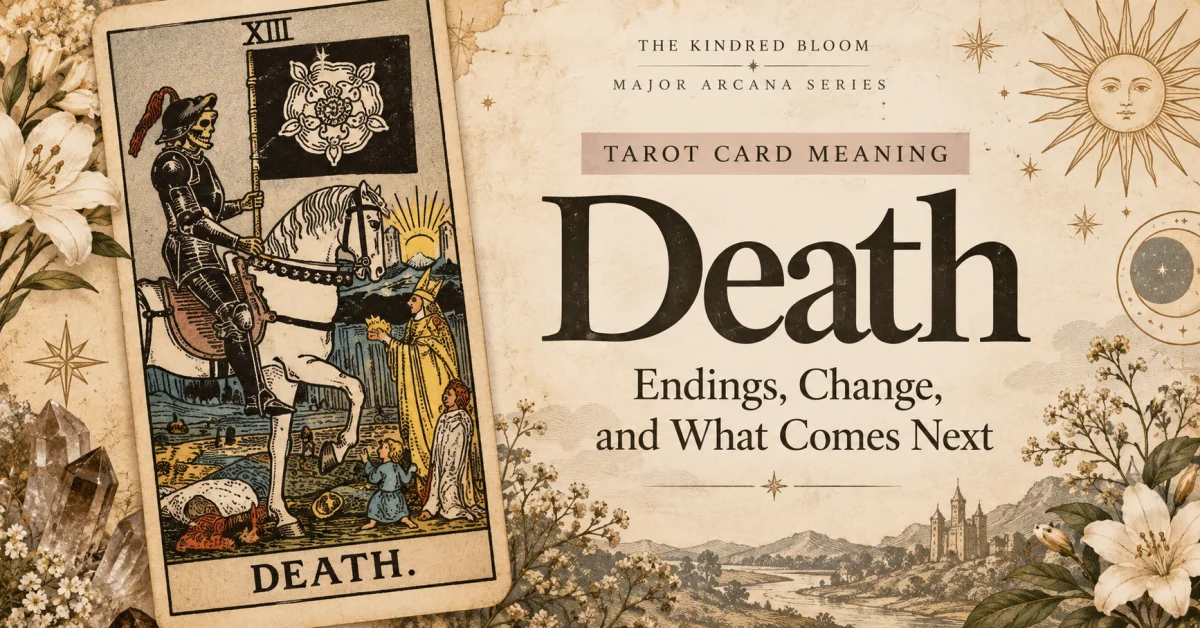
Few tarot cards create an immediate reaction as strong as Death. A skeleton in armour rides forward on a white horse. A king lies beneath him, other figures face the rider, and a child looks upward. In the distance, the sun appears between two towers.
For someone seeing the card for the first time, the conclusion may seem obvious: something terrible is going to happen. Modern tarot readers usually respond by saying that Death does not necessarily mean physical death. Instead, the card is commonly associated with endings, transformation, transition, and renewal.
That explanation is useful, but it can become another keyword to memorise. To understand Death more deeply, it helps to ask a different question: Why are endings so closely connected with transformation in the first place? The history of the card gives us an interesting place to begin.
Death Was Part of Tarot Long Before Modern Tarot Reading
Death is not a modern addition to tarot. Surviving fifteenth-century Italian tarot cards already include a Death trump. The Metropolitan Museum of Art identifies Death among the trumps of the Visconti-Sforza tradition from around 1450. One surviving Visconti Death image shows a skeletal figure carrying a long implement, surrounded by fallen figures, while another early example depicts Death riding a horse.
But there is an important historical distinction to make. These early tarot decks were not created as the modern divination system we use today. The earliest references to tarot date to fifteenth-century northern Italy, where the cards were used for trick-taking games. Their strong association with fortune-telling and occult practice developed much later.
So although Death appeared in early tarot, we should not automatically assume that a fifteenth-century player would have interpreted the card as “personal transformation” in the modern psychological sense. The image came first, while many of the meanings familiar to contemporary tarot readers developed later.
From an Image of Death to an Image of Transformation
The Rider–Waite–Smith Death card, published in 1909, retains the unmistakable figure of Death but changes the surrounding composition considerably. Pamela Colman Smith depicts Death as an armoured skeleton riding a white horse. A king has fallen beneath the horse, while a religious figure, a woman, and a child encounter the rider differently. Nothing in the scene appears capable of stopping him, yet the landscape does not end with Death. In the distance, a sun appears between two towers.
Arthur Edward Waite’s own explanation of the card is particularly revealing. In The Pictorial Key to the Tarot (1911), he discusses Death through ideas of change, transformation, and passage, while also drawing attention to elements such as the sun beyond the towers and the rose displayed on the rider’s banner.
This provides historical support for connecting the Rider–Waite–Smith Death card with transformation. But transformation here does not require us to pretend that an ending is pleasant. Something still ends, and that is precisely what gives the card its power.
Why Does Death Ride Forward?
The central figure does not wait for the people in the card to be ready. He moves forward. The king has already fallen, and although the other figures respond differently, Death continues through the scene regardless.
Visually, this makes the card useful for thinking about a particular kind of change: change that cannot be negotiated away simply because we would prefer things to remain as they are. Some changes are chosen. Others arrive because circumstances change, relationships evolve, opportunities disappear, identities no longer fit, or a stage of life reaches its natural conclusion.
This does not mean that every appearance of Death predicts an unavoidable external event. Rather, the image gives us a way to examine our relationship with endings. When something has clearly reached its end, how much energy are we spending trying to return it to what it used to be?
Death and the Difference Between Change and Ending
Change happens constantly, but an ending is more specific. You can change the way you approach a job while remaining in the same position. You can change a habit without abandoning the larger goal, or adjust a relationship without ending it.
Death becomes particularly relevant when the previous form of something can no longer continue in the same way. Imagine someone who has spent years pursuing a career they once wanted but no longer finds meaningful. The Death card does not tell that person to resign. Instead, it can raise a more useful question: Is this situation asking for an adjustment, or has something more fundamental already ended?
Perhaps the job remains suitable but their expectations need to change. Perhaps the career itself no longer reflects who they have become. Those are very different situations, and Death helps us examine that difference.
The Fallen King: Status Does Not Stop Change
One of the most striking figures in the Rider–Waite–Smith card is the fallen king. His crown lies beside him as Death’s horse moves forward. The image does not need an elaborate hidden meaning to be useful. At the simplest visual level, even the most powerful person in the scene cannot command Death to stop.
That creates an important contrast between control and inevitability. Status, authority, preparation, and effort can influence many parts of life, but they cannot preserve everything indefinitely. A job title changes, a child grows older, a relationship enters a different stage, and a successful period eventually gives way to another one.
Recognising this is not the same as becoming passive. Sometimes accepting that something has changed is exactly what allows us to respond to the new situation more effectively.
The Child and Different Responses to Change
Not everyone in the card responds to Death in the same way. The king has fallen, the religious figure faces the rider, another figure appears overwhelmed, while the child looks toward Death. We should be cautious about assigning rigid psychological meanings to each individual figure unless historical evidence supports them, but as a visual reading exercise, their different postures are useful.
When change arrives, people do not respond identically. One person may resist it, another may grieve, and someone else may become curious about what comes next. The card therefore does not need to divide responses into “good” acceptance and “bad” resistance.
An ending can be necessary and still painful. You can understand that something is over while wishing it were not. Both experiences can exist at the same time.
The Sun Between the Towers
Death dominates the foreground, but the image contains another important detail. Beyond the figures, between two towers, the sun appears on the horizon. Waite specifically refers to this sun in his description of the card and places the image within his broader spiritual interpretation of death, transition, and continuation.
For a modern reading, we do not need to adopt Waite’s entire esoteric framework to notice the visual contrast. The foreground contains an ending, but the horizon still exists. That does not guarantee that whatever comes next will be better. Tarot cannot promise that every loss leads immediately to a wonderful new beginning.
But the image does suggest something more restrained: an ending and a future can exist in the same picture. That is different from saying, “Everything happens for a reason.” Sometimes an ending simply hurts, and the card leaves room for that too.
Does the Death Card Mean Physical Death?
This is one of the most common questions about the card. In a contemporary tarot reading, it is neither responsible nor useful to treat Death as a prediction that someone will physically die.
The historical image clearly represents death, and Waite himself did not erase that association. His writing discusses both ordinary death and mystical ideas of transformation and passage. But that is different from claiming that drawing the card predicts an actual death.
For practical reading, Death is much more useful when examining endings, transitions, irreversible changes, release, and the movement from one state into another. The surrounding question and cards still matter.
Letting Go Is Not the Same as Forgetting
“Let go” is another phrase frequently attached to Death, but letting go can sound much easier than it actually is. Ending a chapter does not require pretending that it never mattered.
A relationship can end while remaining important to your history. A previous career can stop being right for you without becoming a mistake. An old version of yourself can be outgrown without needing to be rejected. Death can therefore represent separation without erasure: something may no longer belong in the present while still having helped create it.
This is especially useful when the card appears around identity changes. The question does not always have to be What should I get rid of? Sometimes the better question is: What am I no longer required to carry forward in the same form?
What Does Death Mean in a Tarot Reading?
In modern tarot, Death is commonly associated with endings, transition, transformation, release, and renewal. Instead of treating those words as interchangeable keywords, look at the situation being asked about. What has actually ended? What is merely changing? What is being held onto because it still has value, and what is being held onto because accepting its ending feels difficult?
Death can sometimes describe an external transition. At other times, the visible circumstances remain the same while a person’s relationship with them changes fundamentally. For example, someone may remain in the same city, relationship, or career while letting go of an expectation that once defined it.
The physical situation continues, but its previous meaning does not. That can also be a form of ending.
Death After The Hanged Man
The transition from The Hanged Man to Death is particularly useful when learning the Major Arcana. The Hanged Man shows suspension. Something has stopped moving in the ordinary way, but it has not necessarily ended. The pause may create time to observe, reconsider, or release the need for immediate action.
Death is different. The central question is no longer simply “Can this wait?” It becomes “Can this continue in its previous form?” That distinction helps prevent the two cards from collapsing into the same general idea of change.
The Hanged Man can represent a period in between actions. Death confronts the possibility that returning to the previous state is no longer the point. This comparison is a modern interpretive tool rather than evidence that early tarot makers deliberately designed the two cards as stages of a psychological journey.
Understanding Death Beyond “Transformation”
It is tempting to make Death less frightening by immediately turning it into a positive card: Don’t worry—Death just means transformation. But that can flatten what makes the card meaningful.
Transformation often requires something to stop being what it was. Sometimes that feels liberating, sometimes it feels painful, and often it feels like both. The history of tarot also reminds us not to treat today’s psychological interpretation as though it has always been fixed. Death already appeared among fifteenth-century Italian tarot trumps, long before tarot acquired its modern association with divination.
Centuries later, the Rider–Waite–Smith card gave the image a particularly rich framework of death, passage, continuation, and renewal. Understanding that history makes the familiar keyword transformation more meaningful.
Death does not need to promise a better future. It asks us to recognise when the old form of something has reached its limit—and to consider what becomes possible once we stop requiring it to remain unchanged.
Continue Exploring
Death follows The Hanged Man (XII) in the Rider–Waite–Smith Major Arcana. The Hanged Man explores suspension, waiting, and perspective; Death turns toward endings and the changes that follow when something can no longer continue in its previous form.
You can also explore The Major Arcana Explained for a broader introduction to the Major Arcana.
Next comes Temperance (XIV), where the focus shifts again. After an ending, how can separate elements begin to work together in a new way?