
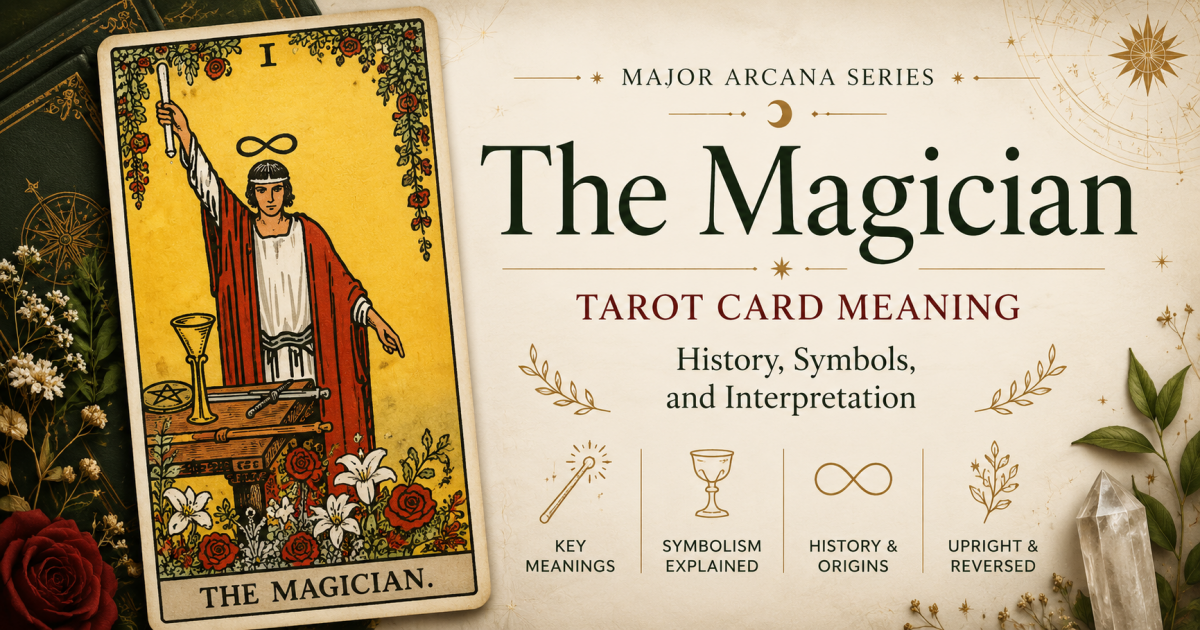
The Magician is associated with skill, intention, resourcefulness, and turning ideas into action. Yet the confident figure in the Rider–Waite–Smith Tarot has a very different appearance from the card’s earliest forms. Understanding that transformation reveals a card not only about what we can achieve, but also about how we choose to use our abilities.
The Magician is the first numbered card of the Major Arcana.
In the Rider–Waite–Smith Tarot, a figure stands behind a table displaying four symbolic objects. One hand raises a wand toward the sky, while the other points toward the earth.
The image suggests someone who has resources available and knows how to direct them toward a purpose.
This is why The Magician is frequently associated with manifestation in modern tarot.
But the card’s history reveals another dimension. Before becoming the ceremonial figure familiar today, The Magician was depicted more like a performer displaying skill with objects.
That earlier character raises an interesting question that remains relevant to modern readings:
Having an ability is one thing. How we use it is another.
The Magician in Early Tarot
The Magician appears in early Italian tarot traditions dating to the fifteenth century.
The card was known by names such as Il Bagatto or Il Bagatello. The precise historical meanings of these terms are debated, but they have been associated with a performer or a figure of relatively low social standing.
In early tarot imagery, the character often appears behind a table with small objects.
Rather than resembling a powerful ceremonial magician, the figure looks closer to someone demonstrating dexterity or entertaining an audience.
This is an important distinction.
The early card provides the visual and historical foundation for The Magician, but it should not automatically be interpreted through the modern language of manifestation or personal empowerment.
Those associations developed through later changes in tarot interpretation.
How Did The Magician Become a Magical Figure?
During the eighteenth and nineteenth centuries, tarot increasingly attracted interest from writers who interpreted its cards through occult and esoteric systems.
The Magician was particularly open to reinterpretation.
A figure associated with handling objects and displaying skill could be understood as someone directing symbolic forces rather than simply performing tricks.
Nineteenth-century occult traditions connected tarot with various systems, including astrology, Kabbalah, and ceremonial magic.
These developments contributed to the transformation of The Magician’s imagery and meaning.
By the time the Rider–Waite–Smith Tarot appeared in 1909, the card presented a figure whose pose and surroundings were explicitly symbolic.
The performer had become an esoteric practitioner.
This historical shift helps explain why modern interpretations often emphasise conscious intention and purposeful action.
The Magician in the Rider–Waite–Smith Tarot
Illustrated by Pamela Colman Smith under the direction of Arthur Edward Waite, The Magician stands behind a table holding four objects:
- A wand
- A cup
- A sword
- A pentacle
These correspond to the four suits of the Minor Arcana.
Above the figure’s head appears an infinity symbol. One hand raises a wand toward the sky, while the other points toward the ground.
Roses and lilies grow around the figure.
Unlike many earlier depictions, the Rider–Waite–Smith image presents The Magician within a carefully arranged symbolic setting.
The objects, gesture, and surrounding garden all contribute to the impression of someone working deliberately with what is available.
But the table is particularly important.
The Magician does not stand before an empty space. The tools are already there.
What Do the Four Objects on the Table Mean?
The four objects connect The Magician with the four suits of the Minor Arcana.
In modern tarot interpretation, the suits are commonly associated with different dimensions of experience:
| Suit | Common association | A question to consider |
|---|---|---|
| Wands | Initiative, creativity, and drive | What motivates me to begin? |
| Cups | Emotions and relationships | How do my feelings affect this situation? |
| Swords | Thought and communication | What needs to be understood or expressed clearly? |
| Pentacles | Material resources and practical matters | What resources or practical steps are needed? |
These associations are interpretive tools rather than fixed rules for every reading.
Together, the four objects suggest that The Magician has several kinds of resources available.
Consider a reading about starting a creative project.
Wands might draw attention to the original idea and motivation. Cups could suggest the emotional connection behind the project. Swords might highlight planning or communicating the concept, while Pentacles could bring the focus to time, money, or equipment.
The card does not guarantee that the project will succeed.
Instead, the image provides a way to examine which resources are already available and how they might work together.
This is also what distinguishes The Magician from The Fool.
The Fool approaches an unfamiliar experience with openness. The Magician begins to work deliberately with the possibilities at hand.
What Does “As Above, So Below” Mean in The Magician?
The Magician’s distinctive pose—one hand raised and the other lowered—is commonly connected in modern esoteric interpretations with the phrase “as above, so below.”
The expression is associated with the Hermetic tradition and broadly concerns correspondences between different levels of existence.
In interpretations of The Magician, the gesture is often understood as a connection between an idea and its expression in the material world.
It offers a visual way to understand the relationship between intention and action.
An idea may begin as something intangible, but bringing it into the world requires engagement with practical circumstances.
However, this symbolism belongs to later esoteric interpretations. We should not assume that fifteenth-century tarot makers originally designed the card around this Hermetic concept.
What Does The Magician Mean in a Tarot Reading?
In contemporary tarot, The Magician is commonly associated with:
- Skill and capability
- Intention
- Initiative
- Resourcefulness
- Concentration
- Communication
- Purposeful action
- Making use of available opportunities
These keywords point toward a central idea: something is available to work with.
That might be a talent, useful knowledge, a relationship, an opportunity, or a practical resource.
The Magician encourages us to examine what can be done with those resources rather than waiting for circumstances to develop on their own.
For example, in a career reading, the card might draw attention to existing skills that could be applied in a new role.
In a creative reading, it could suggest bringing separate ideas and resources together into a workable plan.
In a relationship reading, communication and the way someone uses their influence may become more relevant.
The interpretation depends on the question and surrounding cards.
Rather than treating The Magician as a promise of success, it can be more useful to ask:
What abilities are present, and what would it take to use them effectively?
Does The Magician Mean Manifestation?
Manifestation is one of the most common modern keywords associated with The Magician.
In a broad sense, the word fits the card: an idea or intention is being brought into a more tangible form.
However, this does not require the belief that thinking about something strongly enough will automatically make it happen.
The Rider–Waite–Smith image offers a more practical interpretation.
The Magician has tools on the table and appears ready to use them.
From this perspective, manifestation can be understood as a process involving:
Intention → Resources → Skill → Action
The distinction matters because The Magician is not simply wishing for an outcome.
The card draws attention to the relationship between an intention and the steps taken to pursue it.
It may also reveal a gap between the two.
Someone might have a clear goal but lack a workable plan. Another person might possess useful skills without knowing where to direct them.
The Magician invites us to examine that connection.
The Magician and the Question of Skill
The Magician’s historical connection with performers introduces a more complicated aspect of the card.
Skill can be used in different ways.
A talented communicator may help others understand a difficult idea, but persuasive ability can also be used to mislead.
Someone who understands a situation well may solve a problem—or use that knowledge to gain an unfair advantage.
This does not make The Magician inherently deceptive.
It means that capability alone does not tell us whether an action is constructive.
In a reading involving negotiations, professional relationships, or communication, this distinction may be particularly relevant.
Consider not only whether someone has influence, but also how that influence is being exercised.
The Magician represents the use of ability, not an automatic judgment about the person using it.
Is The Magician a Positive Card?
The Magician is often viewed as a constructive card because it suggests initiative, capability, and purposeful action.
Yet its meaning is not automatically positive in every context.
Confidence can support effective decisions, but it can also become overconfidence.
Persuasion can help communicate an idea, but it may also become manipulation.
Having several tools available is useful only when they are applied appropriately.
The question and surrounding cards help determine which aspect deserves attention.
Rather than reducing The Magician to a good or bad sign, consider whether the situation involves effective use of resources, unused ability, or questions about how influence is being exercised.
The Fool and The Magician: From Possibility to Intention
The Fool and The Magician appear next to each other in the modern Major Arcana sequence, but they approach possibility differently.
The Fool represents openness to an experience whose outcome is not yet known.
The Magician introduces deliberate engagement with the resources already available.
The Fool asks:
What might happen if I step forward?
The Magician asks:
What can I do with what I have?
This comparison offers a helpful way to understand the relationship between the two cards without assuming that the entire Major Arcana was originally designed as one fixed spiritual narrative.
It also shows why The Magician is more specific than the general idea of new beginnings.
The emphasis has shifted from encountering possibility to working with it.
What Should You Remember About The Magician?
The Magician is often summarised through keywords such as skill, intention, resourcefulness, and manifestation.
But the image becomes easier to interpret when these ideas are connected.
The four objects on the table suggest available resources. The figure’s deliberate pose directs attention toward purpose. The card’s historical connection with performers reminds us that skill can be used in different ways.
When The Magician appears in a reading, consider three things:
What is available? What is the intention? How are the available abilities being used?
These questions move beyond a simple promise that anything is possible.
The Magician is about the relationship between potential and purposeful action—and the responsibility involved in putting ability to use.
Continue Exploring
The Magician follows The Fool in the modern Major Arcana sequence, moving from open possibility toward conscious action.
If you’d like to explore the cards in order, read The Fool Tarot Card Meaning first. You may also find The Major Arcana Explained and The History of the Rider–Waite–Smith Tarot helpful for understanding the larger structure and historical background.
Next, we’ll explore The High Priestess, whose quiet, inward imagery creates a striking contrast with The Magician’s active use of skill and intention.