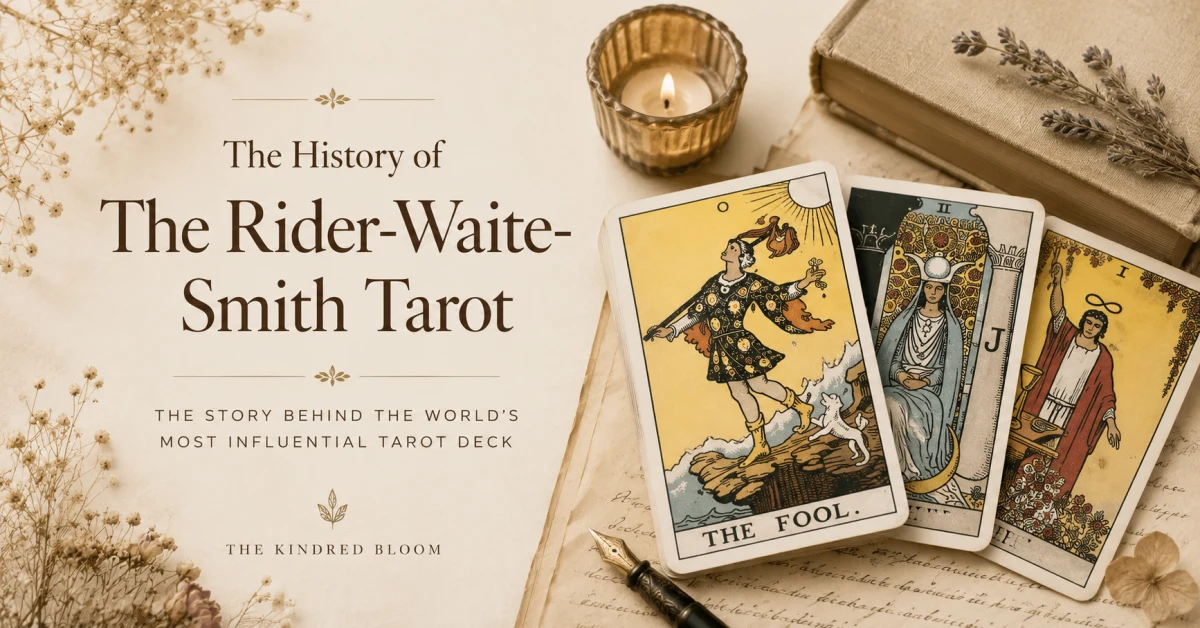
Discover the history of the Rider-Waite-Smith Tarot, the world’s most influential tarot deck. Learn who created it, why it transformed tarot reading, and why it remains the most popular deck for beginners today.
If you’ve spent any time learning tarot, you’ve almost certainly encountered the Rider-Waite-Smith Tarot. It is the deck most beginners are encouraged to start with, and its imagery appears in countless books, courses, and modern tarot decks. Even people who have never owned a tarot deck often recognize cards like The Fool, The Lovers, or Death because they have become part of popular culture.
With such a strong presence today, it’s easy to assume that the Rider-Waite-Smith Tarot was the first tarot deck ever created. In reality, tarot had already existed for more than four hundred years before this deck was published. By the time it appeared in the early twentieth century, tarot already had a long and fascinating history.
So why did one deck become so influential? The answer lies not only in when it was created, but also in the people behind it and the new way they invited readers to understand the cards.
Tarot Before the Rider-Waite-Smith Deck
The history of tarot began in fifteenth-century Italy, where beautifully painted decks such as the Visconti-Sforza Tarot were created for noble families. At that time, tarot cards were primarily used for card games rather than fortune-telling. Over the following centuries, tarot spread throughout Europe, and regional traditions developed. Among the most influential was the Tarot de Marseille, which became one of the best-known historical tarot patterns.
Although these early decks established the familiar structure of 78 cards, they looked quite different from the decks many people use today. The Major Arcana featured distinctive illustrated figures, but most of the Minor Arcana number cards simply displayed repeated suit symbols—cups, swords, batons, or coins—arranged in decorative patterns. Readers relied largely on established traditions, personal experience, and memorized meanings rather than detailed visual storytelling.
During the nineteenth century, interest in symbolism, mysticism, and esoteric philosophy grew rapidly in Britain and other parts of Europe. Some scholars and occult societies began exploring tarot as a symbolic system for meditation and spiritual reflection. This changing cultural environment created the perfect opportunity for a new kind of tarot deck—one that would make symbolism more accessible through illustration.
The Creation of the Rider-Waite-Smith Tarot
The Rider-Waite-Smith Tarot was first published in 1909 through the London publishing company William Rider & Son. The project brought together two remarkable individuals whose contributions shaped the deck in different but equally important ways.
Arthur Edward Waite, a scholar and member of the Hermetic Order of the Golden Dawn, developed the symbolic framework and guided the overall vision for the deck. To bring those ideas to life, he collaborated with artist Pamela Colman Smith, whose imaginative illustrations transformed the project into something entirely new.
Although the deck became widely known for many years as the “Rider-Waite Tarot,” that name reflects only the publisher and Waite himself. Today, many historians, publishers, and tarot educators prefer the name Rider-Waite-Smith (RWS) because it also recognizes Pamela Colman Smith, whose artwork became one of the defining features of the deck. Her illustrations did far more than decorate the cards—they gave each one a story that readers could observe, interpret, and remember.
What Made the Rider-Waite-Smith Tarot Different?
The Rider-Waite-Smith Tarot did not change the number of cards or the overall structure of tarot. It still contained 22 Major Arcana cards and 56 Minor Arcana cards, following a tradition that had existed for centuries. What changed was the way those cards communicated meaning.
For the first time, every card in the Minor Arcana received its own fully illustrated scene. Instead of showing only a collection of suit symbols, Pamela Colman Smith created images filled with people, movement, emotion, and symbolic detail. A reader could look at a card and begin asking questions about what was happening before even learning its traditional interpretation.
This innovation made tarot far more approachable, especially for beginners. Visual storytelling encouraged careful observation alongside study, allowing readers to connect symbolism with meaning rather than relying solely on memorization. While learning the traditional meanings of the cards remains important, the illustrations provide valuable context that supports understanding and long-term learning.
Today, this approach feels completely natural because so many modern tarot decks follow the same model. Yet in 1909, it represented a significant shift that would influence tarot design for generations.
Why Is the Rider-Waite-Smith Tarot Still So Popular?
More than a century after its publication, the Rider-Waite-Smith Tarot remains the foundation for much of modern tarot education. Whether you read books, watch online tutorials, or join tarot communities, you are likely to encounter references to its imagery and symbolism.
Part of its popularity comes from consistency. Because so many authors and teachers use the Rider-Waite-Smith system, beginners can easily compare resources without learning completely different visual languages. The illustrations also make it easier to notice recurring themes, relationships between cards, and symbolic details that appear throughout the deck.
Its popularity, however, should not be mistaken for historical superiority. The Rider-Waite-Smith Tarot did not replace earlier traditions or make them less valuable. Decks such as the Tarot de Marseille and the Visconti-Sforza Tarot remain essential chapters in tarot’s history, each reflecting the culture and artistic style of its own time. The Rider-Waite-Smith deck simply became the bridge that connected those historical traditions with the way many people learn tarot today.
A Lasting Legacy
The influence of the Rider-Waite-Smith Tarot extends far beyond a single deck. Hundreds of modern tarot decks borrow its structure, reinterpret its symbolism, or build directly upon Pamela Colman Smith’s original illustrations. Even when artists create entirely new visual styles, the underlying framework often traces back to the choices made in 1909.
Understanding the history of the Rider-Waite-Smith Tarot also reminds us that tarot has never remained completely unchanged. Every generation has added new artistic ideas and new interpretations while preserving the foundations established centuries earlier. Learning where today’s most familiar deck came from helps us appreciate both its innovation and the much older traditions that made it possible.
Continue Exploring
The Rider-Waite-Smith Tarot is only one chapter in tarot’s long history. In future articles, we’ll take a closer look at the remarkable people behind the deck, including Pamela Colman Smith and Arthur Edward Waite, as well as the historical traditions that came before it.
If you’re continuing your tarot journey, you may also enjoy:
By understanding how the Rider-Waite-Smith Tarot came to shape modern tarot, you’ll have a stronger foundation for exploring the symbolism, structure, and history of the cards themselves.