If you’ve ever seen tarot cards in a movie, on social media, or at a local café, you’ve probably wondered the same thing:
Were tarot cards always used to predict the future?
It’s an easy assumption to make. Today, tarot is often linked with fortune-telling, psychics, and mystical readings. Because of that, many people believe tarot was created for divination from the very beginning.
Surprisingly, history tells a different story.
Before we explore how tarot became connected with fortune-telling, it’s worth taking a step back and looking at where these fascinating cards actually began.
In this guide, you’ll learn:
- Whether tarot cards were originally created for fortune-telling
- What tarot cards were first used for
- How tarot became associated with divination
- Why understanding tarot’s history still matters today
Let’s begin at the very beginning.
Were Tarot Cards Originally Used for Fortune-Telling?
The short answer is no.
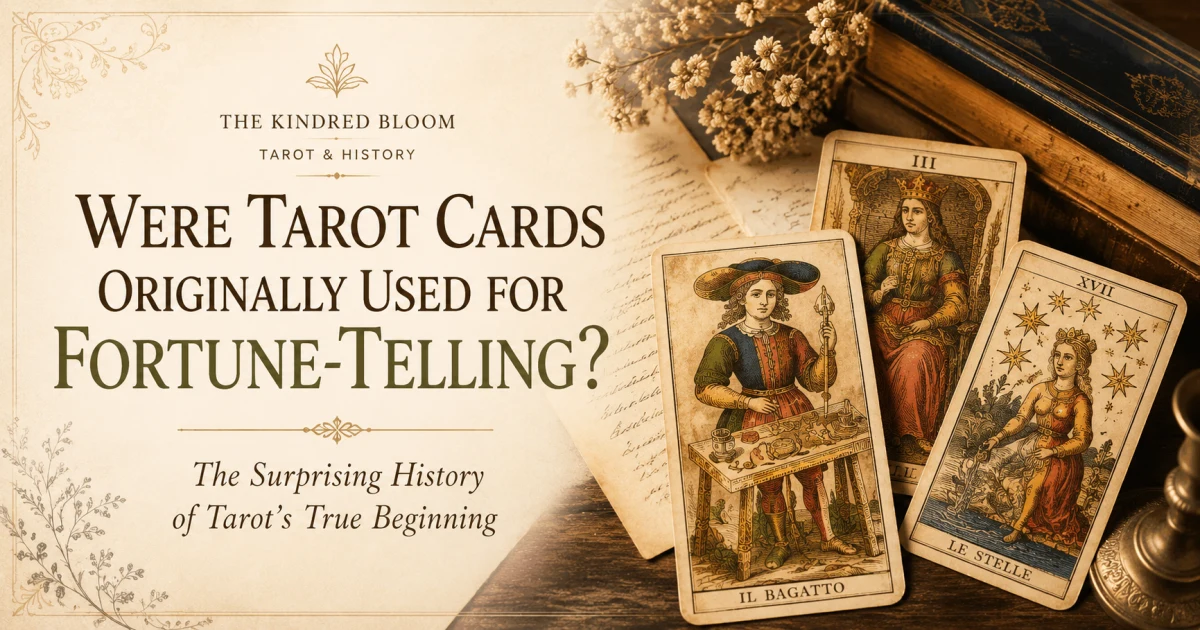
The earliest tarot cards were not created as mystical tools or used to predict the future. Historical records show that tarot first appeared in northern Italy during the fifteenth century, where beautifully illustrated decks were commissioned by wealthy noble families.
Rather than being used for readings, these cards were designed for a trick-taking card game known as tarocchi. They were valued for their craftsmanship, symbolism, and artistic beauty, but there is no evidence that they were originally intended for divination.
This may come as a surprise, especially considering how closely tarot is associated with fortune-telling today.
How Did Tarot Begin?
During the Italian Renaissance, card games were a popular form of entertainment among the upper classes. Wealthy families often hired artists to create luxurious hand-painted decks that reflected the culture and artistic style of the time.
Unlike ordinary playing cards, tarot decks included a unique set of illustrated trump cards featuring figures such as emperors, popes, virtues, celestial bodies, and allegorical characters. These cards eventually became what we now know as the Major Arcana.
Although the imagery was rich in symbolism, historians generally agree that these early decks were created for recreation rather than spiritual practice.
If you’d like to learn more about tarot’s early development, you may also enjoy The History of Tarot Cards, where we explore how tarot first emerged during the Renaissance.
When Did Tarot Become Associated with Divination?
Tarot’s connection with fortune-telling didn’t appear until several centuries later.
During the eighteenth century, French writers and occult thinkers became fascinated by the symbolic images found in tarot cards. They suggested that the cards contained hidden wisdom and ancient spiritual knowledge, even though many of these ideas were based on personal interpretation rather than documented history.
Over time, these interpretations became increasingly influential. By the nineteenth and twentieth centuries, tarot was no longer viewed only as a card game. Instead, it had gradually evolved into a tool for symbolism, personal reflection, and divination.
Rather than changing overnight, tarot’s meaning developed slowly across generations as different people found new ways to understand and use the cards.
Why Do So Many People Think Tarot Was Always Mystical?
Most of us encounter tarot through modern culture.
Films, novels, television shows, and social media often present tarot as something mysterious, magical, or supernatural. Since this is how many people first discover tarot, it’s natural to assume that fortune-telling has always been its original purpose.
History, however, paints a more nuanced picture.
Understanding tarot’s origins doesn’t take away from its modern use. Instead, it helps us distinguish between documented history and the beliefs that developed much later. Both are part of tarot’s story—they simply belong to different chapters.
A Gentle Takeaway
One of the most fascinating things about tarot is that it has never stood still.
What began as a beautifully illustrated Renaissance card game gradually became something much more personal for many people around the world. Today, some appreciate tarot as a historical artifact, others as a symbolic language, and many as a tool for self-reflection or spiritual practice.
Whatever perspective you choose, understanding where tarot came from allows you to appreciate the cards with greater clarity. Sometimes, knowing the history behind something makes it even more meaningful.
Continue Exploring Tarot History
Tarot’s story doesn’t end here.
Now that we know tarot wasn’t originally created for fortune-telling, the next question is just as fascinating:
Who created the first tarot deck?
In our next guide, we’ll travel back to Renaissance Italy and explore the earliest surviving tarot cards, the noble families who commissioned them, and why those remarkable decks continue to influence tarot today.
You May Also Like :