Tarot cards are often surrounded by mystery. Many people believe they have always been used for fortune-telling or that they originated in an ancient civilization. In reality, the history of tarot is both simpler and more fascinating. The cards we know today began as a Renaissance card game before gradually evolving into a tool for divination, self-reflection, and spiritual exploration.
Understanding where tarot came from helps us appreciate the cards beyond their symbolism. It reminds us that tarot has never been static—it has continued to grow and change for more than five centuries.
Before we dive in, here’s what you’ll learn in this guide:
- Where tarot cards first originated
- Why tarot wasn’t originally used for fortune-telling
- How tarot became a tool for divination
- The truth behind the ancient Egypt myth
- Why tarot’s history still matters today
Let’s begin at the very beginning—in Renaissance Italy.
Where Did Tarot Cards Originate?
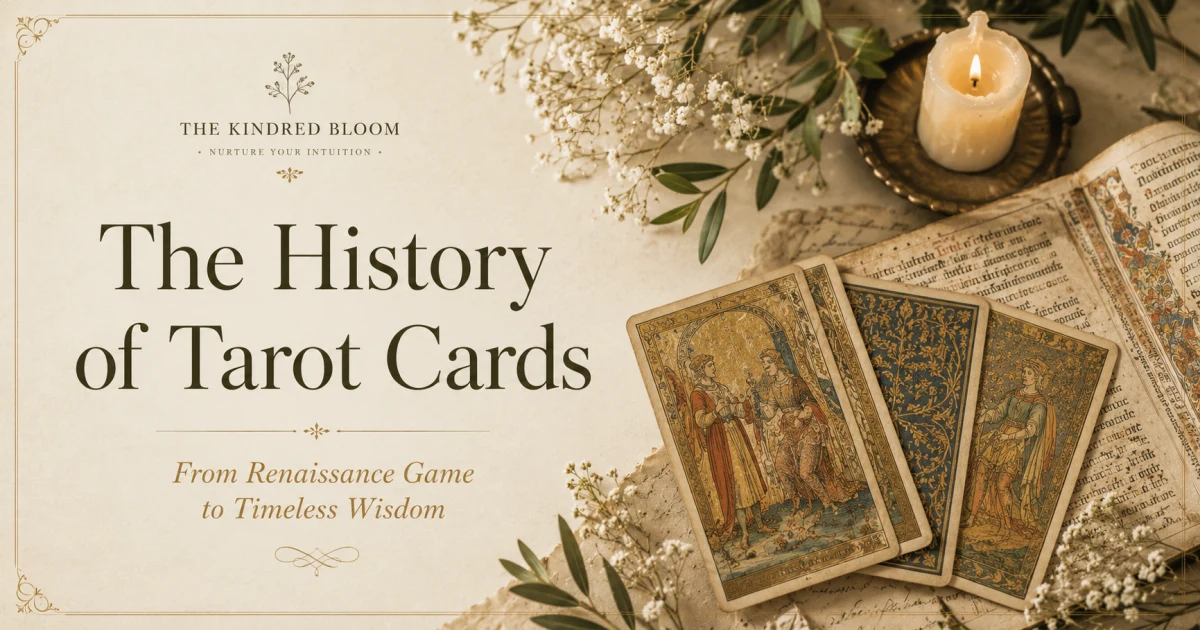
The earliest known tarot cards appeared in northern Italy during the fifteenth century. At the time, they were created for a trick-taking card game enjoyed by wealthy families and members of the nobility. Rather than being designed for readings, these beautifully illustrated cards were simply part of a sophisticated form of entertainment.
Early tarot decks included four familiar suits—Cups, Swords, Batons, and Coins—along with a series of illustrated trump cards. Many of these images, such as emperors, popes, virtues, and allegorical figures, reflected the culture, religion, and art of Renaissance Europe.
Tarot Wasn’t Originally Used for Fortune-Telling
One of the biggest misconceptions about tarot is that it was invented for predicting the future. Historical evidence tells a different story.
For hundreds of years, tarot was primarily used as a card game. It wasn’t until the eighteenth century that scholars, mystics, and occult writers began assigning symbolic and spiritual meanings to the cards. Over time, tarot became associated with astrology, Kabbalah, and other esoteric traditions, gradually transforming into a system for divination and personal insight.
This evolution didn’t happen overnight. It was the result of generations of people interpreting the same images in new and meaningful ways.
Did Tarot Really Come From Ancient Egypt?
You may have heard that tarot originated in ancient Egypt. While this story remains popular, modern historians have found no reliable evidence to support it.
Instead, the earliest documented tarot decks clearly trace back to Renaissance Italy. The Egyptian origin story appeared much later, when writers sought to connect tarot with ancient wisdom and mystical traditions.
Knowing this doesn’t make tarot any less meaningful. Rather, it helps us distinguish between documented history and the symbolic traditions that developed over time. Both are valuable—they simply belong to different parts of tarot’s story.
Why Tarot’s History Still Matters Today
Tarot has never belonged to just one purpose.
For some people, it is a spiritual practice. For others, it is a creative tool, a journaling companion, or a way to reflect on life’s questions. Modern tarot continues to evolve, just as it has throughout history.
Learning about tarot’s origins allows us to see the cards with fresh eyes. Behind every deck is a rich history of artists, players, storytellers, and readers who each added something new to this tradition. That ongoing evolution is part of what makes tarot so timeless.
Thoughts
The history of tarot cards is not the story many people expect. Rather than beginning as a mysterious tool for fortune-telling, tarot started as a Renaissance card game and gradually became a symbolic language that people continue to interpret in their own ways.
Whether you read tarot for spiritual guidance, self-reflection, or simple curiosity, understanding its history adds depth to every card you draw. The symbols may remain the same, but their meanings continue to grow with each generation.
Continue Exploring!
Curious about one of the oldest surviving tarot decks? In the next article, we’ll explore the Visconti-Sforza Tarot and discover why it remains one of the most important decks in tarot history!✨