The Visconti-Sforza Tarot is one of the oldest surviving tarot decks known today. Discover who commissioned these remarkable cards, how they were used, and why they remain one of the most important sources for understanding tarot’s early history.
When exploring the history of tarot, one deck appears again and again: the Visconti-Sforza Tarot.
Although historians cannot identify the very first tarot deck ever created, the Visconti-Sforza Tarot is widely regarded as one of the oldest surviving examples. The cards offer a rare opportunity to see what tarot looked like during the Italian Renaissance, long before it became associated with divination or spiritual practice.
For anyone interested in tarot history, the Visconti-Sforza Tarot is more than a beautiful collection of cards. It provides valuable historical evidence that helps us understand where tarot began and how it gradually evolved over the centuries.
What Is the Visconti-Sforza Tarot?
The name Visconti-Sforza Tarot does not refer to a single complete deck. Instead, it describes a small group of closely related tarot decks created during the middle of the fifteenth century for members of the ruling families of Milan.
Today, surviving cards are preserved in several museums and collections around the world. Because many cards have been lost over time, no complete original Visconti-Sforza deck is known to survive.
Even so, the remaining cards represent some of the earliest physical evidence of tarot available to historians today.
Who Commissioned the Deck?
The decks are named after two influential Renaissance families: the Visconti family and the Sforza family, who ruled Milan during different periods of the fifteenth century.
Scholars generally believe that these decks were commissioned for members of these noble families, possibly to celebrate important occasions such as marriages, political alliances, or other significant events.
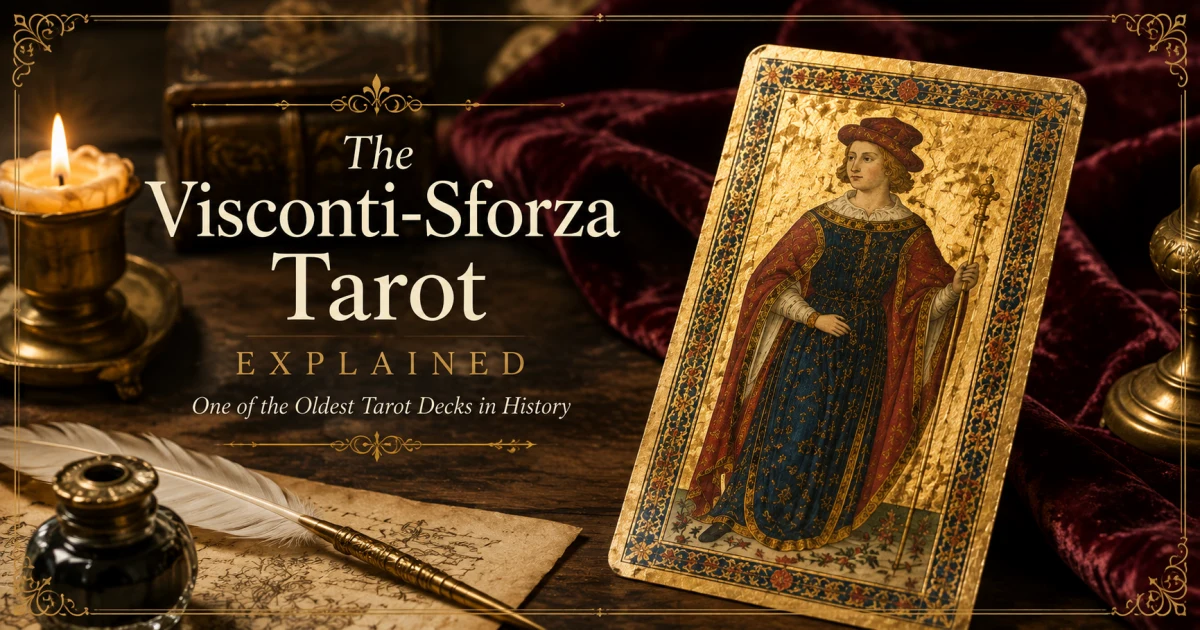
Unlike ordinary playing cards, the Visconti-Sforza cards were individually painted by hand using expensive pigments and gold leaf. Their remarkable craftsmanship suggests that they were luxury objects created for wealthy patrons rather than everyday household use.
Although some details remain uncertain, there is broad scholarly agreement that the decks were produced for Milanese nobility during the Renaissance.
Were These Cards Originally Used for Fortune-Telling?
Based on the historical evidence currently available, there is no clear evidence that the Visconti-Sforza Tarot was originally created for fortune-telling.
Instead, historians generally agree that early tarot decks were used to play tarocchi, a trick-taking card game that became popular in parts of northern Italy during the fifteenth century.
The connection between tarot and divination appears to have developed much later.
This distinction is one of the most important ideas in tarot history. It reminds us that the earliest tarot cards and the modern practice of tarot reading belong to different periods of the cards’ long development.
What Makes the Visconti-Sforza Tarot Unique?
One reason the Visconti-Sforza Tarot remains so important is its remarkable artistic quality.
The cards reflect the culture of Renaissance Italy, featuring richly dressed nobles, delicate decorative patterns, and generous use of gold leaf. Rather than resembling modern playing cards, they often feel closer to illuminated manuscripts or miniature works of art.
Many subjects familiar to modern tarot readers—including the Fool, the Magician, the Empress, the Emperor, and Death—already appear in these early decks. Although the artistic style differs greatly from later tarot traditions, the presence of these figures demonstrates that several key elements of tarot had already taken shape by the fifteenth century.
Studying these cards allows us to see which features of tarot remained surprisingly consistent and which developed over time.
How Is It Different From the Rider-Waite-Smith Tarot?
For many readers today, the Rider-Waite-Smith Tarot, first published in 1909, is the best-known tarot deck.
The Visconti-Sforza Tarot, however, was created more than four centuries earlier and reflects a very different historical context.
One noticeable difference is the Minor Arcana. In the Visconti-Sforza decks, the numbered suit cards are generally decorative rather than fully illustrated with narrative scenes.
By comparison, the Rider-Waite-Smith Tarot introduced illustrated scenes for every card in the Minor Arcana, making symbolic interpretation more accessible for many readers.
Comparing these two decks highlights how tarot evolved over time—not only artistically, but also in the ways people understood and used the cards.
Why Is the Visconti-Sforza Tarot Still Important Today?
Although relatively few people use the Visconti-Sforza Tarot for everyday readings, its historical significance remains extraordinary.
The surviving cards help researchers study the origins of tarot and provide an important reference point for understanding later decks.
They also remind us that tarot has continued to change throughout its history.
History helps explain where the cards came from, while later traditions help explain how many of their symbolic meanings developed. Together, these perspectives offer a fuller understanding of tarot than either could provide on its own.
What Can Beginners Learn From This Deck?
You do not need to own a Visconti-Sforza Tarot deck to appreciate its importance.
Simply recognizing that one of the earliest surviving tarot decks looks very different from modern tarot encourages us to see tarot as something that has evolved rather than remained fixed.
It also helps explain why later decks, such as the Tarot de Marseille and the Rider-Waite-Smith Tarot, share certain features while introducing new artistic styles and symbolic ideas.
Learning about these early decks provides valuable historical context before exploring the many tarot traditions that developed in later centuries.
Continue Exploring
The Visconti-Sforza Tarot represents one of the earliest surviving chapters in tarot’s long history, but it is only the beginning of the story.
If you’d like to continue exploring, you may also enjoy:
- Who Created the First Tarot Deck?
- The History of the Rider-Waite-Smith Tarot
- The History of the Tarot de Marseille
As tarot spread across Europe, new artistic traditions and regional styles emerged. Among them, the Tarot de Marseille would become one of the most influential tarot traditions in history—and the next chapter in tarot’s remarkable journey.