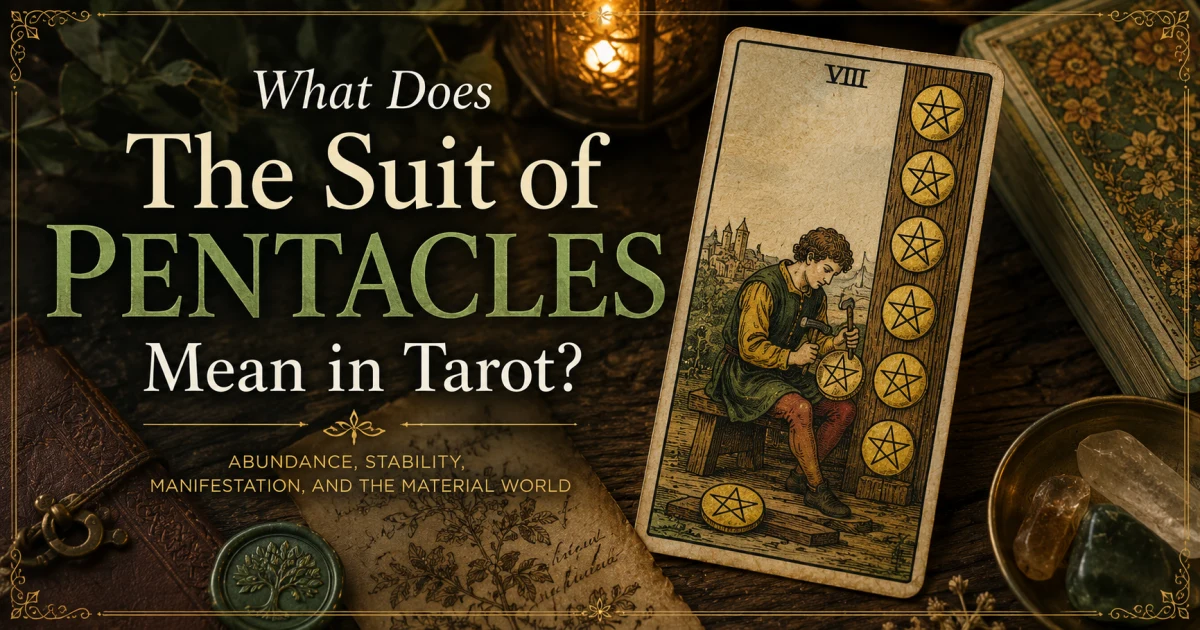
The Suit of Pentacles is commonly associated with the material and practical areas of life, including work, resources, stability, and the physical world. Explore where the suit came from, why it is connected with Earth, and how its symbolism can help you understand the Minor Arcana.
After exploring the energy of Wands, the emotional world of Cups, and the thoughts and decisions represented by Swords, we arrive at the final suit of the Minor Arcana: Pentacles.
Pentacles often brings our attention back to what is tangible. Work, money, possessions, the body, home, resources, and long-term security can all fall within its territory.
In many modern tarot traditions, Pentacles are associated with material resources, practical matters, stability, work, and the physical world. The suit is also commonly connected with the classical element of Earth.
But the pentacle symbol itself was not part of tarot in exactly the same form from the beginning. Earlier tarot traditions commonly used Coins, and the symbolism familiar to many English-speaking tarot readers developed later.
Understanding that history gives us a more complete picture of what Pentacles can represent today.
What Is the Suit of Pentacles?
Pentacles is one of the four suits of the Minor Arcana, alongside Wands, Cups, and Swords.
Like the other suits, it contains 14 cards: the Ace, cards numbered Two through Ten, and four Court Cards—the Page, Knight, Queen, and King.
In modern tarot readings, Pentacles commonly relates to the practical and material aspects of life. This can include finances, employment, education, possessions, physical well-being, home, and the resources we use to create stability.
Money is certainly part of this suit, but it is not the whole story.
Pentacles can also explore effort, patience, skill, responsibility, security, and the process of building something that lasts. In this sense, the suit often asks us to consider not only what we have, but how we create, maintain, and value the resources in our lives.
Where Did the Suit of Pentacles Come From?
The modern name Pentacles can make the suit seem particularly mystical, but its historical roots are more straightforward.
When tarot developed in fifteenth-century Italy, the four suits included Cups, Swords, Batons, and Coins. Coins remained part of several traditional European tarot systems, including the Tarot de Marseille.
The five-pointed star enclosed within a circle—the image many readers now associate with a pentacle—became especially familiar through later occult tarot traditions.
The Rider-Waite-Smith Tarot, published in 1909, uses pentacles prominently throughout the suit, helping establish the name and imagery for generations of English-speaking tarot readers.
This means that the modern Suit of Pentacles can be understood as a continuation of the older Suit of Coins, interpreted through a later symbolic tradition.
The structure remained the same: fourteen cards belonging to one of the four Minor Arcana suits. What changed was some of the imagery and the symbolic framework surrounding it.
Why Are Pentacles Associated With Earth?
In many modern tarot traditions, Pentacles correspond to the classical element of Earth.
Earth provides an intuitive symbolic connection to the physical and material world. It is solid, tangible, and associated with growth that takes place gradually over time.
A seed does not become a tree immediately. It needs soil, nourishment, time, and consistent conditions in which to grow. This makes Earth a useful metaphor for many Pentacles themes: patience, work, resources, stability, and long-term development.
The association can also extend to the body and physical surroundings. Where Swords may draw attention to what we think and Cups to what we feel, Pentacles may ask us to notice what is happening in the practical circumstances of everyday life.
As with the elemental correspondences of the other suits, however, the Pentacles–Earth relationship belongs to later esoteric tarot systems rather than the original purpose of fifteenth-century tarot cards.
It is a meaningful part of modern tarot interpretation, but it should be distinguished from the historical origin of the suit.
What Does Pentacles Represent in a Tarot Reading?
When Pentacles appear in a reading, they often bring attention to something practical, tangible, or connected with resources.
In a career reading, this might involve employment, professional development, skills, income, or the effort required to build something over time.
In a relationship reading, Pentacles could point toward practical stability, shared responsibilities, support, or the material circumstances surrounding a relationship.
In a personal reading, the suit might relate to routines, education, home life, physical needs, possessions, or the way you manage your time and resources.
The exact meaning depends on the individual card and the question being explored.
Rather than automatically reading a Pentacles card as “money,” it can be more useful to ask:
What is being built, maintained, valued, or managed here?
That question often reveals a broader range of possibilities.
Pentacles Represent More Than Money
Money is one of the most recognizable themes associated with Pentacles, and several cards in the suit clearly lend themselves to questions involving finances and material resources.
But limiting the entire suit to money leaves out much of its symbolic range.
Pentacles can relate to work, craftsmanship, learning, responsibility, health, home, security, generosity, and long-term effort. Many of these themes involve resources, but those resources are not always financial.
Time is a resource. So is knowledge. Physical energy, skills, supportive environments, and access to opportunities can also shape what we are able to build.
This broader perspective is particularly helpful when Pentacles appear in readings that have nothing to do with finances.
A Pentacles card in a relationship reading, for example, might highlight reliability or the practical work required to sustain a partnership. In a personal-development reading, it could point toward habits, patience, or building a stronger foundation.
The suit reminds us that much of life is shaped by what we consistently do, maintain, and cultivate.
How the Pentacles Develop From Ace to King
The fourteen Pentacles cards explore different experiences within the material and practical world.
The Ace of Pentacles is commonly associated with a new material opportunity, resource, or foundation. As the numbered cards continue, the suit explores themes involving balance, work, skill, resources, security, hardship, generosity, patience, and long-term achievement.
The Court Cards—the Page, Knight, Queen, and King—can represent people, qualities, roles, or different approaches to the practical themes of the suit.
As with Wands, Cups, and Swords, the cards should not be treated as one perfectly linear story. Each has its own traditional meanings.
Still, understanding the broader character of Pentacles makes those individual meanings easier to place within a larger framework.
What If Many Pentacles Appear in a Reading?
When several Pentacles appear together, practical or material considerations may be especially prominent in the situation.
Depending on the cards and the question, this could relate to work, finances, stability, responsibilities, physical circumstances, or a long-term project that requires sustained attention.
Several Pentacles do not automatically predict financial success or difficulty.
Instead, look at the specific cards. Are resources being gained, shared, protected, or lost? Is effort producing results? Is patience required? Does the situation feel stable, or is security becoming a concern?
The surrounding cards can also show how practical matters interact with other areas of life.
Cups might add an emotional dimension, Swords could highlight decisions or communication, and Wands may introduce motivation or action.
The suit gives us a general area to explore; the complete spread provides the context.
How to Learn the Pentacles Cards
Learning the traditional meanings of the Pentacles cards gives you a reliable foundation for understanding the suit.
Begin with its broad themes: resources, work, stability, the physical world, and long-term development. From there, gradually learn the key meanings of each individual card.
The imagery can then help deepen what you have learned.
In the Rider-Waite-Smith Tarot, notice how pentacles are held, exchanged, displayed, or arranged. Pay attention to the surroundings as well. Buildings, gardens, clothing, tools, and landscapes can all contribute to the practical atmosphere of the cards.
Consider what the figures are doing. Are they working, waiting, giving, receiving, resting, or protecting something?
These details can help you understand how the traditional meanings are expressed visually.
As with the other suits, imagery does not need to replace learned meanings. Instead, knowledge and observation can work together, giving you a stronger foundation for interpreting the cards in different contexts.
Continue Exploring
The Suit of Pentacles completes our introduction to the four suits of the Minor Arcana.
If you’d like to continue exploring, you may also be interested in:
- What Does the Suit of Swords Mean in Tarot?
- What Does the Suit of Cups Mean in Tarot?
- What Do the Four Tarot Suits Mean?
Together, the four suits offer different ways of looking at everyday experience: Wands through energy and action, Cups through emotions and relationships, Swords through thought and communication, and Pentacles through the practical and material world.
Learning these broader themes gives us a foundation for the next stage of our tarot journey: exploring how the individual cards within each suit develop their own meanings.