
Temperance is often summed up with a few familiar words: balance, moderation, patience, and harmony. They are all useful meanings, but if we stop there, we miss something important about the card.
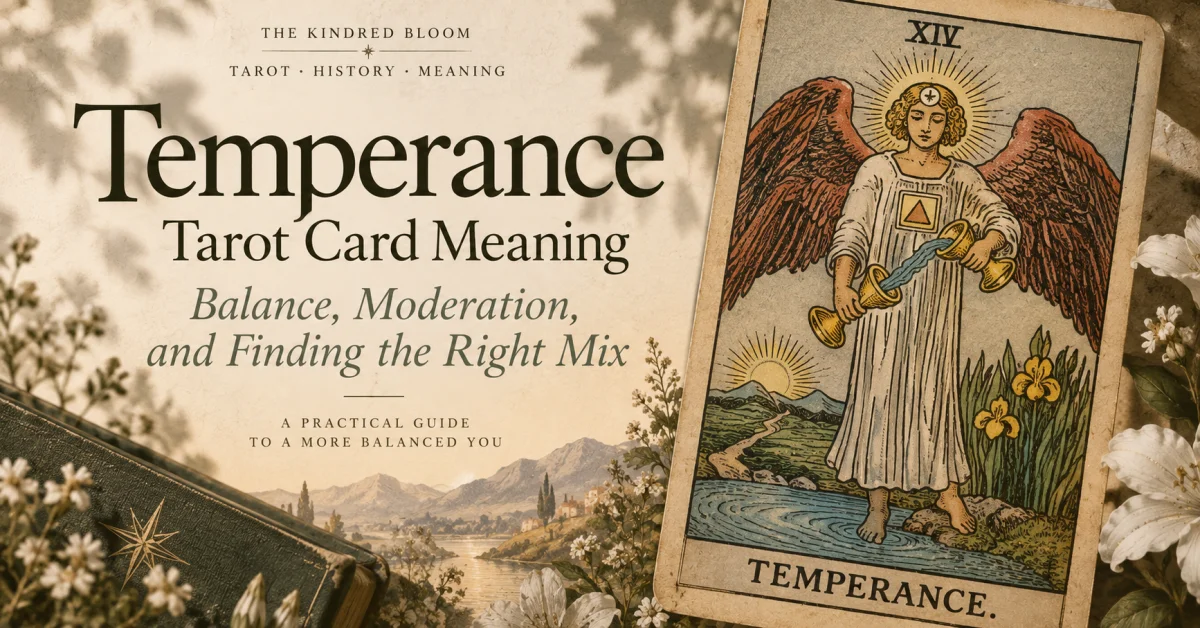
Look closely at the Rider–Waite–Smith image. The angel is not standing perfectly still between two equal objects. Instead, liquid is being poured from one cup into another. One foot rests on land while the other touches the water, and a path stretches into the distance behind the figure. Everything about the card suggests that balance is something being worked out, rather than something already perfected.
That gives us a different way to approach Temperance. Instead of simply asking, Where do I need more balance?, we can ask: What needs to be adjusted so that the different parts of this situation can work together?
Temperance Before Modern Tarot Reading
Temperance has been part of tarot for a very long time. It appears among the trump cards of fifteenth-century Italian decks such as the Visconti-Sforza Tarot, long before tarot developed its modern association with divination.
The idea of temperance itself was already familiar in European culture. Temperance was traditionally counted among the four cardinal virtues, alongside Prudence, Fortitude, and Justice. In art, the virtue was often represented as a female figure associated with restraint and measured behaviour, and pouring or mixing liquid between vessels became one of the visual motifs connected with her.
This historical background helps explain why the card did not begin simply as the modern idea of “work-life balance.” Its roots are closer to measure, restraint, and the careful regulation of excess. Over time, tarot readers expanded those ideas into the broader meanings we now associate with Temperance: harmony, patience, integration, adjustment, and finding a sustainable middle ground.
That does not mean every modern meaning was hidden inside the earliest card. It simply shows how an older idea of temperance could develop naturally into the richer interpretation we use today.
Why Is the Angel Pouring Between Two Cups?
The two cups are probably the most memorable part of Temperance. Liquid moves continuously between them, making the card feel active despite its calm atmosphere.
This is what makes Temperance different from the kind of balance represented by a perfectly even scale. The goal is not necessarily to make two things equal. It is to find the proportion that allows them to work together.
Think about making a cup of coffee. Equal amounts of coffee, water, milk, and sugar would not automatically create the best drink. Depending on what you like, one ingredient may need more and another less. If the taste is wrong, you adjust it.
Temperance works in a similar way. Balance does not always mean 50/50. Sometimes it means finding the right mix.
This can apply to almost anything: work and rest, independence and connection, logic and emotion, saving and enjoying money, planning and spontaneity. The card does not tell us that both sides deserve exactly the same amount. It asks whether the current proportion is actually working.
One Foot on Land, One Foot in Water
The angel stands with one foot on dry land and the other in water. Modern tarot readers often connect water with emotion or intuition and land with practical reality. That can be a helpful way to read the image, but we do not need to make the symbolism more complicated than it has to be.
At the simplest level, the figure is comfortable occupying two different spaces at once. There is no visible struggle to choose one and reject the other.
That is an important part of Temperance. We often think we need to choose between qualities that seem opposite: being ambitious or taking care of ourselves, being independent or close to someone, following intuition or thinking practically. Sometimes a choice really is necessary, but sometimes the problem comes from assuming that the two sides cannot coexist.
Temperance asks whether they can.
Balance Is Not the Same as Giving Everything Equal Attention
The word balance can be misleading because it makes us imagine a perfectly organised life where every area receives equal time and energy. Real life rarely works like that.
Someone preparing for an important exam may need to study much more than usual for a few weeks. A person starting a new job may temporarily give more energy to work. Someone recovering from exhaustion may need the opposite and spend considerably more time resting.
None of these situations is automatically unbalanced simply because the numbers are unequal. What matters is whether the arrangement fits the situation and whether it can continue without creating unnecessary harm.
This is why I find proportion more useful than equality when thinking about Temperance. The card can ask: Does something need less? Does something else need more? Or does the whole mixture need to be rearranged?
Moderation Does Not Always Mean “Do Less”
Temperance is also commonly associated with moderation, which can make the card sound like a warning against excess: spend less, work less, eat less, want less.
Sometimes that interpretation fits. But moderation is not automatically about reducing everything.
Imagine someone who spends almost every evening working and very little time resting. The adjustment might be to work less, but another way of describing exactly the same change is that they need more rest. Someone who has become isolated while pursuing a personal goal may not need to remove another activity from their life; they may need to add connection back into it.
So when Temperance appears, it can be helpful to move beyond What should I cut back on? and ask What is missing from the mixture?
Sometimes balance is restored by taking something away. Sometimes it is restored by adding something back.
Finding a Balance That Can Change
There is also a path behind the angel leading toward the distant horizon. It is easy to focus entirely on the cups and overlook this part of the card, but I think it adds something useful to the overall image.
The angel may appear balanced in this particular moment, yet the path continues. The scene does not feel like a final destination where everything has been solved forever.
That reflects how balance works in real life. The combination that works now may not work six months from now. A new job, relationship, responsibility, or goal can change what we need. Finding balance once does not mean we have discovered a permanent formula.
Temperance is less about achieving balance once and more about learning how to adjust when the balance changes.
What Does Temperance Mean in a Tarot Reading?
In a reading, Temperance often appears when different needs, priorities, people, or approaches have to coexist. It may point toward patience, moderation, cooperation, adjustment, or integration, but the most useful interpretation depends on what is actually being mixed.
Suppose you ask about work. Temperance could draw attention to the relationship between ambition and recovery rather than simply telling you to “work less.” In a relationship, it might highlight how two people with different needs can create enough shared space without expecting either person to give up their individuality. In a creative project, it may suggest bringing together ideas that initially seem unrelated.
But not everything should be combined. Some differences cannot be resolved through endless adjustment, and sometimes a clear decision is healthier than permanent compromise. Temperance is not a command to keep accommodating every situation.
That is why the question matters. Instead of automatically reading the card as find balance, ask:
What am I trying to combine, and can these things realistically work together?
If they can, the next question becomes: What needs to change in the mixture?
Temperance Is Not Exactly the Same as Compromise
Temperance and compromise often overlap, but I would not treat them as exactly the same thing. Compromise usually means that each side gives something up so they can meet somewhere in the middle. Temperance can be broader than that.
Imagine two people who enjoy spending their free time very differently. A simple compromise might be choosing one person’s preferred activity this weekend and the other’s next weekend. But another solution might be spending some time together while also giving each person enough independent time.
Neither arrangement is automatically better. What matters is finding something that genuinely works for the people involved rather than forcing everything into an exact middle point.
That is very Temperance: not necessarily meeting halfway, but discovering the proportion that works.
Temperance After Death
Temperance follows Death (XIII), and putting the two cards next to each other makes their differences easier to understand.
Death asks us to recognise when something can no longer continue in its previous form. Temperance comes afterward and introduces a different problem: What do we do with what remains?
Imagine leaving a job you have held for many years. Death can describe the ending itself—the role, routine, and perhaps even part of the identity attached to it. Temperance becomes relevant when you begin creating a new routine and deciding how work, rest, money, ambition, and personal life will fit together now.
This is a useful modern way to compare the cards rather than proof that the earliest tarot makers intended them as consecutive stages of personal development. But for learning tarot, the contrast is helpful.
Death ends the old arrangement. Temperance experiments with a new one.
Understanding Temperance Beyond “Balance”
If you remember only one thing about Temperance, I would not make it balance. I would remember the liquid moving between the two cups.
The card is not showing us a finished equation. It is showing us adjustment in progress. A little more here, a little less there, perhaps a combination we have not tried before.
Its historical roots in the virtue of temperance give us the ideas of moderation and restraint, while the Rider–Waite–Smith imagery makes it easy to extend those ideas into integration and adjustment. Together, they give us a card that feels much more practical than simply “avoid excess.”
When Temperance appears, try looking at the situation as a mixture. What is overpowering everything else? What has almost disappeared? What needs to be added, reduced, or combined differently?
The goal does not have to be perfect balance.
It just needs to be a mixture that actually works.
Continue Exploring
Temperance follows Death (XIII) in the Rider–Waite–Smith Major Arcana. Death explores endings and the moment when something can no longer continue in its previous form. Temperance turns toward what happens afterward: adjustment, integration, and the search for a new arrangement that can work.
You can also explore The Major Arcana Explained for a broader introduction to the Major Arcana.
Next comes The Devil (XV), where the question changes again. Instead of asking how different parts can work together, The Devil invites us to look at attachment, temptation, restriction, and the things that may have more influence over us than we realise.