
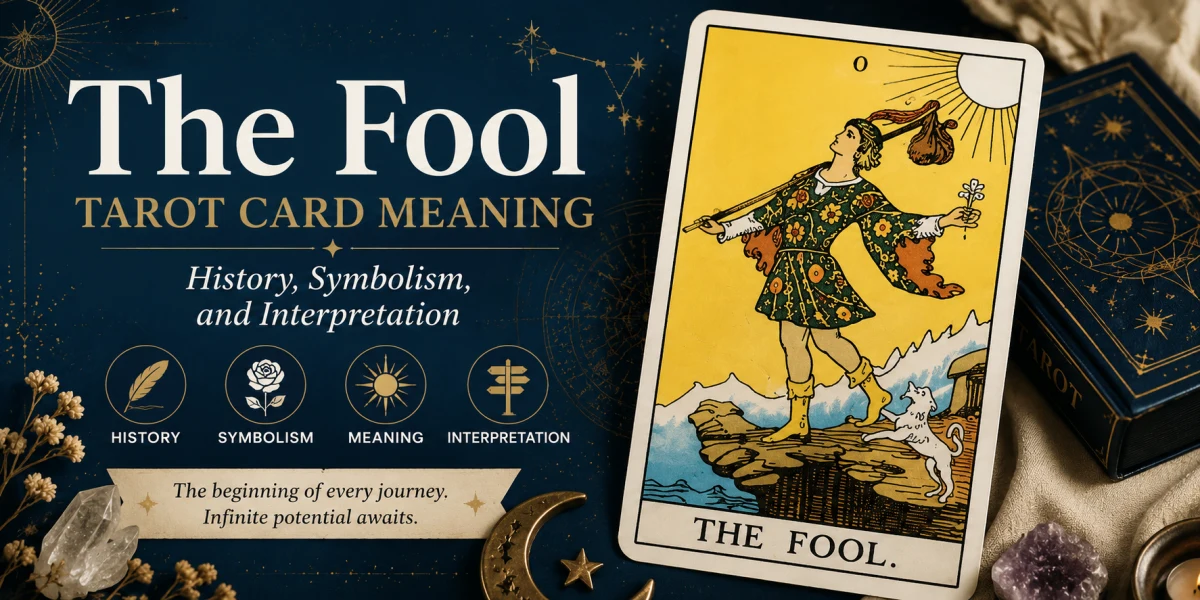
The Fool is often associated with new beginnings, freedom, and possibility. Yet its meaning is more complex than simply taking a leap of faith. From its unusual place in early tarot to the familiar cliffside scene of the Rider–Waite–Smith deck, The Fool invites us to explore what it means to begin without knowing the outcome.
In the Rider–Waite–Smith Tarot, a young traveller stands near the edge of a cliff. A small bundle rests over one shoulder, a white rose is held in one hand, and a dog moves beside the figure.
It is an image many tarot readers recognise immediately.
But The Fool has not always looked this way. Earlier tarot decks depicted the card differently, and its historical role was not the same as its modern position at the beginning of the Major Arcana.
Exploring these changes helps us understand an important distinction: The Fool’s history tells us where the card came from, while its modern symbolism helps us interpret what it may mean in a reading.
The Fool in Early Tarot
The Fool appears among the earliest surviving tarot cards from fifteenth-century Italy.
At the time, tarot was primarily used for card games. The Fool held a special role within those games and did not function in exactly the same way as the numbered trump cards.
This helps explain why The Fool was traditionally unnumbered.
Its appearance also differed from the youthful traveller familiar to modern readers. Depending on the deck, early representations could show a ragged or socially marginal figure, sometimes resembling a wanderer or beggar.
There was no single historical Fool image identical to the modern Rider–Waite–Smith version.
This distinction matters because we should not assume that the card originally carried all the meanings associated with it today.
Ideas such as embracing a new opportunity, trusting the journey, and exploring personal freedom belong largely to later approaches to tarot interpretation.
Why Is The Fool Numbered 0?
In many modern decks, The Fool is numbered 0 and placed at the beginning of the Major Arcana.
Historically, however, it was generally separate from the numbered trump sequence.
Later occult and esoteric approaches increasingly incorporated The Fool into an ordered symbolic system. When the Rider–Waite–Smith Tarot was published in 1909, its Fool was numbered 0.
Within modern tarot interpretation, zero can suggest a state before something has taken shape: an open beginning, an undefined direction, or the possibility of several different paths.
This is a useful symbolic association, but it should not be confused with the card’s original purpose.
The Fool was not originally created as card zero to represent infinite potential.
Its modern meaning developed through changes in tarot’s imagery and interpretation.
How The Fool Changed in the Rider–Waite–Smith Tarot
The Rider–Waite–Smith Tarot gave The Fool the appearance that has influenced many later decks.
Illustrated by Pamela Colman Smith under the direction of Arthur Edward Waite, the card shows a richly dressed young figure approaching a precipice.
The traveller carries a small bundle, holds a white rose, and moves alongside a small dog. Mountains rise in the distance beneath a bright sky.
Compared with many earlier depictions, this Fool appears more idealised and adventurous.
Rather than focusing primarily on a marginal or comic figure, the image presents someone standing at the threshold of an experience.
The change in imagery helps explain why contemporary interpretations often emphasise beginnings, openness, and the willingness to explore.
Yet the cliff remains an essential part of the scene.
The traveller may be moving toward something wonderful—or may not fully understand what lies ahead.
That uncertainty is what makes the card more interesting than a simple symbol of optimism.
Understanding the Symbols in The Fool
The Rider–Waite–Smith image contains several details that can guide a reading.
These interpretations are possibilities rather than fixed rules. Their relevance depends on the question, the surrounding cards, and the reader’s approach.
The Cliff: Possibility and Risk
The Fool stands close to the edge of a cliff, but the image does not reveal what happens next.
This creates a tension between opportunity and danger.
The cliff may suggest the courage needed to enter unfamiliar territory. It can also raise a question about preparation: Is the traveller aware of the edge, or too absorbed in the journey to notice it?
In a reading about a new opportunity, this detail might encourage openness while drawing attention to the practical consequences of a decision.
The card does not automatically say, “Take the leap.”
It invites us to consider both the opportunity and what remains unknown.
The Small Bundle: Travelling Lightly
The Fool carries only a small bundle.
It can suggest freedom from unnecessary baggage, a willingness to leave familiar circumstances behind, or the beginning of an experience for which everything has not yet been prepared.
The bundle also offers a useful contrast: travelling lightly does not necessarily mean travelling with nothing.
When interpreting this symbol, consider what the person may need to carry forward—and what they may be ready to leave behind.
The Dog: Companion, Instinct, or Warning?
The dog beside The Fool can be understood in several ways.
Some readers see it as a loyal companion. Others interpret it as instinct, excitement, or a warning about the nearby cliff.
Rather than assigning the dog one universal meaning, look at its relationship to the traveller.
Does its presence make the scene feel supportive? Does it draw attention to something the traveller may be overlooking?
The answer may change depending on the reading.
The White Rose: Openness and Innocence
The white rose contributes to the image’s delicate, idealised atmosphere.
Modern readers may associate it with innocence, openness, or approaching an experience without established expectations.
These are interpretive associations, not proof that every detail has one universally agreed meaning.
The rose can be especially useful when a reading concerns someone’s intentions or attitude toward a new experience.
The Mountains: The Journey Beyond the First Step
The mountains in the distance suggest that the traveller’s path extends beyond the immediate scene.
A beginning is only one moment in a much longer process.
The mountains can therefore draw attention to challenges, growth, or experiences that have not yet arrived.
Together, the cliff and mountains create an important contrast: the next step may be uncertain, but the journey does not end with that step.
What Does The Fool Mean in a Tarot Reading?
In modern tarot, The Fool is commonly associated with:
- New beginnings and unfamiliar experiences
- Freedom and openness
- Curiosity and exploration
- Spontaneity
- Possibility and uncertainty
- Taking a chance
- Inexperience or insufficient preparation
These keywords are useful starting points, but they are not a complete interpretation.
The Fool is not simply about starting something new. It describes a situation in which the outcome is not yet clear and the person may not have all the experience or information they need.
To understand which aspect matters, return to the image and the question being asked.
For example, imagine The Fool appears in a reading about changing careers.
The card might reflect excitement about entering a new field and a willingness to learn. But the cliff may also bring practical considerations into focus, such as understanding the financial implications or researching the role before making a decision.
The interpretation does not need to be either entirely encouraging or entirely cautionary.
Both possibilities exist within the same image.
The Fool asks us to recognise an opening without pretending that uncertainty has disappeared.
Is The Fool a Positive Card?
The Fool is often viewed positively in contemporary tarot because it suggests freedom, possibility, and a fresh perspective.
However, its meaning depends on context.
Spontaneity can help someone move beyond an overly restrictive routine, but it can also become impulsiveness.
Trust can make a new experience possible, but unquestioning trust may overlook genuine risks.
Likewise, caution can be sensible—or it can prevent someone from moving forward when they are ready.
The card is therefore more useful as an invitation to examine the balance between openness and awareness than as a simple prediction of a good or bad outcome.
What About The Fool Reversed?
Not every tarot reader uses reversed cards, and there is no single required way to interpret them.
For readers who do use reversals, The Fool reversed may highlight either an excess or a restriction of the card’s usual qualities.
It might suggest rushing into something without preparation, overlooking consequences, or acting impulsively.
Alternatively, it may point to hesitation, fear of uncertainty, or difficulty taking an initial step.
These interpretations seem opposite, but both concern the way a person responds to the unknown.
The question and surrounding cards help clarify which reading is relevant.
A reversed Fool should not automatically be treated as a negative prediction.
Is The Fool the Beginning of the “Fool’s Journey”?
The Fool’s Journey is a popular framework that presents The Fool as a traveller moving through the Major Arcana, encountering experiences and lessons along the way.
It can be a helpful way to study relationships between the cards.
However, it is a later interpretive framework rather than an established account of tarot’s original purpose.
There is no surviving evidence demonstrating that fifteenth-century tarot creators designed the Major Arcana as a twenty-two-stage spiritual journey beginning with The Fool.
We can appreciate the Fool’s Journey as a modern learning tool without presenting it as the historical origin of the cards.
What Should You Remember About The Fool?
The Fool is often summarised as a card of new beginnings, but its deeper meaning lies in the relationship between possibility and uncertainty.
The traveller has not yet reached a destination. The path is open, and the outcome remains unknown.
The cliff reminds us that freedom does not eliminate risk. The small bundle suggests that we do not need to carry everything from the past. The dog introduces questions about companionship, instinct, and awareness.
When The Fool appears in a reading, consider what kind of beginning is taking place—and what the person may need to notice before moving forward.
The card does not promise success or demand a leap of faith.
It reminds us that every unfamiliar journey begins before we know exactly where it will lead.
Continue Exploring
The Fool is only the beginning of our journey through the individual Major Arcana cards.
If you’d like more background before continuing, you may also enjoy The Major Arcana Explained, The History of the Rider–Waite–Smith Tarot, and Who Was Pamela Colman Smith?
Next, we’ll explore The Magician, a card that shifts from The Fool’s open possibility toward intention, skill, and the use of the resources at hand.