Some tarot cards seem to ask us to take action. Others ask us to pause, reflect, or make a choice. The Wheel of Fortune is different. It reminds us that sometimes, things change whether we are ready for them or not.
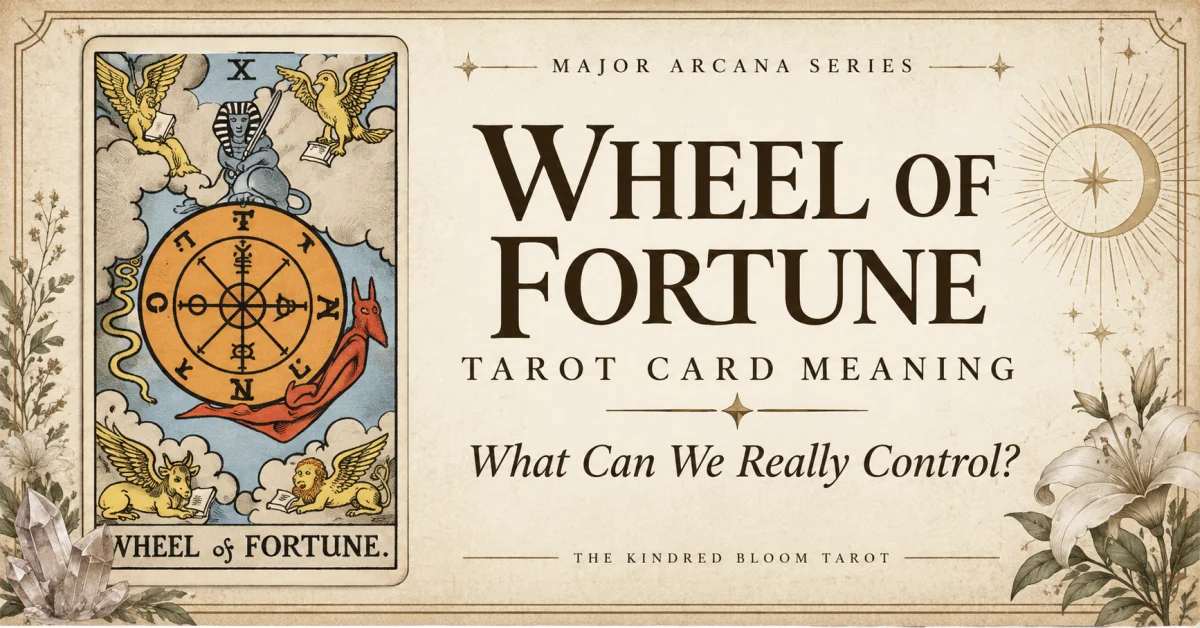
In the Rider-Waite-Smith Tarot, the Wheel of Fortune is filled with movement and symbolism. A large wheel dominates the card. Strange creatures surround it. Figures rise and fall around its edges, while four winged beings sit calmly in the corners.
At first glance, it can be tempting to reduce the Wheel of Fortune tarot card meaning to one simple word: luck.
And luck can certainly be part of the card. The Wheel of Fortune may appear when circumstances shift unexpectedly, an opportunity arrives, or events seem to move in our favor. But the card becomes much more interesting when we look beyond the idea of being simply “lucky” or “unlucky.”
The wheel is always capable of turning.
Someone at the top can move downward. Someone at the bottom can rise. A difficult period can change, but so can a comfortable one. The Wheel of Fortune therefore speaks not only about fortune, but also about cycles, uncertainty, movement, and our relationship with forces we cannot completely control.
That leads to one of the most useful questions we can ask when this card appears:
What is changing—and what part of this situation is actually within my control?
Wheel of Fortune at a Glance
Card: X — Wheel of Fortune
Major Arcana Number: 10
Element: Traditionally associated with Fire in the Golden Dawn system
Astrological Association: Jupiter
Traditional Keywords: Change · Cycles · Fortune · Turning Point · Opportunity · Destiny · Movement
The Wheel of Fortune is the tenth card of the Major Arcana. It follows The Hermit, a card associated with introspection, solitude, and the search for wisdom.
The transition between these two cards is particularly interesting.
The Hermit turns inward and searches for understanding. The Wheel of Fortune reminds us that even after we have reflected, prepared, and learned, the world around us continues to move.
We can understand ourselves better.
We can make thoughtful decisions.
But we cannot control every circumstance that enters our lives.
The Wheel of Fortune in the Rider-Waite-Smith Tarot
The Rider-Waite-Smith Wheel of Fortune is one of the more symbolically dense cards in the deck.
At its center is a large wheel containing letters and alchemical symbols. Around the wheel are several unusual figures, including a serpent descending on one side, a figure rising on the other, and a sphinx positioned at the top.
In each corner of the card is a winged figure associated with one of the four living creatures described in biblical visionary imagery: a human or angel, an eagle, a lion, and an ox. Each holds a book.
These figures are also traditionally connected with the four fixed signs of the zodiac: Aquarius, Scorpio, Leo, and Taurus.
There is a striking contrast here.
The wheel moves.
The creatures around it rise and fall.
Yet the four figures in the corners appear comparatively steady.
This difference between movement and stability gives us an important way to approach the card. Circumstances may be changing, but not everything changes at the same speed—or in the same way.
What Do the Letters on the Wheel Mean?
The wheel itself contains several letters, including T, A, R, and O.
Because they are arranged around a circle, they can be read and rearranged in different ways. The design has consequently inspired numerous symbolic interpretations.
The wheel also contains Hebrew letters associated with the divine name often transliterated as YHWH, along with symbols connected to alchemical traditions.
Rather than assuming that every symbol has one single hidden message, it is more useful to recognize what the overall design accomplishes.
The wheel becomes more than a physical object.
It represents a world in which different systems, forces, and patterns are constantly interacting.
And at the center of all that complexity is movement.
The Wheel of Fortune Before the Rider-Waite-Smith Tarot
The idea of the Wheel of Fortune is much older than the Rider-Waite-Smith Tarot.
The concept is often known by the Latin name Rota Fortunae, or the Wheel of Fortune. In medieval European art and literature, Fortune was frequently imagined turning a wheel that raised some people while bringing others down.
The image expressed a simple but uncomfortable truth: status and circumstances can change.
A person who is powerful today may not remain powerful forever. Someone experiencing hardship may later rise. Human fortune is unstable.
Early tarot decks inherited this already-established visual tradition rather than inventing the wheel as an entirely new tarot symbol.
This historical background matters because it helps us see why the Wheel of Fortune is about more than getting lucky.
The deeper idea is changeability.
Fortune turns.
Wheel of Fortune Tarot Card Meaning
When the Wheel of Fortune appears in a reading, something may be shifting.
Sometimes the shift is obvious: a new opportunity, a change in circumstances, an unexpected meeting, a change of direction, or the end of one phase and beginning of another.
Other times, the movement is subtler. You may simply realize that a situation cannot remain exactly as it is.
The Wheel of Fortune can therefore represent a turning point.
But a turning point does not automatically tell us whether the outcome will be good or bad.
That distinction is important.
If we memorize only:
Wheel of Fortune = good luck
we may miss much of what the card is showing us.
Instead, try:
Wheel of Fortune = the situation is moving.
Then look at the surrounding cards and the question being asked to understand where that movement may be leading.
Is the Wheel of Fortune Really About Destiny?
The Wheel of Fortune is frequently associated with fate and destiny, but those words can easily become more absolute than the card requires.
Drawing this card does not necessarily mean that an event has been predetermined and cannot be changed.
A more practical interpretation is that the card recognizes something we experience constantly in real life: our choices matter, but our choices are not the only forces shaping what happens to us.
We cannot choose every opportunity that appears.
We cannot control another person’s decisions.
We cannot guarantee that careful plans will unfold exactly as expected.
Timing, circumstances, other people, chance, and larger social conditions can all affect an outcome.
The Wheel acknowledges that uncertainty.
But acknowledging what we cannot control is not the same as saying that we have no agency at all.
And this is where the card becomes especially useful.
What Can We Control—and What Can’t We Control?
Imagine standing beside a turning wheel.
You may not be able to stop the wheel from moving, but you can still decide how you respond to its movement.
That distinction is at the heart of how I like to read the Wheel of Fortune.
Suppose you unexpectedly receive a job opportunity.
You did not control the timing of the offer.
But you can decide whether to investigate it, negotiate, accept it, or decline it.
Or imagine that circumstances change in a relationship.
You cannot completely control what another person feels or chooses.
But you can control how honestly you communicate, what boundaries you establish, and what you decide to do next.
The Wheel of Fortune can therefore invite us to divide a situation into two parts:
What is moving beyond my control?
and
What can I still choose?
Sometimes the greatest source of frustration is trying to control the first category while ignoring the second.
The Top of the Wheel Is Not Permanent
There is another lesson hidden in the wheel itself.
No position lasts forever.
When life is difficult, the Wheel of Fortune can remind us that the present moment is not necessarily permanent.
But the same principle applies when things are going well.
Success, comfort, and opportunity should not automatically be treated as permanent either.
This does not make the Wheel a pessimistic card.
Instead, it makes it a card of perspective.
Enjoy favorable circumstances when they arrive. Learn from difficult periods when you can. Prepare where preparation is possible.
But remember that life moves.
The wheel turns precisely because it is a wheel.
Reading the Wheel of Fortune in Different Situations
In a career reading, the Wheel of Fortune may indicate a changing environment, an unexpected opportunity, a shift in responsibilities, or circumstances that alter your professional direction. Rather than immediately labeling the change as positive or negative, ask where the movement is taking place and how much influence you actually have over it.
In a relationship reading, the card may point to a change in the relationship’s rhythm or circumstances. Something that has felt stagnant may begin moving, or outside events may affect the connection. Again, the surrounding cards are important.
In a personal growth reading, the Wheel can highlight your relationship with uncertainty itself. Do you adapt when circumstances change, or spend your energy trying to return everything to exactly how it was?
And in a reading about a decision, the Wheel may suggest that timing and external circumstances deserve more attention than usual.
The card does not necessarily say, “Leave everything to fate.”
It may instead say:
Recognize the forces you cannot control so that you can use your choices more wisely.
How to Read the Wheel Instead of Memorizing It
It is still useful to memorize a few foundational meanings:
Change · Cycles · Turning point · Fortune · Opportunity · Movement
These keywords give you somewhere to begin.
But once you know them, return to the image.
Where would you place yourself on the wheel?
Are you rising, falling, or trying desperately to stay in one position?
What around you is moving?
What remains steady?
And perhaps most importantly:
Are you trying to control the wheel—or deciding what to do while it turns?
Those questions can tell you much more than the word “luck” alone.
Questions to Ask When the Wheel of Fortune Appears
When you draw the Wheel of Fortune, consider asking yourself:
- What is changing in this situation?
- What part of this change is outside my control?
- What choices are still available to me?
- Am I resisting a cycle that has already begun to shift?
- Is an unexpected opportunity appearing?
- What have I been treating as permanent that may actually be temporary?
The goal is not to predict every turn of the wheel.
It is to understand where you stand while it is turning.
The Wheel Keeps Turning
The Wheel of Fortune can certainly bring fortunate developments. Sometimes the timing works in our favor. A door opens unexpectedly, circumstances improve, or something that felt stuck begins moving again.
But its message is larger than “good luck is coming.”
The wheel reminds us that life contains cycles we participate in but do not completely command.
That can feel unsettling—but it can also be freeing.
We do not have to control every variable before taking the next step.
Sometimes our task is simply to recognize what has changed, accept what we cannot determine, and make the best choice available from where we are now.
The Wheel of Fortune does not ask us to control the wheel. It asks us to understand how we move with it.
Continue Exploring
Continue your journey through the Major Arcana and the foundations behind the cards:
The Hermit Tarot Card Meaning: Solitude, Wisdom, and the Search Within
What Is the Major Arcana? A Beginner’s Guide to the 22 Cards
The History of Tarot Cards