
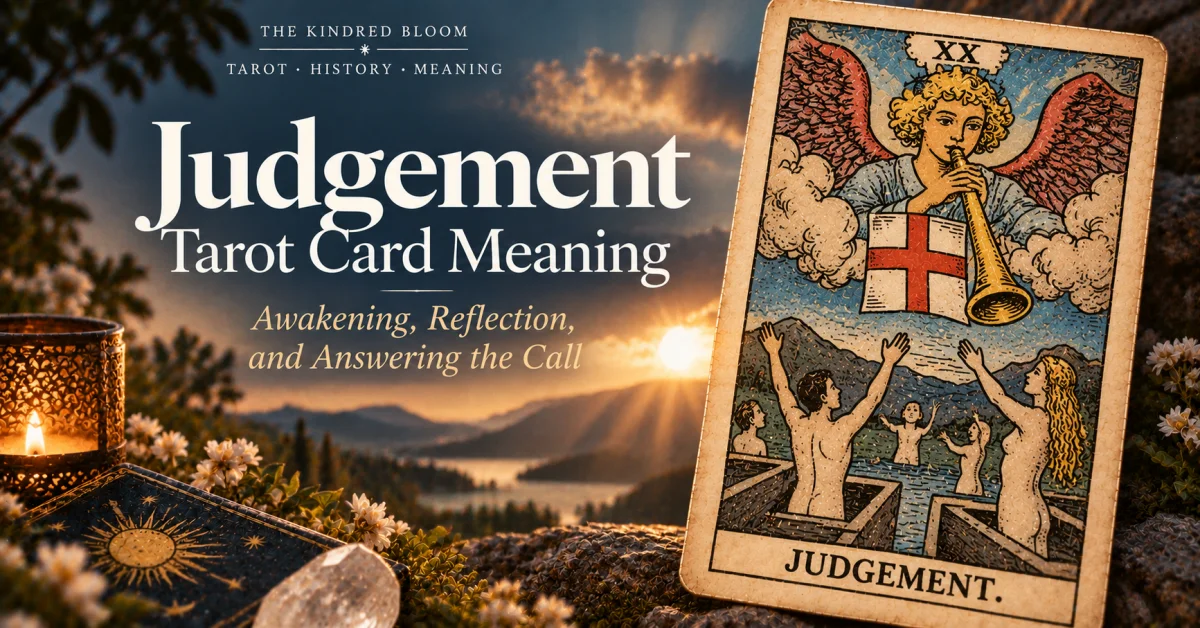
Judgement is one of the most striking cards in the Major Arcana. An angel appears in the clouds, sounding a trumpet, while people rise from their coffins below. Their arms are raised toward the sky, and the entire scene feels as though something important is taking place. Unlike the peaceful atmosphere of The Sun, Judgement has a sense of urgency. Something has been announced, and the figures are responding to it.
The card is often associated with awakening, rebirth, reflection, and second chances. These meanings make sense, but I think there is more to Judgement than the idea of starting over. What interests me most is the moment between recognising something and deciding what to do about it. We can spend years knowing that something in our lives needs attention without ever feeling ready to address it. Judgement reminds me of the point when that awareness becomes difficult to ignore.
The History Behind the Judgement Tarot Card
Judgement has a long history in tarot, and its traditional imagery comes from the Christian Last Judgement. In European religious art, angels sounding trumpets and the dead rising from their graves were familiar representations of resurrection and divine judgement. These images would have been recognisable in the cultural world where early tarot developed.
Tarot originated as a card game in fifteenth-century northern Italy, long before the personal and psychological readings familiar today. The original religious imagery should therefore be distinguished from modern interpretations involving self-discovery, personal growth, and second chances.
In the Rider–Waite–Smith Tarot, published in 1909, Pamela Colman Smith retained the familiar scene of an angel sounding a trumpet above people rising from open coffins. The trumpet carries a flag marked with a red cross, while additional figures appear in the distance. The image has a sense of scale that makes it feel different from a private moment of reflection. Whatever is happening seems to reach everyone in the scene.
The Meaning of the Trumpet
The trumpet is probably the most important detail in Judgement. It is not a quiet symbol that someone might overlook. A trumpet is meant to be heard, and in the religious tradition behind the card, its sound announces the resurrection of the dead.
In modern tarot readings, I find the trumpet useful as an image of recognition. Sometimes we receive information that changes everything immediately. More often, though, we already know something is wrong or no longer suitable, but we have become used to living around it. A job no longer feels meaningful, a relationship needs an honest conversation, or a goal we once cared about has stopped reflecting who we are.
The realisation may not be new. What changes is our willingness to take it seriously. That is how I tend to understand the call in Judgement: something that has been waiting for our attention finally becomes important enough to respond to.
Awakening Does Not Always Lead to Immediate Change
Awakening is one of the most common keywords associated with Judgement, but recognising something and changing our circumstances are not the same thing. We can understand a situation perfectly well and still need time to decide what to do.
Someone might realise that they have been making career decisions mainly to meet other people’s expectations. That understanding could be important, but it does not mean they should immediately resign from their job. Financial responsibilities, family circumstances, and practical limitations still matter. Sometimes the first step is simply acknowledging that the direction they have been following no longer feels right.
The figures rising from their coffins make this distinction interesting. They are not shown arriving somewhere new or celebrating a completed transformation. They are just beginning to rise. I think that is a more realistic way to understand awakening. A meaningful change in perspective can happen long before the rest of our lives catches up with it.
Why Are People Rising From Coffins?
The coffins are among the most recognisable elements of the card. In its historical religious context, the scene represents resurrection, but modern readers may also connect it with leaving behind an earlier stage of life.
I would be careful about interpreting that earlier stage as something entirely negative. Not everything we leave behind was a mistake. Sometimes a goal that once motivated us no longer feels important. A way of thinking that helped us through a difficult period may become limiting later. Even a decision we would not make today might have been reasonable with the knowledge and circumstances we had at the time.
This is one of the things I appreciate about Judgement. It allows us to look at the past without necessarily rejecting it. We can recognise that something has served its purpose and still be grateful for what it gave us.
Looking Back Without Blaming Yourself
Reflection is an important part of Judgement, especially when we begin to understand how earlier decisions have shaped our present circumstances. Looking back can help us recognise mistakes, appreciate progress, and notice patterns we were too close to see at the time.
But there is a difference between reflecting honestly and repeatedly criticising ourselves. If someone realises that they ignored their own needs in a past relationship, that understanding might help them communicate differently in the future. It does not mean they were foolish for caring about the other person, or that every good memory from the relationship was meaningless.
I think Judgement is most useful when reflection leads somewhere. We can acknowledge what happened, take responsibility where appropriate, and decide what we want to carry forward. Spending endless time deciding whether our past selves were good or bad rarely helps us make better choices now.
Does Judgement Mean a Second Chance?
Judgement is often described as a card of second chances, and that interpretation can be meaningful. Someone might return to an unfinished project, reconsider an opportunity, or find themselves facing a familiar situation with a different perspective.
However, a second chance does not necessarily mean getting back exactly what was lost. A relationship may have ended permanently, a previous opportunity might no longer exist, and some choices cannot be undone. Sometimes the opportunity is not to return to the past but to respond differently in the present.
A person who once avoided difficult conversations, for example, might learn to communicate more openly in a new relationship. They have not erased what happened before, but they are no longer approaching the same problem in the same way. To me, that is a perfectly meaningful form of renewal, even if it does not look like the dramatic rebirth shown in the card.
Judgement and Justice: Two Different Kinds of Evaluation
Judgement and Justice are easy to confuse because their names both suggest evaluation. Looking at their images, however, reveals an important difference.
Justice sits with scales and a sword. The scales suggest weighing information carefully, while the sword represents the decision that follows. In a reading, Justice is particularly useful when considering fairness, evidence, responsibility, and the consequences of our choices.
Judgement has a very different atmosphere. Rather than a seated figure evaluating a situation, we see people responding to a call. The emphasis is less on deciding what is fair and more on recognising something significant enough to reconsider how we live or act.
Consider someone reflecting on a mistake at work. Justice might encourage them to examine what happened, what responsibilities were involved, and what a fair response would be. Judgement might become relevant when that experience helps them recognise a larger pattern and decide to approach their work differently.
These are modern interpretive distinctions rather than fixed historical rules, but they can be useful when learning how the two cards work in a reading.
When an Important Realisation Feels Uncomfortable
We often imagine awakening as an inspiring experience, but important realisations are not always pleasant. Sometimes they involve disappointment, regret, or the uncomfortable feeling that something familiar no longer fits.
You might realise that you have been pursuing a goal mainly because it impressed other people. Perhaps you have stayed in a situation because changing it would require a difficult conversation. Or you might finally recognise a strength you have been reluctant to acknowledge because accepting it would mean taking on a new responsibility.
None of these experiences guarantees an easy next step. Understanding what needs attention does not automatically tell us how to address it. Judgement can describe the significance of that recognition without suggesting that every problem should be resolved immediately.
What Does Judgement Mean in a Tarot Reading?
In contemporary tarot, Judgement is commonly associated with awakening, reflection, renewal, accountability, important decisions, and second chances. When I interpret this card, I usually look at what has become difficult to ignore. Has something changed in the way the person understands their situation? Are they reconsidering an old decision, recognising a pattern, or preparing to respond differently?
In a career reading, Judgement may relate to reviewing professional goals, recognising how much someone has developed, or deciding whether their current direction still suits them. In a relationship reading, it might reflect an honest conversation, a reassessment of past behaviour, or an opportunity to approach a familiar issue with greater awareness. It does not automatically predict reconciliation or the return of someone from the past.
For personal readings, I find Judgement especially relevant when someone is reconsidering an identity or belief they have carried for a long time. The question is not always whether their previous choices were right or wrong. Sometimes it is simply whether those choices still make sense for the person they have become.
Judgement After The Sun
The Sun and Judgement both have a strong sense of openness, but their emphasis is different. The Sun is associated with vitality, confidence, enjoyment, and the relief of understanding where we stand. Judgement takes that awareness into a more reflective space.
Knowing what matters to us can be valuable on its own. At other times, that understanding changes the decisions we are willing to make. Someone may recognise that they genuinely enjoy creative work, for example, and begin questioning whether their current career leaves enough room for it. They may not change jobs immediately, but their priorities have shifted.
This is how I find the two cards useful together. The Sun can represent the experience of seeing something more clearly, while Judgement explores what happens when that understanding begins to influence our choices. It is a modern way of comparing the cards, not evidence that the earliest tarot makers deliberately arranged them as a psychological journey.
Understanding Judgement Beyond “Awakening”
Judgement is a dramatic card, but the experiences it describes do not always look dramatic from the outside. Most of us have had moments when something we already knew suddenly felt too important to keep overlooking. Sometimes that leads to a major decision. Other times, it begins with a quiet change in how we think about ourselves.
I don’t see Judgement as a demand to become a completely different person overnight. We can recognise what needs to change while still respecting the responsibilities and limitations of our present circumstances. We can also look back at our earlier choices without treating every mistake as proof that we failed.
What makes the card meaningful to me is the connection between awareness and response. Understanding something about our lives matters most when we begin allowing that understanding to shape what we do next.
Continue Exploring
Judgement follows The Sun (XIX) in the Rider–Waite–Smith Major Arcana. The Sun explores clarity, vitality, and the freedom that comes with understanding where we stand. Judgement turns toward reflection and the choices we make when that understanding begins to change our priorities.
You can also explore The Major Arcana Explained for a broader introduction to the Major Arcana.
Next comes The World (XXI), the final card of the Major Arcana. Rather than treating it simply as a card of success or a happy ending, we can explore what completion really means and why finishing something does not necessarily mean that every part of life is resolved.