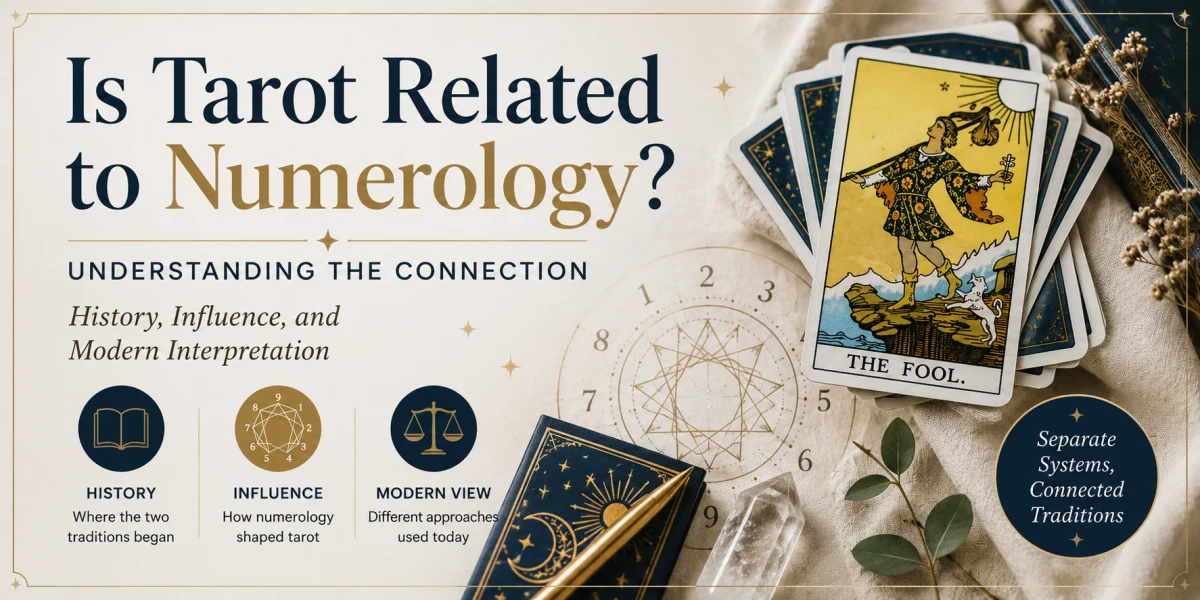
Many beginners notice that tarot cards are numbered and wonder whether tarot and numerology are the same thing. While the two traditions are connected in important ways, they have different histories and developed independently. Understanding that relationship provides useful context for studying the Minor Arcana.
If you’ve spent any time learning tarot, you’ve probably come across the idea of numerology.
Many tarot books describe the numbers on the Minor Arcana using themes such as beginnings, balance, growth, challenge, or completion. Because of these recurring patterns, it’s natural to wonder whether tarot is simply another form of numerology.
The short answer is no.
Tarot and numerology are related, but they are not the same system.
Understanding how the two became connected helps explain why numbers are important in modern tarot while also placing those interpretations within their historical context.
What Is Numerology?
Numerology is the practice of exploring symbolic meanings associated with numbers.
Different numerological traditions have developed in different cultures and historical periods, and they do not all interpret numbers in exactly the same way.
In Western traditions, numbers are often understood as representing broad symbolic ideas rather than simply quantities.
For example, the number one is commonly associated with beginnings or unity, while two is frequently connected with duality, balance, or relationship.
These themes are not mathematical rules. Instead, they are symbolic interpretations that have developed over time.
Were Tarot Cards Originally Based on Numerology?
Based on the historical evidence available today, no.
The earliest surviving tarot decks appeared in northern Italy during the fifteenth century as playing cards.
Like other card games of the period, tarot used numbered cards to organise each suit from Ace through Ten, followed by four Court Cards.
There is currently no convincing historical evidence that the earliest tarot decks were designed around a system of numerological symbolism.
In other words, the cards had numbers because they were playing cards—not because they were originally intended to express numerological ideas.
This distinction is important because it reminds us that the history of tarot and the history of modern tarot interpretation are not exactly the same story.
So How Did Tarot Become Connected to Numerology?
The connection developed gradually.
During the eighteenth and nineteenth centuries, interest in tarot shifted beyond card games and toward symbolism, philosophy, and esoteric traditions.
Writers such as Etteilla began developing systems for tarot interpretation, while later figures and organisations—including Éliphas Lévi and the Hermetic Order of the Golden Dawn—explored relationships between tarot and other symbolic systems.
These systems included numerology, Kabbalah, astrology, and various philosophical traditions.
Rather than replacing tarot’s earlier history, these ideas added new layers of interpretation that continue to influence many modern tarot readers.
Does Every Tarot Reader Use Numerology?
Not necessarily.
Some readers study numerology in depth and actively incorporate it into their tarot practice.
Others rely primarily on the imagery of the cards, traditional card meanings, intuitive observation, or the context of a reading.
Many readers combine several of these approaches.
Because tarot has developed through many different traditions, there is no single method that every reader follows.
This diversity is one reason tarot continues to be interpreted in different ways around the world.
How Do Tarot Numbers Work Today?
Today, many tarot readers view the numbers as one layer of meaning among several.
When interpreting a Minor Arcana card, readers may consider:
- the symbolism traditionally associated with the number
- the symbolism of the suit
- the card’s imagery
- the surrounding cards
- the question being asked
For example, the Three of Cups and the Three of Pentacles both carry the number three.
Many traditions associate three with ideas such as growth or development.
However, each card expresses those themes differently because the suits represent different areas of experience.
Rather than determining the meaning on their own, the numbers work together with the card’s other elements.
Why Is This Distinction Important?
Understanding the relationship between tarot and numerology helps avoid two common misunderstandings.
The first is the belief that tarot has always been based on numerology.
Current historical evidence does not support that conclusion.
The second is the belief that numerology has no place in tarot at all.
Modern tarot traditions have clearly been influenced by numerological ideas, even though tarot itself has its own separate history.
Recognising both parts of the story allows us to appreciate tarot more accurately.
It reminds us that tarot has evolved over centuries, with different generations adding new ways of understanding the cards.
Should Beginners Learn Numerology?
Learning numerology can certainly deepen your understanding of tarot, but it is not a requirement for beginning your tarot journey.
Many readers first build a solid foundation by learning the structure of the tarot deck, the suits, the Major and Minor Arcana, and the traditional meanings of the cards.
As their confidence grows, they may gradually explore additional systems—including numerology—to enrich their understanding.
Approaching tarot in this way allows each layer of knowledge to build naturally upon the one before it.
Continue Exploring
Numerology has influenced many modern approaches to tarot, but it is only one part of a much larger tradition.
If you’d like to continue exploring, you may also enjoy:
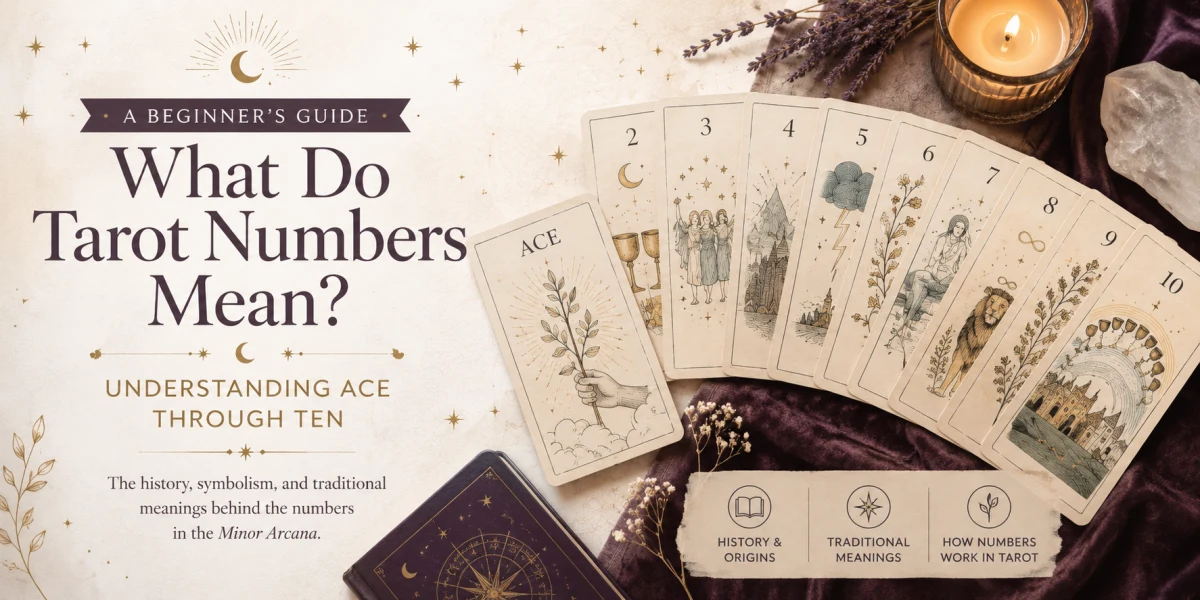
Understanding where numerology fits within tarot’s history provides a helpful foundation for exploring how the numbered cards are interpreted today.