If you’ve ever been curious about tarot, you’re not alone!
For many people, tarot feels both fascinating and a little mysterious. The beautiful artwork, unfamiliar symbols, and stories about predicting the future can make it difficult to know where to begin.
That was true for me as well.
As I started learning about tarot, I realized there was much more to it than I had first imagined. The more I studied, the more I discovered that tarot is not simply about finding answers. It’s also about asking thoughtful questions, understanding symbolism, and seeing familiar situations from a new perspective.
I created The Kindred Bloom as a place to organize what I’m learning and to share that journey with others. Whether you’re simply curious or have just picked up your first deck, I hope this space makes tarot feel a little more approachable.
Let’s begin with the most basic question!
Understanding Tarot Cards
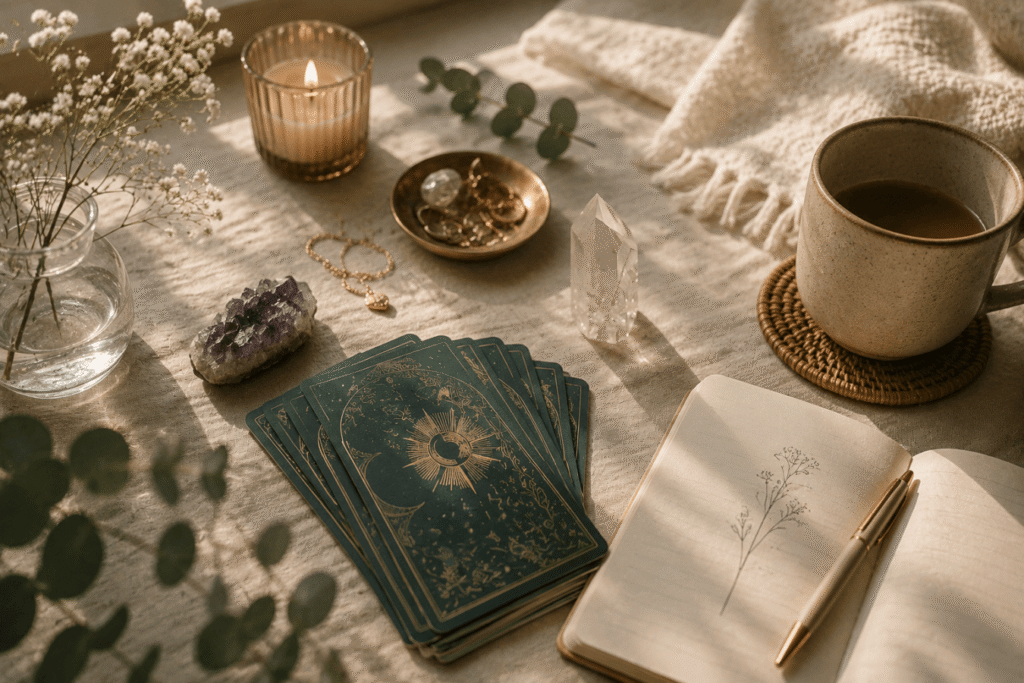
At its simplest, tarot is a deck of illustrated cards used for reflection, interpretation, and exploration.
A traditional tarot deck contains 78 cards, each with its own imagery, symbolism, and history. During a reading, cards are drawn in response to a question or situation, and their meanings are interpreted within that context.
While each card has traditional meanings, tarot isn’t simply about memorizing definitions. The surrounding cards, the question being asked, and the symbolism within the artwork all contribute to a reading.
That’s one of the reasons tarot continues to fascinate so many people. The more you learn, the more connections you begin to notice.
People also approach tarot in different ways.
Some see it as a spiritual practice. Others use it for self-reflection, creativity, or simply as a way to slow down and think more deeply about their experiences.
In recent years, some therapists, counselors, and coaches have also used tarot as a reflective conversation tool. The cards can sometimes help people express thoughts or emotions that are difficult to put into words.
There isn’t one single “correct” way to understand tarot. Throughout this website, we’ll explore these different perspectives together.
Does Tarot Predict the Future?
This is probably one of the most common questions people ask.
The short answer is: it depends on who you ask.
Some readers believe tarot can reveal possible future outcomes. Others see tarot as a way of understanding the present more clearly rather than predicting what will happen.
Personally, one of the things I appreciate most about tarot is that it encourages reflection. Rather than giving me absolute answers about the future, it helps me better understand my current situation, my thoughts, and the choices in front of me.
Because of that, I’ve found that the way we ask our questions matters.
Broad questions like “What will happen in my life?” or “Will I become rich?” often leave too much open to interpretation.
Instead, I find it more helpful to ask about a specific situation within a realistic time frame.
For example:
tarot often invites us to ask,
- Am I likely to complete the project I’m currently working on successfully within the next three months?
- Will my boyfriend and I make up today?
- What should I focus on before my upcoming job interview?
Questions like these give the reading a clearer direction and make it easier to reflect on the possibilities surrounding a particular situation.
For me, tarot isn’t about trying to predict every detail of the future. It’s about gaining insight into the present so I can make more mindful decisions about what comes next.
How Does Tarot Work?
One of the most interesting things about tarot is that there isn’t one universally accepted explanation for how it works.
Some people believe tarot connects with intuition, synchronicity, or spiritual guidance. Others understand it through psychology, seeing the cards as symbols that help us recognize thoughts, emotions, and patterns we may not have fully acknowledged before.
From my own experience, tarot has never felt like something that simply tells me what will happen next.
Instead, it often feels like holding up a mirror to parts of myself that usually remain unseen. Rather than creating new answers, the cards often bring hidden thoughts, emotions, or patterns gently to the surface, things that were already within me but that I hadn’t fully recognized.
Sometimes a reading doesn’t tell me something I didn’t already know. Instead, it helps me notice what I had been overlooking all along.
Whether that’s intuition, symbolism, or simply taking the time to pause and reflect, I don’t believe there’s only one right explanation.
What matters most to me is that tarot has helped me understand myself more honestly. That personal experience is one of the reasons I continue studying tarot and why I wanted to create this space to learn and share alongside others.
What’s Inside a Tarot Deck?
The Major Arcana consists of 22 cards, beginning with The Fool and ending with The World.
These cards often represent important life themes, personal growth, turning points, and meaningful lessons.
Some of the most recognizable cards include:
- The Magician
- The High Priestess
- The Lovers
- Death
- The Tower
- The Star
- The Moon
- The Sun
Their names can sound dramatic at first.
For example, the Death card rarely represents physical death. More often, it symbolizes endings, transformation, and new beginnings.
Learning the symbolism behind these cards is one of the most rewarding parts of studying tarot.
The Minor Arcana
The Minor Arcana contains 56 cards divided into four suits:
- Wands
- Cups
- Swords
- Pentacles
Each suit represents a different area of life.
- Wands often relate to creativity, motivation, and action.
- Cups are associated with emotions and relationships.
- Swords commonly represent thoughts, communication, and decisions.
- Pentacles are connected with work, finances, health, and the physical world.
These themes provide a helpful starting point, although every individual card has its own story to tell.
Can Anyone Learn Tarot?
I genuinely believe anyone can learn tarot.
That doesn’t mean it’s something you’ll master overnight.
There are 78 cards to become familiar with, countless symbols to notice, and many different traditions and interpretations to explore. Like learning a new language, tarot takes time.
There will be moments when you reach for a guidebook and that’s completely normal.
Many experienced readers still do.
Over time, familiar cards begin to feel like familiar friends. Patterns become easier to recognize, and meanings that once seemed complicated gradually become more natural.
You don’t need to know everything before you begin.
You simply need curiosity, patience, and a willingness to keep learning!
Beginning the Journey
One of the things I love most about tarot is that there is always something new to discover.
Even after studying a card several times, you might notice a symbol you had never paid attention to before or come across an interpretation that changes the way you see it.
That’s part of what makes this journey so enjoyable.
The Kindred Bloom isn’t a place where I claim to have every answer.
It’s a place where I’ll continue studying, asking questions, organizing what I learn, and sharing it with anyone who finds it helpful.
If this is your first step into tarot, welcome.
And if you’ve already been reading tarot for years, I’m happy our paths have crossed.
I hope this becomes a place where we can continue learning, exploring, and growing together!
one card at a time.🔮