Discover what the Major Arcana is, why these 22 cards are so important, and how they fit into the history and structure of a tarot deck.
After learning that a standard tarot deck contains 78 cards, the next question naturally follows:
What is the Major Arcana?
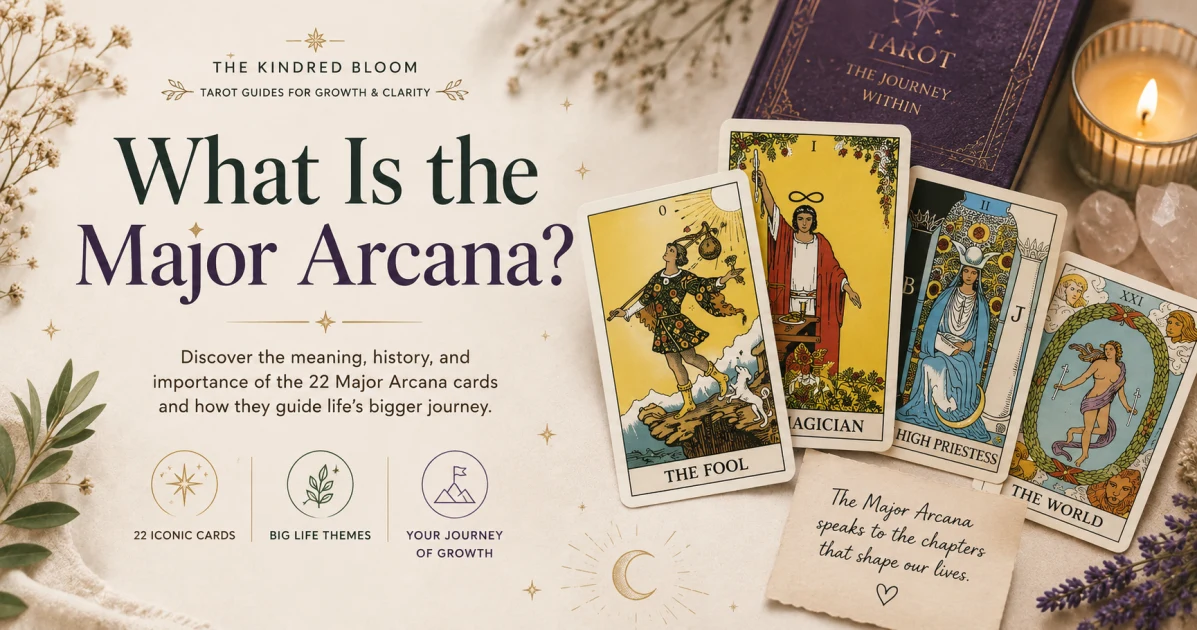
The Major Arcana is the smaller of the tarot deck’s two main sections, containing 22 cards that are often considered the most recognizable in tarot. Cards such as The Fool, The Lovers, Death, and The World have appeared in books, films, artwork, and popular culture for generations, even among people who have never owned a tarot deck.
Yet despite their popularity, the Major Arcana is often misunderstood. Rather than existing as a collection of mysterious fortune-telling cards, they form part of a much larger system that has developed over more than five centuries.
Understanding what the Major Arcana is—and what it is not—is one of the best ways to build a solid foundation in tarot.
What Does “Major Arcana” Mean?
The word arcana comes from the Latin word arcanum, meaning “secret” or “mystery.” The term Major Arcana can therefore be understood as the “greater mysteries.”
In a standard tarot deck, the cards are divided into two groups:
- 22 Major Arcana cards
- 56 Minor Arcana cards
The word major doesn’t mean these cards are more valuable or more magical than the others. Instead, it suggests that they focus on broader themes and significant experiences, while the Minor Arcana explores the details of everyday life.
Both sections are essential. Together, they create the complete structure of a tarot deck.
Where Did the Major Arcana Come From?
The Major Arcana first appeared in the beautifully illustrated tarot decks created in 15th-century northern Italy.
Early decks, including the famous Visconti-Sforza Tarot, already featured many figures that are still familiar today, such as The Fool, The Magician (then known as Il Bagatto), and The World.
However, these cards were not originally created for fortune-telling.
Historians generally agree that they were designed as part of an elaborate card game enjoyed by wealthy families during the Renaissance. It was only centuries later, particularly from the late 18th century onward, that occult writers began assigning deeper symbolic and spiritual meanings to the cards.
This historical distinction is important because it reminds us that the meanings associated with the Major Arcana have evolved over time. The cards themselves remained remarkably consistent, while the ways people interpreted them continued to grow and change.
What Do the Major Arcana Cards Represent?
Today, many tarot readers see the Major Arcana as representing the larger patterns and milestones of human experience.
Rather than focusing on everyday tasks or temporary situations, these cards often explore themes such as:
- Personal growth
- Important life decisions
- Change and transformation
- Wisdom and self-discovery
- Responsibility
- Hope and resilience
These themes are broad enough that different readers may interpret them in different ways. A single card can carry several layers of meaning depending on the context of a reading.
You may also hear people talk about “The Fool’s Journey.” This popular modern framework views the 22 cards as a symbolic journey that begins with The Fool and ends with The World, with each card representing a different stage of personal growth.
While many beginners find this approach helpful, it’s worth remembering that The Fool’s Journey is a modern teaching tool rather than a historical explanation for the earliest tarot decks. Understanding this difference helps separate the history of tarot from later methods of interpretation.
Why Are the Major Arcana Important?
When Major Arcana cards appear in a tarot reading, many readers consider them to highlight themes that deserve particular attention.
This doesn’t necessarily mean that a dramatic life event is about to happen. Instead, these cards often encourage deeper reflection on the situation, the choices involved, or the lessons that may emerge over time.
The Major Arcana is also only one part of the story.
A tarot reading usually combines both the Major and Minor Arcana. While the Major Arcana may point toward broader themes or long-term growth, the Minor Arcana often provides the everyday context in which those themes unfold.
Understanding how these two sections work together is far more useful than studying either one in isolation.
Do You Need to Memorize All 22 Cards?
Learning the Major Arcana does involve some memorization. Becoming familiar with each card’s name, central themes, and important symbols gives you a useful foundation for reading tarot with greater confidence.
However, you do not need to memorize every possible meaning before you begin. Tarot cards can carry different meanings depending on the question, their position in a spread, and the other cards surrounding them. Trying to learn a long list of fixed definitions all at once can make the process feel more confusing than helpful.
A balanced approach is to begin with one or two core ideas for each card. For example, The Hermit is often connected with reflection and inner guidance, while Strength may suggest courage, patience, or emotional resilience. As you spend more time with the cards, their additional meanings and symbols will gradually become easier to remember.
It can also help to study the images rather than relying only on keywords. Notice the figures, colors, objects, and actions shown on each card. These visual details often act as memory cues and can help you understand why a card carries certain associations.
Memorization provides the foundation, but interpretation develops through observation, context, and practice. You do not need perfect recall from the beginning, but building a steady knowledge of the cards will make your readings clearer and more thoughtful over time.
Continue Exploring
Now that you’ve learned about the Major Arcana, continue building your understanding of the tarot deck with these beginner-friendly guides:
As you explore each topic, you’ll discover how tarot’s history, structure, and symbolism fit together to form one remarkable tradition.✨