The High Priestess is commonly associated with intuition, mystery, and inner awareness. Yet the card did not begin as the mystical figure familiar to modern tarot readers. Its transformation from the early Papess to the Rider–Waite–Smith High Priestess reveals how its imagery came to express the relationship between knowledge, uncertainty, and patient observation.
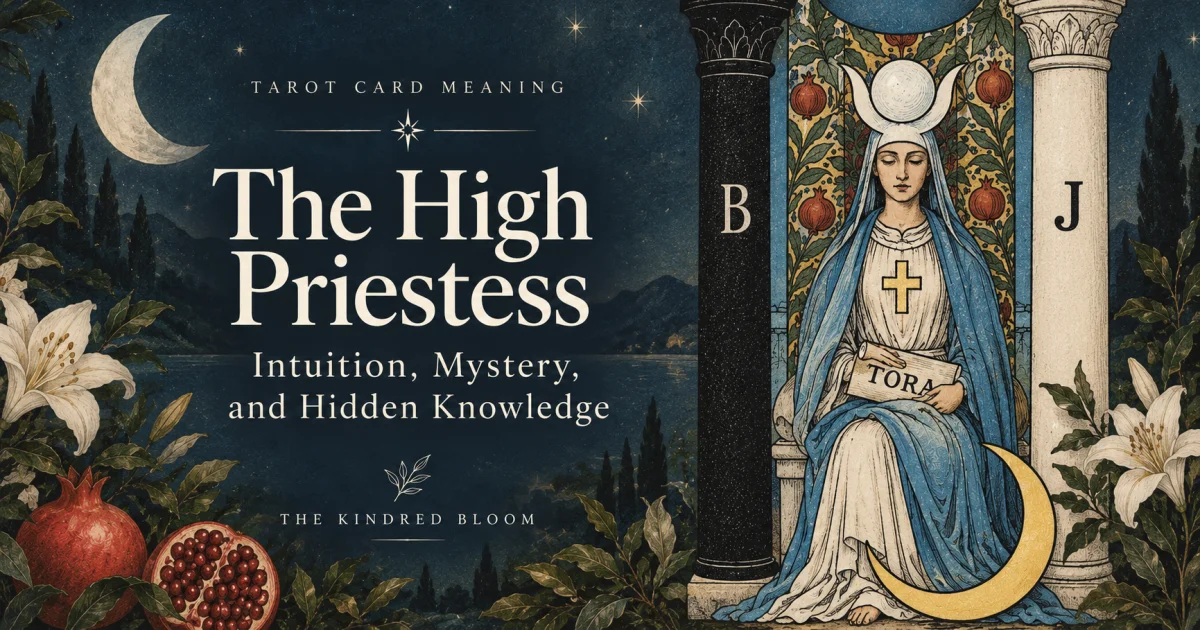
The High Priestess is one of the quietest cards in the Major Arcana. Unlike The Magician, who stands actively before his tools, she sits between two pillars with a veil behind her. A crescent moon rests near her feet, and a partially concealed scroll lies across her lap.
Nothing in the scene demands immediate action. Instead, the image creates the impression that something is present but not completely revealed. This is why modern tarot readers frequently associate The High Priestess with intuition, mystery, and knowledge that has not yet come fully into view.
However, the card’s historical ancestor was not originally called The High Priestess. Understanding that earlier identity helps us distinguish the card’s history from the meanings it acquired later.
The High Priestess in Early Tarot
In earlier European tarot traditions, the card corresponding to today’s High Priestess was commonly known as La Papessa, translated into English as The Papess or The Popess. The figure appeared as a female counterpart to the Pope, another character among the early tarot trumps.
The precise meaning of particular early representations remains uncertain, and historians have proposed different explanations for the figure. What is clear is that the card existed long before the modern image of an esoteric High Priestess became standard.
The early Papess should therefore not automatically be interpreted through contemporary keywords such as intuition or the subconscious. Those associations belong largely to the card’s later development within divinatory and esoteric tarot traditions.
From The Papess to The High Priestess
As tarot became increasingly associated with divination and Western esotericism, its trump cards acquired new symbolic interpretations. The Papess gradually became associated with secret knowledge, spiritual understanding, and mystery.
This transformation is particularly visible in the Rider–Waite–Smith Tarot, published in 1909. Illustrated by Pamela Colman Smith under the direction of Arthur Edward Waite, the card presents a solemn seated woman surrounded by religious and esoteric imagery.
Rather than appearing primarily as a female papal figure, she now occupies a setting that suggests stillness, concealment, and knowledge that cannot immediately be accessed. The pillars, veil, moon, and scroll work together to establish this atmosphere.
What Do the Pillars Mean?
The High Priestess sits between a black pillar marked B and a white pillar marked J. These letters refer to Boaz and Jachin, the names traditionally associated with the two pillars at the entrance to Solomon’s Temple in the Hebrew Bible.
The contrasting colours also invite interpretations involving duality, such as light and darkness, the known and unknown, or conscious and unconscious awareness. These are additional symbolic readings rather than the literal meaning of the biblical names.
The High Priestess sits between the pillars instead of standing beside only one. In a reading, this arrangement can encourage us to consider whether a situation contains two perspectives that have not yet been fully understood. It does not necessarily suggest that one side must be chosen immediately.
The Veil Behind The High Priestess
Behind The High Priestess hangs a patterned veil decorated with pomegranates and palms. The veil creates a visual boundary: something lies beyond it, but the viewer cannot see everything.
The pomegranates have a long history of religious and mythological symbolism outside tarot. Within this particular image, however, the veil’s most immediate effect is to separate what is visible from what remains concealed.
This makes the veil especially relevant when The High Priestess appears in a reading about an unclear situation. Rather than assuming that someone is deliberately hiding a secret, the image may simply suggest that important information is not yet available. The distinction matters because incomplete knowledge does not automatically imply deception.
Why Is There a Moon?
Lunar imagery appears prominently in the Rider–Waite–Smith High Priestess. A crescent moon rests near her feet, while her crown also incorporates lunar forms.
In Western esoteric interpretations, the Moon is associated with receptivity, cycles, and less direct forms of awareness. These associations contribute to the card’s modern connection with intuition and the unconscious.
The lunar imagery can encourage a reader to notice gradual changes or feelings that have not yet been clearly expressed. However, this symbolism belongs to a particular stage in tarot’s development and should not be projected backward as proof that the fifteenth-century Papess was originally intended as a card of lunar intuition.
What Is Written on the Scroll?
The scroll across The High Priestess’s lap bears the letters TORA, generally understood as a reference to the Torah. Part of the scroll is concealed by her clothing, making it another example of knowledge that is present but not entirely visible.
This detail adds an important dimension to the card. The High Priestess does not hold an empty scroll, nor is she surrounded by symbols of complete ignorance. Knowledge exists within the image, but access to it appears limited.
In a reading, the scroll may prompt a practical question: Is the necessary information genuinely unavailable, or is there something that has not yet been examined closely enough? Sometimes further research, a careful conversation, or simply allowing more time can reveal what was previously unclear.
What Does The High Priestess Mean in a Tarot Reading?
In contemporary tarot, The High Priestess is commonly associated with intuition, inner knowledge, mystery, stillness, receptivity, observation, patience, and information that has not yet been revealed.
These keywords are useful, but “trust your intuition” should not become the card’s only interpretation. Sometimes The High Priestess appears in a situation where there simply is not enough information to reach a conclusion. In that context, the card may suggest waiting, listening, researching, or observing rather than making an immediate decision.
For example, imagine The High Priestess appears in a reading about an unfamiliar job opportunity. The card does not necessarily indicate that the employer is concealing something or that the opportunity is destined to succeed. Instead, it may draw attention to unanswered questions about the role, workplace, or expectations.
The pillars suggest considering different perspectives, the veil points toward information that is not yet visible, and the partially concealed scroll reminds us that some knowledge may require closer examination. Together, these symbols offer a way to interpret the card without turning uncertainty into an unsupported prediction.
Does The High Priestess Mean You Are Psychic?
Not necessarily. The High Priestess can be interpreted spiritually, particularly within tarot traditions that emphasise psychic perception, but drawing the card does not establish that someone possesses supernatural abilities.
Intuition can also describe recognising subtle patterns, noticing emotional responses, or becoming aware that something deserves further attention. These experiences do not always produce an immediate or reliable answer.
A useful distinction is that intuition may draw attention to a question, but it does not automatically provide evidence for the answer. If The High Priestess appears in a reading about another person’s intentions, for instance, an uneasy feeling alone is not proof that the person is being dishonest. The card may instead encourage careful observation and a willingness to revise an initial impression when more information becomes available.
The High Priestess and Hidden Knowledge
One way to understand The High Priestess is to distinguish between what is unknown and what is hidden. Something unknown is simply outside our present understanding, while something hidden suggests that further information may exist beyond what we can currently see.
The Rider–Waite–Smith image repeatedly explores this distinction. The veil conceals part of the background, the scroll is only partly visible, and the seated figure occupies a space between contrasting pillars.
These details do not prove that every reading involves a secret. Instead, they make the card particularly useful for examining the limits of what is currently understood. It can represent knowledge that has not yet become accessible, an unanswered question, or the need to resist filling gaps with assumptions.
Is The High Priestess a Passive Card?
The High Priestess may appear passive when compared with The Fool or The Magician. She does not approach a cliff or raise a wand. She remains seated, holding her scroll.
Yet stillness and passivity are not necessarily the same thing. Observation can be deliberate, waiting can be a considered choice, and listening may reveal information that hurried action would overlook.
The High Priestess therefore introduces a different kind of agency into the Major Arcana. Rather than focusing on the ability to make something happen, the card draws attention to recognising when understanding should come before action.
This does not mean waiting indefinitely. It means considering whether the next useful step is to act, gather information, or acknowledge that a clear answer is not yet available.
The Magician and The High Priestess: Action and Receptivity
The contrast between The Magician and The High Priestess is particularly useful when studying the Major Arcana. The Magician stands before a table displaying his tools, while The High Priestess sits with a partially concealed scroll.
The Magician directs attention toward intention and the use of available resources. The High Priestess draws attention toward observation and what remains unknown. One card asks what can be done with existing knowledge; the other asks whether that knowledge is complete.
Their approaches are different, but they are not necessarily opposites. Purposeful action can benefit from careful observation, while insight becomes more useful when it eventually informs a decision.
What Should You Remember About The High Priestess?
Intuition is a useful keyword for The High Priestess, but it becomes more meaningful when connected with stillness, observation, hidden knowledge, and patience.
The veil and partially concealed scroll remind us that information may be incomplete. The pillars invite us to consider different perspectives, while the seated figure suggests that understanding does not always develop through immediate action.
When The High Priestess appears in a reading, consider what is known, what remains uncertain, and whether further observation could change the interpretation. The card does not require us to invent an answer for what we cannot yet see. Sometimes its most useful message is simply to recognise that there may still be more to discover.
Continue Exploring
The High Priestess follows The Magician in the modern Major Arcana sequence, shifting the emphasis from outward action toward inward awareness and hidden knowledge.
If you’d like to follow the series in order, read The Fool Tarot Card Meaning and The Magician Tarot Card Meaning first.
You may also enjoy The Major Arcana Explained for a broader introduction to the twenty-two Major Arcana cards.
Next, we’ll explore The Empress, whose imagery moves into themes of abundance, nature, creativity, and growth.