The Emperor is commonly associated with authority, structure, stability, leadership, and responsibility. From his historical origins as a ruler to the imposing imagery of the Rider–Waite–Smith Tarot, the card explores not only power itself, but how that power is organised and used.
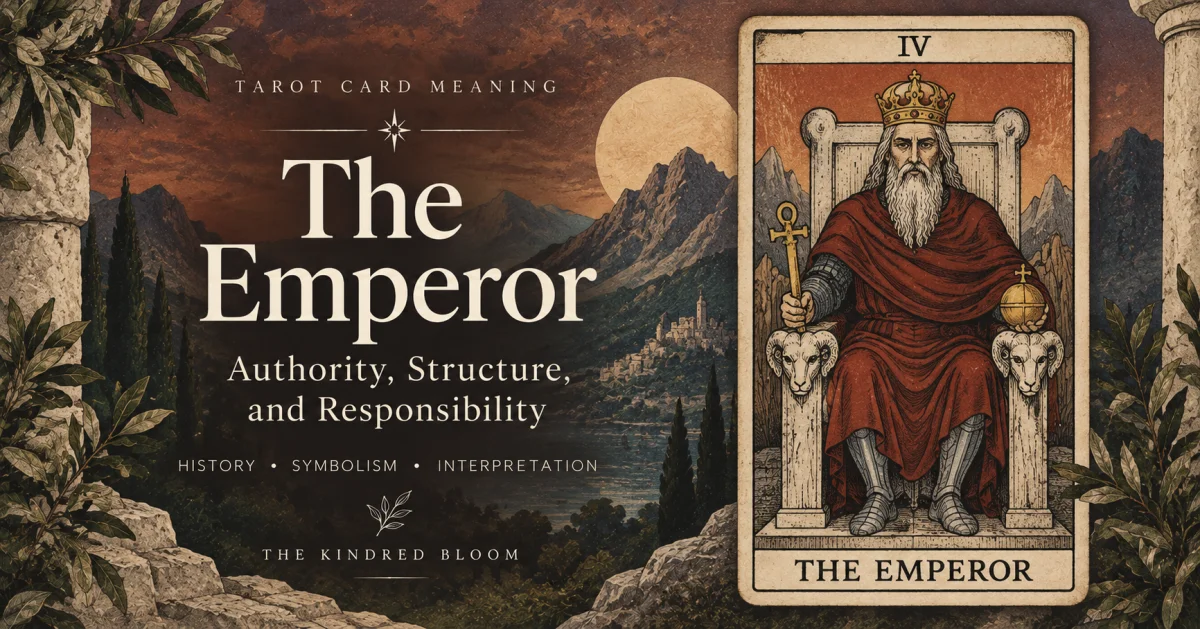
The Emperor sits on a stone throne.
Unlike the lush landscape surrounding The Empress, his environment in the Rider–Waite–Smith Tarot is stark and mountainous. His throne is decorated with ram heads, he wears armour beneath his robes, and he holds symbols of authority in his hands.
Everything about the image feels solid.
For this reason, The Emperor is commonly associated with structure, authority, stability, leadership, discipline, and control.
But authority is not necessarily the same as domination.
The Emperor is commonly associated with authority, stability, leadership, and responsibility. His imposing throne and mountainous surroundings in the Rider–Waite–Smith Tarot suggest a world built on structure. Yet the card’s history as a representation of imperial power reminds us that authority is not only about maintaining order, but also about how that order affects others.
The Emperor sits on a stone throne against a stark mountain landscape. Ram heads decorate his seat, armour is visible beneath his robes, and he holds objects associated with rulership.
Compared with the fertile surroundings of The Empress, his environment feels deliberately solid and restrained. This visual contrast helps explain why modern readers associate The Emperor with structure, discipline, boundaries, and control.
However, structure is not automatically beneficial simply because it creates order. A clear system can protect people and support long-term goals, while an inflexible one can limit growth. The Emperor invites us to examine both the stability that authority provides and the responsibility that comes with exercising it.
The Emperor in Early Tarot
The Emperor appears in early Italian tarot traditions dating to the fifteenth century. Alongside figures such as The Empress, the Pope, and the Papess, he represented a recognisable position within the social and political hierarchy of the period.
An emperor was a figure of secular authority. In medieval and Renaissance Europe, imperial imagery could communicate rank, sovereignty, and political legitimacy. Early tarot players would therefore have encountered a familiar type of ruler rather than a card originally designed around modern concepts such as personal boundaries or psychological stability.
This distinction matters when interpreting the card today. The Emperor’s historical identity provides the foundation for its imagery, but many of its contemporary meanings developed later as tarot became associated with divination and esoteric interpretation.
The card did not begin as a universal instruction to become more disciplined. It began with the recognisable image of a ruler.
From Imperial Authority to a Symbol of Structure
As tarot developed into a system used for divination and symbolic interpretation, the Emperor’s identity expanded beyond the literal figure of a sovereign.
A ruler could become a metaphor for the structures that organise everyday life: laws, institutions, leadership, routines, and responsibilities. The central question shifted from identifying an emperor to examining how authority operates.
The Rider–Waite–Smith Tarot, published in 1909 and illustrated by Pamela Colman Smith under the direction of Arthur Edward Waite, presents this theme through a carefully arranged visual setting.
The Emperor sits firmly on his throne, surrounded by stone and mountains. His clothing and the objects he holds reinforce his position as a ruler, while the overall composition creates an impression of endurance and control.
These details offer a starting point for modern interpretations, but they should not all be projected backward onto the earliest Emperor cards. The historical ruler and the modern symbolic figure are connected through imagery, not identical in meaning.
Why Is The Emperor’s Throne Made of Stone?
The Emperor sits on a massive stone throne, creating an immediate contrast with the softer, fertile landscape surrounding The Empress.
Stone can suggest durability, permanence, and a foundation capable of withstanding pressure. In a reading, this may draw attention to the systems that allow something to remain stable over time, such as consistent routines, clear expectations, or dependable agreements.
Yet stone is also resistant to change. A structure that once provided security may become restrictive if it cannot adapt to new circumstances.
This tension is central to the card: stability is useful when it supports a purpose, but permanence alone does not make a system effective.
For example, The Emperor appearing in a reading about a growing business might highlight the need for clear processes and responsibilities. If the business already struggles with excessive rules, the same imagery could encourage a closer look at which procedures still serve a useful purpose.
What Do the Rams Mean?
Ram heads decorate The Emperor’s throne. In the esoteric correspondences associated with the Rider–Waite–Smith tradition, The Emperor is linked with Aries, the zodiac sign represented by the ram.
Within astrology, Aries is traditionally associated with initiative, assertiveness, and the drive to act. These qualities complement modern interpretations of The Emperor as a figure of leadership and direction.
The ram heads therefore reflect a particular symbolic framework rather than being merely decorative. However, this astrological association should be distinguished from the card’s earlier identity as an imperial figure. It is not evidence that fifteenth-century tarot makers originally designed The Emperor to represent Aries.
Why Is The Emperor Wearing Armour?
Armour is visible beneath The Emperor’s robes. Although he is seated rather than shown in battle, his clothing suggests that he is prepared to defend his position.
Armour can represent protection, readiness, and the responsibilities involved in maintaining security. This symbolism helps explain why The Emperor is often connected with boundaries and dependable systems.
In everyday life, boundaries can protect time, resources, and relationships. A clear agreement, for instance, may prevent misunderstandings by establishing what each person is responsible for.
But armour also creates separation. When protection becomes excessive, it may prevent communication or make adaptation difficult. The image therefore encourages us to consider whether a boundary is protecting something important or creating unnecessary distance.
The Mountains Behind The Emperor
Bare mountains dominate the background of the Rider–Waite–Smith card. Their harsh appearance differs noticeably from the vegetation and flowing water surrounding The Empress.
Mountains are often interpreted as symbols of endurance, strength, or challenges that require persistence. Here, they reinforce the impression of a setting shaped by solidity rather than spontaneous growth.
The landscape does not necessarily imply that The Emperor rejects creativity or emotion. Instead, it provides a visual emphasis on resilience and the conditions required to maintain order.
When this card appears in a reading, the mountains may draw attention to a challenge that cannot be resolved through enthusiasm alone. A long-term commitment, for example, may require consistent effort and a structure capable of supporting that effort.
What Is The Emperor Holding?
In the Rider–Waite–Smith image, The Emperor holds an ankh-shaped sceptre and an orb.
The orb has a long history in European royal imagery as a symbol of sovereignty. The ankh originates in ancient Egyptian symbolism and is commonly associated with life.
Their appearance together reflects the varied symbolic influences found in the Rider–Waite–Smith deck. Within the image, both objects reinforce The Emperor’s identity as a ruler, while the ankh introduces an additional association with life.
It is useful to recognise these identifiable references without assuming that every object must have one fixed meaning in every reading.
What Does The Emperor Mean in a Tarot Reading?
In contemporary tarot, The Emperor is commonly associated with:
- Authority and leadership
- Structure and organisation
- Stability and consistency
- Discipline and responsibility
- Boundaries
- Rules and systems
- Protection
- Control
These keywords become more useful when connected to the situation being examined. The Emperor may appear when an idea needs a practical plan, a project requires clearer responsibilities, or a relationship would benefit from agreed boundaries.
For example, imagine the card appears in a reading about a creative project that has struggled to progress. The Emperor might direct attention toward setting a schedule, defining priorities, or creating a realistic budget. The issue may not be a lack of inspiration but the absence of a system that supports consistent work.
In another reading, the situation may already be highly structured. The card could then raise a different question: are the existing rules helping people achieve their goals, or have they become obstacles?
Rather than treating The Emperor as a command to take control, consider what kind of structure the situation needs and who is responsible for maintaining it.
Authority, Leadership, and the Limits of Control
The Emperor’s historical identity as a ruler makes authority central to the card. Yet authority and excessive control are not the same thing.
Constructive leadership can establish clear expectations, distribute responsibilities, provide protection, and create consistency. These qualities allow people to understand how a system works and what is expected of them.
However, authority can also be exercised through unnecessary restrictions, unwillingness to listen, or an excessive need to control every decision. A leader who establishes useful procedures may help a team work effectively, while one who insists on approving every minor action may slow the same team down.
This distinction is especially relevant when The Emperor appears in readings about work, institutions, or relationships. The card does not establish that an authority figure is trustworthy or untrustworthy. Instead, it offers a framework for examining how decisions are made, whether responsibilities are clear, and whether existing boundaries serve their intended purpose.
The question is not simply who holds power, but how that power is exercised.
Does The Emperor Represent a Father?
The Emperor is frequently associated with a father figure in traditional and modern tarot interpretation. Depending on the question, the card may represent a father, employer, manager, mentor, or another person who occupies a position of authority.
However, it does not automatically indicate a literal father, nor must it represent a man. The qualities associated with The Emperor—leadership, responsibility, discipline, and the ability to establish structure—are not limited to any gender.
In some readings, the card may not represent a person at all. It could instead describe an organisation, a set of rules, or the need to establish a more reliable routine.
Rather than immediately asking which person The Emperor represents, consider where authority or responsibility is operating within the situation.
When Does Structure Become Rigidity?
One of The Emperor’s most important tensions is the relationship between stability and flexibility.
A routine may initially make daily life easier, but it can become restrictive when circumstances change. A rule created to protect people may eventually need revision. A leader who once provided necessary direction may need to allow others greater independence as their experience grows.
The stone throne and mountainous landscape make this tension visible. They suggest endurance, but they also invite us to consider the limitations of something that does not easily move.
In a reading, The Emperor may therefore highlight the need to establish structure or to examine whether an existing system has become too rigid. The question and surrounding cards help determine which interpretation is more relevant.
A useful structure should be stable enough to provide support and flexible enough to remain effective.
The Empress and The Emperor: Growth and Structure
The Empress and The Emperor appear next to each other in the modern Major Arcana sequence, and their Rider–Waite–Smith imagery offers a striking contrast.
The Empress sits within a fertile landscape surrounded by growing plants and flowing water. The Emperor sits on stone against bare mountains.
In modern interpretation, The Empress can draw attention to nourishment, creativity, and the conditions that encourage growth. The Emperor shifts the focus toward the organisation and responsibility needed to sustain that growth.
Consider a new creative project. The Empress might encourage the development of an idea, while The Emperor could highlight the need for a schedule, budget, or clear plan.
Neither approach is sufficient in every situation. Growth without adequate support may become difficult to maintain, while a rigid system that leaves no room for development may eventually become stagnant.
This comparison is a useful modern interpretive tool. Historically, the two cards were also connected through their identities as recognisable figures within imperial hierarchy, rather than originally being designed as a fixed psychological pair.
What Should You Remember About The Emperor?
Authority, structure, stability, and responsibility provide a useful foundation for understanding The Emperor. But the card becomes more meaningful when these ideas are connected to the purpose of leadership.
The stone throne suggests endurance, the armour introduces protection, and the objects of rulership reinforce the figure’s authority. Together, they create an image of someone responsible for maintaining order.
When The Emperor appears in a reading, consider what needs a stronger foundation, which responsibilities should be clarified, and whether existing rules are helping or limiting the situation.
The card does not suggest that more control is always the answer. Sometimes leadership requires standing firm, while at other times it requires recognising when a system must change.
The Emperor invites us to consider what kind of structure will provide lasting support—and whether the authority behind it is being used responsibly.
Continue Exploring
The Emperor follows The Empress in the modern Major Arcana sequence, shifting from organic growth and nourishment toward structure, stability, and authority.
If you’d like to follow the series in order, explore The Fool Tarot Card Meaning, The Magician Tarot Card Meaning, The High Priestess Tarot Card Meaning, and The Empress Tarot Card Meaning.
You may also enjoy The Major Arcana Explained for a broader introduction to the twenty-two Major Arcana cards.
Next, we’ll explore The Hierophant, a card whose history is especially important for understanding why modern interpretations often connect it with tradition, institutions, teaching, and established systems of belief.