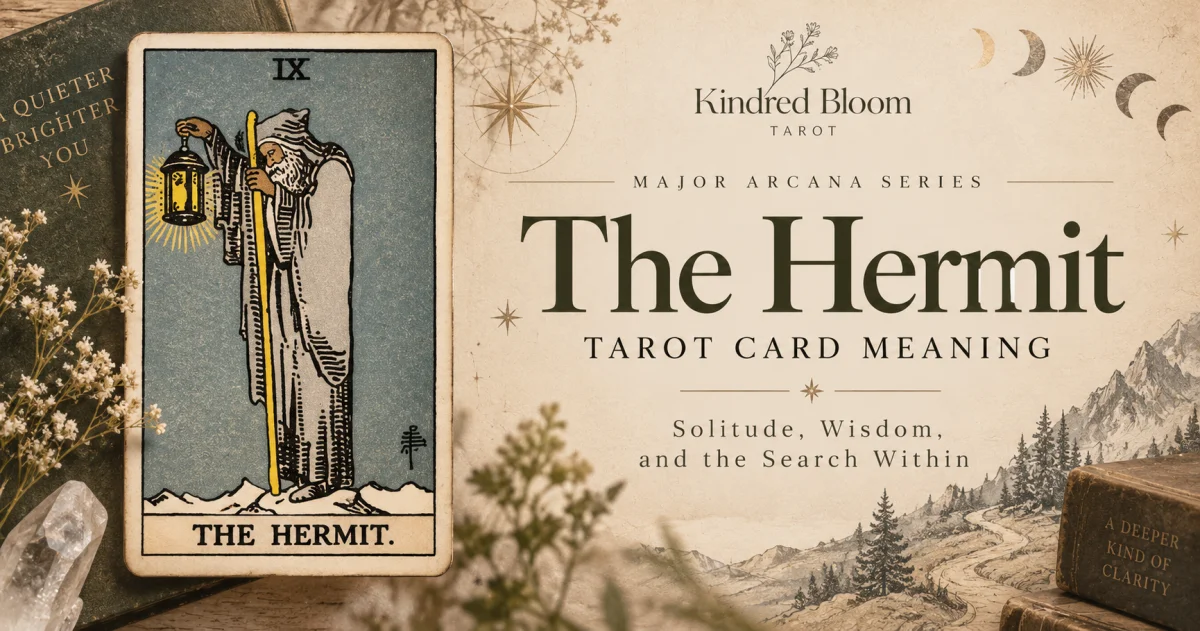
There is only one person on The Hermit card.
He stands alone on the top of a mountain, holding a lantern in one hand and a staff in the other. There is no crowd around him, no obvious destination ahead, and very little happening in the background.
At first, this can make The Hermit seem like a card about loneliness or isolation.
But being alone and being lonely are not necessarily the same thing.
The Hermit tarot card meaning is often connected with introspection, solitude, wisdom, and stepping away from outside noise in order to listen more carefully to what is happening within.
Sometimes we look for answers by asking more people, gathering more information, or moving faster. The Hermit suggests another possibility: perhaps the answer becomes clearer when we stop searching outside ourselves for a moment.
The Hermit Is Alone—but Is He Lonely?
This is one of the most useful distinctions to make when reading The Hermit.
Loneliness is generally something we experience as an unwanted lack of connection. Solitude, on the other hand, can be intentional. We may choose to spend time alone because we need space to think, reflect, recover, study, or understand something more deeply.
The figure on The Hermit does not appear abandoned.
He stands upright and composed. His isolation seems deliberate rather than accidental.
This is why The Hermit does not automatically mean separation, sadness, or withdrawal from other people. In some readings, it certainly can point toward distance. But the image encourages us to ask why that distance exists.
Are you withdrawing because you are afraid to engage with the world?
Or are you deliberately creating enough space to hear your own thoughts?
Those two situations may look similar from the outside, but they are very different experiences.
Look Closely at the Lantern
One of the most recognizable symbols on The Hermit is the lantern in his hand.
Inside it is a six-pointed star. In the Rider-Waite-Smith deck, Waite associated the lantern with a guiding light, while the card more broadly became connected with the idea of knowledge gained through withdrawal and contemplation.
But there is another interesting detail to notice.
A lantern does not illuminate everything.
Unlike the Sun, which floods an entire landscape with light, a lantern reveals only a limited area around the person carrying it.
That makes the image particularly interesting in a tarot reading.
The Hermit may not promise that you will suddenly understand everything. Instead, it can suggest having enough light to see the next part of the path.
Sometimes clarity comes gradually.
You may not know exactly where a relationship is going, what your career will look like five years from now, or how an uncertain situation will eventually resolve. The Hermit can remind us that complete certainty is not always necessary before taking the next step.
Perhaps you only need enough light for the step immediately in front of you.
The Mountain and the Staff
The Hermit stands high on a mountain, separated from the landscape below.
Mountains often suggest difficulty, elevation, or a journey that requires effort. Here, the setting can reinforce the sense that whatever wisdom The Hermit possesses was not necessarily gained quickly or easily.
In his other hand, he carries a staff.
A staff can provide support during a journey, and in this image it contributes to the impression of someone who has travelled rather than someone who simply appeared at the top of the mountain.
Together, the mountain, staff, and lantern create a card that feels less like passive isolation and more like a deliberate search for understanding.
The Hermit has stepped away—but there is a purpose behind that distance.
Where Did The Hermit Come From?
The solitary figure did not begin with the Rider-Waite-Smith deck.
In earlier tarot traditions, the card was commonly depicted as an elderly man and was sometimes associated with ideas such as old age or time. In historical decks, the imagery and titles were not always identical to the modern Hermit familiar to many tarot readers today.
Over time, the figure became increasingly associated with the archetype of the hermit: someone who withdraws from ordinary society in pursuit of contemplation, wisdom, or spiritual understanding.
When Pamela Colman Smith illustrated the Rider-Waite-Smith deck under Arthur Edward Waite’s direction, the image became the familiar cloaked figure standing alone with his lantern.
This history is useful because it reminds us that tarot meanings did not appear fully formed at one moment. Images and interpretations developed over time, and modern readers inherit layers of those traditions.
What Does The Hermit Mean in a Tarot Reading?
The Hermit often appears when a situation benefits from reflection before action.
It can suggest taking time to think independently, stepping away from other people’s opinions, studying something more deeply, or temporarily reducing distractions.
But context matters.
In a relationship reading, The Hermit does not automatically mean a breakup. It might suggest that one person needs personal space, that the relationship requires deeper reflection, or that the answer cannot be found simply by asking what everyone else thinks.
In a career reading, it might point toward independent work, study, mentorship, research, or reconsidering what you genuinely want from your professional direction.
In a personal reading, the message may be simpler: there is too much noise around you to hear yourself clearly.
The traditional keywords give us a useful starting point:
Solitude · Introspection · Wisdom · Reflection · Inner guidance · Search for truth
But those words should not replace the image.
Look at the person standing alone. Look at how much—or how little—the lantern reveals. Look at the distance between The Hermit and everything else.
Then ask what those details resemble in the situation you are reading about.
When Solitude Becomes Isolation
There is another side of The Hermit’s imagery worth considering even without using reversed meanings.
Solitude can be valuable, but more solitude is not always better.
A person can step away from noise in order to think clearly. But a person can also remain alone for so long that reflection becomes avoidance.
That distinction can matter when The Hermit appears.
If you have been constantly surrounded by other people’s expectations, the card may suggest creating more space for yourself.
But if you have already spent a long time thinking, researching, waiting, or avoiding contact, the same image might raise a different question:
Have I learned what I needed from this period of solitude—or am I hiding inside it?
The card itself does not provide a universal answer.
The question, surrounding cards, and circumstances help determine which side of the image is most relevant.
This is one reason tarot becomes limiting when every card is reduced to a fixed definition.
You Don’t Need to See the Entire Road
Perhaps the most useful detail in The Hermit is not that he is alone.
It is that he continues to carry a light.
He does not hold a map showing the entire journey. His lantern cannot reveal everything beyond the mountain. It simply gives him light where he stands.
When The Hermit appears, we can therefore ask:
What do I already know when I stop listening to everyone else?
What do I need space to understand?
Am I choosing solitude, or am I avoiding connection?
And perhaps most importantly:
What is the next thing my lantern allows me to see?
The Hermit does not necessarily ask us to disappear from the world.
Sometimes it simply asks us to become quiet enough to find our own direction before returning to it.