
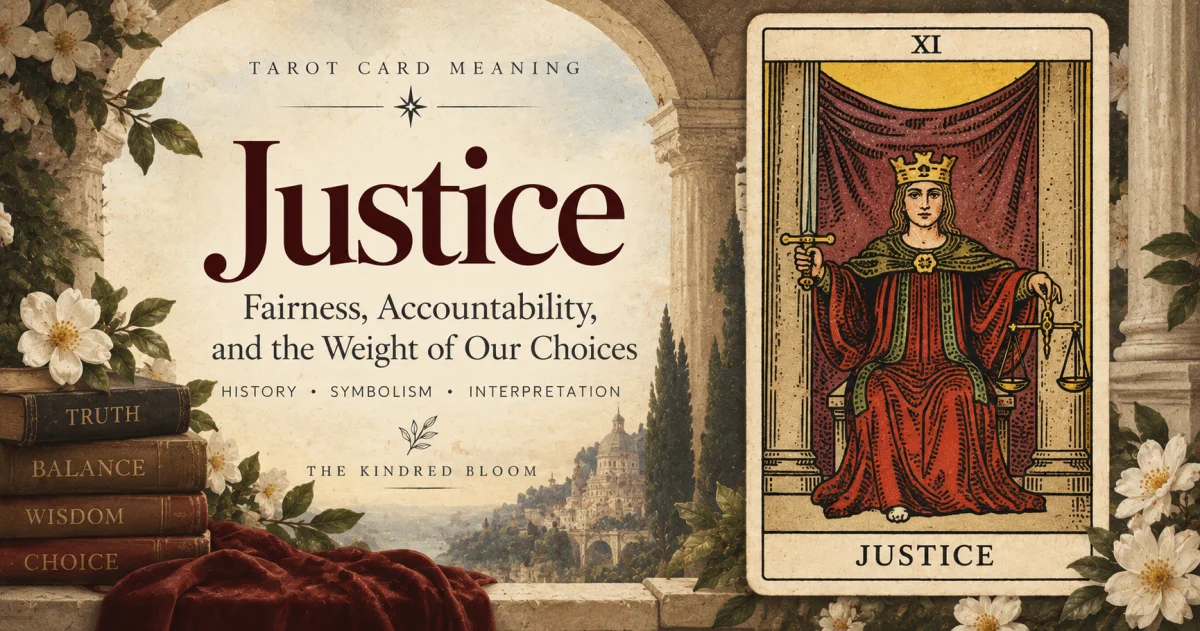
Justice is often associated with fairness, truth, responsibility, and consequences. In the Rider–Waite–Smith Tarot, a seated figure holds a balanced scale in one hand and an upright sword in the other. Together, these objects raise a question that goes beyond deciding who is right or wrong: what does it take to make a fair judgment?
Justice sits between two pillars, holding a sword upright in the right hand and a set of scales in the left. A purple curtain hangs behind the figure, while a crown and red robe reinforce the impression of authority.
The composition is remarkably direct. There is no crowded landscape or dramatic action. Instead, the viewer’s attention is drawn to two objects: the scales and the sword.
The scales suggest weighing information. The sword suggests the ability to reach a decision and act upon it. Considered together, they offer a useful way to understand the card: a judgment should not be separated from the process used to reach it.
Justice is therefore more than a symbol of punishment or reward. It invites us to examine the relationship between evidence, decisions, and responsibility.
Justice in Early Tarot: A Familiar Virtue
Justice appears in early Italian tarot traditions dating to the fifteenth century. Unlike some tarot figures whose meanings developed considerably through later esoteric interpretation, Justice already belonged to an established visual tradition.
In European art, Justice was commonly personified as a figure holding scales and a sword. She represented one of the four cardinal virtues, alongside Prudence, Fortitude, and Temperance.
Early tarot was primarily used for card games, and the presence of Justice among its trump cards does not establish that the deck was originally designed as a divinatory system. Nevertheless, the figure and her attributes would have been recognisable within the moral and artistic culture of the period.
This historical background explains why fairness, judgment, and moral responsibility remain closely associated with the card today. These themes were not invented solely by modern tarot readers, although their application to personal decisions and psychological questions reflects later interpretive practices.
Why Is Justice Number XI in the Rider–Waite–Smith Tarot?
Justice is numbered XI (11) in the Rider–Waite–Smith Tarot, published in 1909 and illustrated by Pamela Colman Smith under the direction of Arthur Edward Waite.
Readers who encounter other tarot traditions may notice a different arrangement. In the Tarot de Marseille tradition, Justice is generally numbered VIII (8), while the card commonly known as Strength or Fortitude occupies XI (11). The Rider–Waite–Smith deck places Strength at VIII and Justice at XI.
The numbering difference is a feature of different tarot traditions rather than an indication that one card has a universally correct position.
For someone learning with the Rider–Waite–Smith deck, Justice follows Wheel of Fortune. Their placement offers an interesting modern interpretive comparison: Wheel of Fortune draws attention to changing circumstances, while Justice shifts the focus toward how we evaluate situations and respond to them.
This comparison can be useful for learning the sequence, but it should not be treated as proof that early tarot cards were designed as stages in a predetermined spiritual journey.
The Scales: What Are We Actually Weighing?
Justice holds a set of scales in her left hand. Scales have long been associated with weighing, balance, and the evaluation of competing claims.
In the card, they provide a visual starting point for thinking about fairness. A fair judgment requires more than having a strong opinion. It may require examining relevant information, considering different perspectives, and recognising what remains uncertain.
Imagine someone asking about a disagreement at work. Justice does not necessarily identify one person as entirely right and the other as entirely wrong. The scales may instead encourage the reader to ask what each person knows, what evidence is available, and whether the situation has been assessed consistently.
The scales also invite us to consider our own assumptions. Are we giving one piece of information more weight because it confirms what we already believe? Have we overlooked something because it is uncomfortable to acknowledge?
The scales remind us that reaching a conclusion and carefully evaluating a situation are not the same thing.
The Upright Sword: A Decision Must Eventually Be Made
The sword in Justice’s right hand introduces a different quality. While the scales suggest consideration, the upright sword evokes clarity, authority, and decisive action.
It is possible to examine a situation endlessly without reaching a conclusion. The sword offers a counterpoint: after weighing the relevant information, a decision may still be necessary.
In a reading about a difficult choice, Justice might encourage someone to establish clear criteria before acting. What matters most? Which facts are relevant? What consequences are reasonably foreseeable?
The sword does not mean that every decision will be painless or universally accepted. It suggests the importance of being clear about why a choice is made and being prepared to take responsibility for it.
Read together, the two objects create a sequence: consider carefully, decide deliberately, and recognise the consequences of the decision.
Neither object tells us that the person holding it is automatically correct. Authority and fairness are related themes in the image, but they are not interchangeable.
The Pillars and Curtain: A Formal Setting for Judgment
Justice sits between two pillars, with a curtain behind the throne. The symmetrical composition creates a sense of order and restraint.
Unlike The Empress, whose surroundings are filled with living things, or Wheel of Fortune, whose image is dominated by movement, Justice appears still and composed.
This visual contrast helps establish the card’s atmosphere. Justice does not depict a spontaneous reaction. The figure occupies a formal setting in which judgment appears to require attention and deliberation.
The pillars and curtain can therefore support a modern interpretation concerned with procedures, boundaries, and the conditions under which decisions are made.
However, these details do not provide a universal formula for interpreting every reading. Their significance is best considered alongside the more recognisable historical attributes of Justice: the scales and sword.
Does Justice Mean That Everyone Should Be Treated the Same?
Fairness and identical treatment are not always the same thing.
Applying a rule consistently can be important, but circumstances may also matter. Two people can face similar situations while having different responsibilities, resources, or relevant needs.
The scales offer a useful way to explore this distinction. They invite consideration of what is relevant to a judgment rather than assuming that fairness can always be achieved through a simple, identical response.
For example, imagine two colleagues missing the same deadline. One had access to all the necessary information, while the other was waiting for materials that never arrived. Treating both situations as identical without examining the circumstances could overlook important differences.
Justice does not provide a definitive answer to every ethical dilemma. Instead, the card can encourage a more careful process: establish the relevant facts, identify the standards being used, and consider whether those standards are being applied appropriately.
This makes the card useful for reflecting on fairness without reducing it to a rigid rule.
What Does Justice Mean in a Tarot Reading?
In contemporary tarot, Justice is commonly associated with fairness, truth, accountability, balance, integrity, decisions, and consequences.
These keywords become more useful when connected to the image. The scales direct attention toward evaluation, while the sword points toward a decision that may follow.
In a career reading, Justice might encourage someone to examine a contract, clarify expectations, or assess whether a decision-making process is fair. In a relationship reading, it may raise questions about honesty, shared responsibility, or whether both people have had an opportunity to express their perspectives.
Consider a person deciding whether to leave a job after a disagreement with a manager. Rather than interpreting Justice as a promise that the person will be vindicated, the reader could use the card to examine the decision itself.
What happened? Which details can be confirmed? What outcome is the person seeking? What responsibilities or practical consequences would accompany each option?
The card does not guarantee that an institution will act fairly or that a dispute will end in someone’s favour. Its value in a reading lies in helping the person examine the situation with greater clarity.
Justice, Accountability, and Self-Blame
Justice is closely associated with accountability, but responsibility should not be confused with accepting blame for everything that happens.
Taking responsibility involves recognising the choices and actions that belong to us. Self-blame can go further, assigning personal fault even when circumstances were outside our control.
This distinction becomes especially useful when Justice appears after Wheel of Fortune in the Rider–Waite–Smith sequence.
Wheel of Fortune can prompt reflection on change, uncertainty, and circumstances that are difficult to control. Justice then offers a different question: given the situation as it stands, which decisions and responsibilities actually belong to us?
Imagine someone whose project fails because an unexpected external event disrupts their plans. Justice does not require them to blame themselves for the event. It may instead encourage an honest assessment of what was beyond their control, what they could have handled differently, and what they can reasonably do next.
Accountability becomes more useful when it is accurate, rather than when it is simply harsh.
Does Justice Predict a Legal Outcome?
Because the card depicts a figure associated with judgment, Justice is often connected with legal matters, contracts, and formal decisions in modern tarot.
However, drawing Justice does not establish that a legal case will be won, that a contract is favourable, or that an authority will reach a fair outcome.
When a question concerns an actual legal dispute, the card can be used as a reflective prompt to consider documentation, obligations, or questions that need clarification. It should not replace qualified legal advice or an examination of the relevant facts.
The same principle applies to workplace investigations, financial agreements, and other consequential decisions. The imagery can help organise reflection, but it cannot supply information that the reader does not have.
Justice and Wheel of Fortune: Circumstances Versus Response
Wheel of Fortune and Justice offer a particularly useful comparison when studied together.
Wheel of Fortune depicts movement and change. Its imagery encourages reflection on uncertainty and the limits of personal control.
Justice presents a still figure holding instruments of evaluation and decision. Its imagery directs attention toward judgment and responsibility.
Together, the cards can help distinguish two questions that are easy to confuse: What happened beyond my control? and What can I reasonably decide or take responsibility for now?
For example, a sudden organisational change may affect someone’s career without their choosing it. They cannot necessarily reverse the change, but they may still need to evaluate their options, review their obligations, and decide how to respond.
This is a modern interpretive comparison, not a claim that the cards were historically created to tell a fixed story. It is useful because the contrast between their images helps clarify their different themes.
Understanding Justice Beyond Right and Wrong
Justice is often reduced to a simple promise that truth will prevail or that everyone will receive what they deserve. Such interpretations can overlook the uncertainty and complexity involved in real decisions.
The Rider–Waite–Smith image offers a more practical approach. The scales ask us to evaluate. The sword reminds us that choices may require action. The seated figure suggests a deliberate process rather than an impulsive response.
When Justice appears in a reading, consider what information is available, which standards are being applied, and what responsibilities genuinely belong to the people involved.
The card does not guarantee a perfect outcome. It invites us to make the process of reaching a decision as thoughtful, consistent, and accountable as possible.
Continue Exploring
Justice follows Wheel of Fortune in the Rider–Waite–Smith Major Arcana sequence. While Wheel of Fortune explores change and the limits of control, Justice turns attention toward evaluation, choice, and responsibility.
You can also explore The Emperor to compare different expressions of authority, or read The Major Arcana Explained for an introduction to the wider sequence.
Next, we’ll explore The Hanged Man (XII), whose suspended figure introduces a different kind of challenge: what happens when progress requires us to reconsider our perspective rather than make an immediate decision?