The Hanged Man is commonly associated with surrender, waiting, and seeing a situation differently. Yet the history of the card is less peaceful than its modern meanings might suggest. Looking at the suspended figure—from early Italian tarot to the Rider–Waite–Smith deck—reveals how much the interpretation of a single image can change over time.
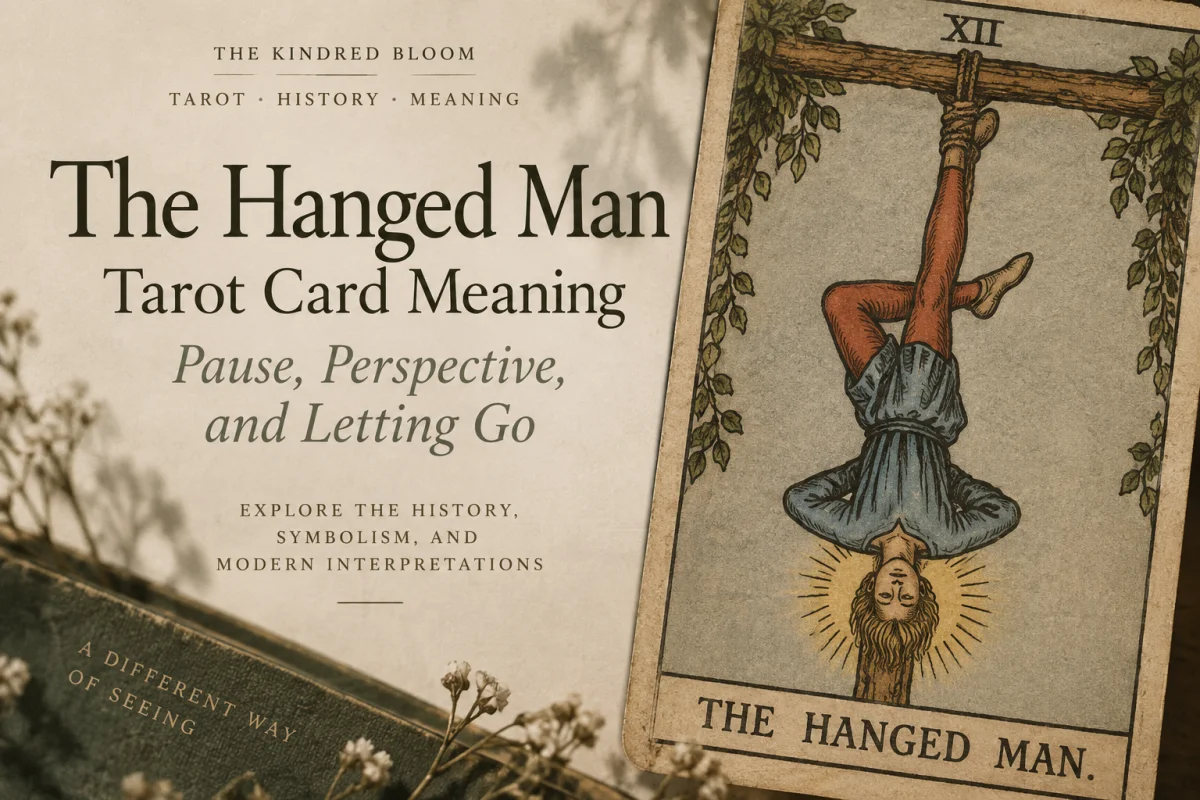
A man hangs upside down by one foot. His other leg bends behind him, his hands are positioned behind his back, and a bright halo surrounds his head.
At first glance, the scene seems uncomfortable. Yet the figure in the Rider–Waite–Smith Tarot does not appear to struggle. His expression is calm, and the structure supporting him is made from living wood with leaves still growing from it.
That contrast is one of the most useful ways to approach The Hanged Man. His circumstances appear restrictive, but his expression does not suggest panic.
This is why the card can be more interesting than simply “wait” or “do nothing.” Sometimes movement is impossible. Sometimes it is deliberately postponed. And sometimes remaining where we are allows us to notice something we could not see while trying to move forward.
But this peaceful interpretation was not always attached to the image of the hanging figure.
Before The Hanged Man: The Traitor in Early Tarot
Tarot emerged in northern Italy during the fifteenth century. Surviving luxury decks such as the Visconti-Sforza Tarot show that many of the Major Arcana figures familiar today already had recognizable predecessors, although the cards were not originally created as the modern system of divination we now know.
Among the Visconti-Sforza trumps is a suspended figure identified in the Metropolitan Museum of Art’s description of the sequence as the Traitor.
That historical detail matters because it cautions us against assuming that the earliest viewers would have looked at an upside-down figure and immediately thought of mindfulness, surrender, or gaining a new perspective.
The early image belonged to a different cultural setting. It would therefore be too simple to take the modern meaning of The Hanged Man and project it unchanged onto fifteenth-century tarot.
Likewise, we should be careful about claiming that every historical hanging figure had one fixed symbolic meaning. What the surviving cards do show is that the peaceful, introspective interpretation familiar to many modern readers was not the only way this image was understood.
From the Traitor to the Rider–Waite–Smith Hanged Man
By the time the Rider–Waite–Smith Tarot appeared in 1909, the suspended figure had been placed within a much more explicitly esoteric framework.
Pamela Colman Smith’s image presents a man hanging from a wooden structure shaped like a cross. Leaves grow from the wood, one leg is folded behind the other, and light surrounds his head.
Arthur Edward Waite’s own description is especially useful here because it prevents us from having to guess what every visual detail was intended to mean.
In The Pictorial Key to the Tarot, published in 1911, Waite specifically calls attention to three features: the wood is living, the man’s expression suggests a state of deep absorption rather than suffering, and the figure represents life held in suspension rather than death.
That is a significant shift in emphasis.
The physical position remains uncomfortable and inverted, but the emotional atmosphere is no longer primarily one of disgrace or punishment. The figure appears strangely composed.
This distinction provides a strong foundation for the card’s modern association with suspension, surrender, reflection, and a change in perspective—without pretending that all of those contemporary keywords were present from tarot’s beginning.
Why Is The Hanged Man Upside Down?
Being upside down changes what you see without necessarily changing what surrounds you.
That makes the posture an appealing visual metaphor for perspective. The same situation can look different when approached from another position.
But we should be careful not to turn every element of the illustration into a rigid symbolic formula. The card does not literally tell us that every difficult situation will improve if we simply “look at it differently.”
A more grounded interpretation is that the figure cannot proceed in the ordinary way. His position interrupts normal movement.
Imagine someone repeatedly trying to solve a problem using the same approach. The Hanged Man may not provide the solution. Instead, the image can introduce a pause in which the assumptions behind that approach can be examined.
What becomes visible when progress temporarily stops?
That question gets closer to the distinctive character of The Hanged Man than simply memorising new perspective as a keyword.
The Halo: Is The Hanged Man Enlightened?
A bright halo surrounds the figure’s head, and this is one of the most striking additions to the Rider–Waite–Smith composition.
Combined with his calm expression, the halo makes the scene look less like ordinary physical punishment and more contemplative or spiritual.
It is tempting to reduce this immediately to “the halo means enlightenment.” But Waite’s own explanation is more complex. He describes the card as carrying profound spiritual significance and connects the figure with the possibility of awakening, while also saying that much of its significance is veiled.
For a modern reader, the halo can therefore support an interpretation involving insight or awareness without guaranteeing that the person represented by the card has suddenly discovered a hidden truth.
Sometimes the insight may be much simpler: recognising that an answer is not available yet, noticing an assumption that needs reconsideration, or accepting that immediate action would not improve the situation.
The Living Wood: Suspension Is Not an Ending
The structure from which the man hangs is not dead timber. Leaves grow from it.
Waite explicitly drew attention to this detail when describing the card, pairing it with his distinction between suspended life and death.
This gives us a useful way to distinguish The Hanged Man from the card that follows it: Death.
The Hanged Man depicts interruption without necessarily depicting an ending. Something may still be alive even when it is not currently progressing in an obvious way.
A project can be paused without being abandoned. A decision can remain unresolved without being permanently avoided. A relationship can enter a period of uncertainty without its future already being determined.
The important question is why the suspension exists and what is happening during it.
Waiting Is Not Always the Same as Doing Nothing
This is where The Hanged Man becomes particularly useful in an actual reading.
Suppose someone is waiting to hear whether they have been accepted for a new job. There may genuinely be nothing they can do to accelerate the employer’s decision.
In that situation, The Hanged Man does not need to mean “try harder.” Nor does it need to promise that waiting will produce the desired outcome.
Instead, the card can help distinguish between action that would change the situation and action taken simply because uncertainty feels uncomfortable.
In another reading, however, a person might have postponed a difficult conversation for months. The same image could raise a different question: is the pause creating useful space for reflection, or has waiting become a way of avoiding a decision?
This is why pause alone is not enough to interpret The Hanged Man. We also need to ask what the pause is doing.
Surrender Does Not Mean Giving Up
Surrender is another word frequently associated with The Hanged Man, but it can easily be misunderstood.
Giving up usually implies abandoning an effort or goal. Surrender, in the context of this card, can be understood more narrowly as recognising where force is no longer useful.
The suspended figure cannot walk forward while hanging from one foot. Struggling against that fact would not necessarily give him more control.
Applied carefully in a reading, this can mean accepting a temporary limitation, releasing an approach that is not working, or acknowledging that an outcome cannot currently be forced.
It does not mean that people should passively accept harmful circumstances or surrender control that they actually possess.
The distinction is important: The Hanged Man can invite us to question unnecessary resistance without turning passivity into a virtue.
What Does The Hanged Man Mean in a Tarot Reading?
In contemporary tarot, The Hanged Man is commonly associated with pause, suspension, surrender, waiting, reflection, sacrifice, and a change in perspective.
Rather than treating these as separate definitions, look first at what is happening in the image.
The figure cannot move normally. Yet he is not visibly fighting his position. His head is illuminated, the wood supporting him remains alive, and the scene feels suspended rather than concluded.
Together, these details suggest several useful questions: Is immediate action actually possible? Would acting now improve the situation? Is something being seen differently because normal progress has stopped? And is the pause serving a purpose, or merely prolonging avoidance?
The answer will depend on the question being asked and the surrounding cards.
The Hanged Man does not automatically tell someone to wait. It asks us to understand the nature of the waiting.
When a New Perspective Actually Matters
“Look at things differently” sounds useful, but it can become an empty phrase unless we know what needs reconsideration.
Suppose someone believes they have only two choices: stay in an unsatisfying job or resign immediately. The Hanged Man might encourage them to question the structure of the decision itself.
Are those genuinely the only possibilities? Could responsibilities be changed? Could another position be explored before resigning? Is the urgency coming from the situation, or from discomfort with uncertainty?
The card has not supplied a third option. Instead, it has interrupted the assumption that the original two options are the only ones available.
That is an important distinction.
Perspective does not magically change reality. It can change which parts of reality we are able to notice.
The Hanged Man After Justice
In the Rider–Waite–Smith sequence, The Hanged Man follows Justice.
Justice holds scales and a sword, imagery that lends itself to evaluation and decision. The Hanged Man immediately presents a very different scene: the central figure is unable to move in the ordinary way.
For learning purposes, the contrast is useful. Justice can help us think about weighing information and reaching a considered decision. The Hanged Man reminds us that not every situation is ready to be resolved immediately.
Sometimes the responsible choice is to decide.
Sometimes more information, time, or distance is needed before a decision can be made well.
This is a modern way of comparing neighbouring cards, not evidence that fifteenth-century tarot makers designed them as consecutive stages of one spiritual journey.
Understanding The Hanged Man Beyond “Just Wait”
The history of The Hanged Man makes the card particularly interesting because its imagery has not carried one unchanged meaning across the centuries.
An early Italian tarot sequence included the suspended figure as the Traitor. Centuries later, the Rider–Waite–Smith image presents a calm figure surrounded by signs that Waite himself associated with suspended life and spiritual significance.
Modern ideas such as pause, surrender, and perspective make more sense when viewed against that later image—but they become more useful when we resist turning them into automatic instructions.
The Hanged Man does not necessarily say wait.
Instead, look at the suspension itself.
What cannot move right now? What are you trying to force? What becomes easier to see when you stop pushing for an immediate answer?
Sometimes a pause is an obstacle. Sometimes it is avoidance. And sometimes it creates the space needed to see a familiar situation differently.
Learning to distinguish between them is where The Hanged Man becomes more than a keyword.
Continue Exploring
The Hanged Man follows Justice (XI) in the Rider–Waite–Smith Major Arcana sequence. Justice draws attention to evaluation, decisions, and accountability, while The Hanged Man introduces situations in which immediate action may not be the most useful response.
You can also explore The Major Arcana Explained for a broader introduction to the sequence.
Next comes Death (XIII), where suspension gives way to a different question: what happens when something is not merely paused, but has reached an ending?