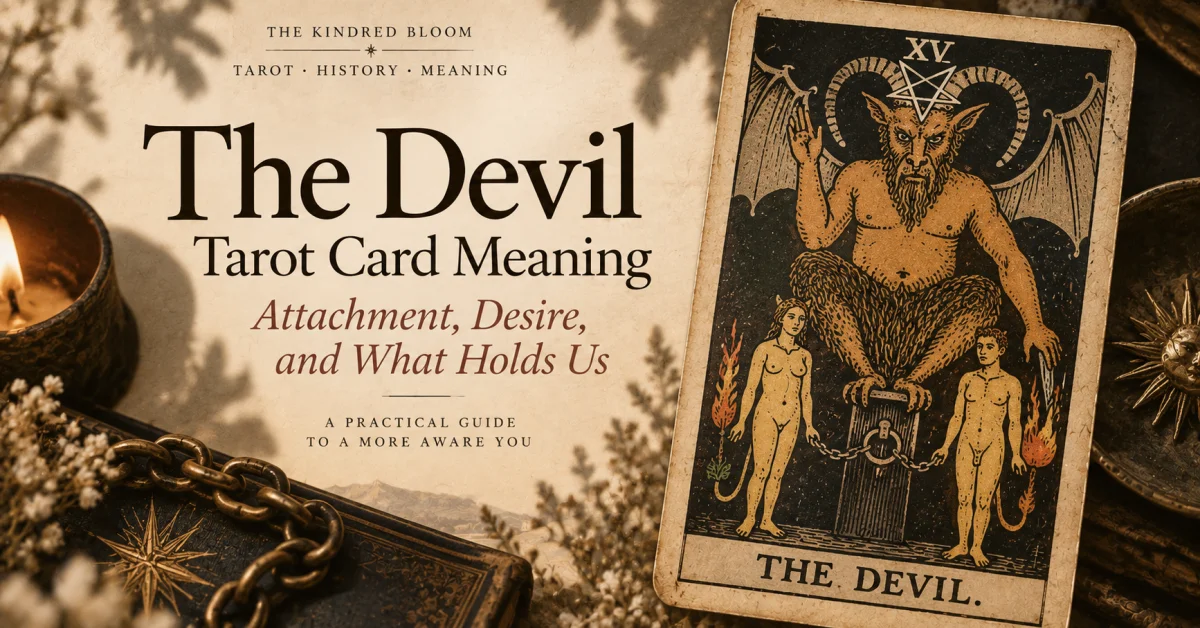
The Devil is one of those tarot cards that can feel unsettling before we even begin to interpret it. A horned figure sits above two people who are chained to a pedestal. The scene is dark, there is fire in the background, and the two figures seem to be trapped beneath something much larger than themselves.
It is easy to look at this image and immediately think of addiction, temptation, obsession, or toxic relationships. Those meanings can fit, but they can also reduce The Devil to a simple warning that something is bad. There is another way to approach it that I find more useful: What has power over me, and what is my relationship with it?
Desire itself is not necessarily harmful. Money, pleasure, ambition, comfort, recognition, and material things are not automatically negative either. The more interesting question is what happens when wanting something begins to influence our choices so strongly that saying no becomes difficult.
The Devil Before Modern Tarot Reading
The Devil belongs to a much older visual world than modern psychological tarot. Tarot emerged in northern Italy during the fifteenth century as a card game, long before the cards became strongly associated with divination and occult practice. Images of demons, temptation, sin, and punishment would also have been familiar within the religious art and culture of Christian Europe.
That historical background is useful, but we should be careful about reading modern psychology into early tarot. Ideas such as self-sabotage, toxic attachment, limiting beliefs, and addiction are part of the language contemporary readers use to understand The Devil. We cannot assume that a fifteenth-century card player would have looked at the image in exactly the same way.
By the time the Rider–Waite–Smith Tarot appeared in 1909, The Devil belonged to a much more explicitly esoteric tarot tradition. Pamela Colman Smith’s illustration also gave us many of the details modern readers now focus on: the horned central figure, the inverted pentagram, the torch, and most importantly, the two chained people below.
Look at the Chains
The chains are probably the first thing I would pay attention to when The Devil appears in a reading. A man and woman stand beneath the central figure with collars around their necks, clearly connected to the structure supporting The Devil. Restriction is difficult to miss.
Look a little closer, though, and the collars do not appear especially tight. There seems to be space between the chains and the people wearing them. This has led to a popular interpretation that they could simply remove the chains if they chose to, but I would be careful with that conclusion. A loose-looking chain does not mean every difficult situation is easy to leave.
What the image can do is encourage us to investigate the restriction more closely. How much of this situation is being controlled by circumstances, and how much of it has become something I now carry within myself?
The answer may be very different from one reading to another.
Not Every Chain Is Easy to Remove
Imagine someone who feels trapped in a job they dislike but depends on the salary to pay rent and support their family. Telling them that they can simply walk away because their “chains are loose” ignores the reality of their situation. The restriction is not imaginary.
Now imagine someone who has enough savings to change careers but stays in a job they hate because they are terrified of losing status or appearing unsuccessful. They also feel trapped, but what is holding them there is different.
The Devil can make sense in both situations. Instead of immediately telling us how to escape, it can encourage us to identify what the chain is actually made of. It might be money, responsibility, fear, habit, shame, comfort, desire, another person, or several things tangled together.
Understanding the chain comes before deciding what to do with it.
Desire Is Not the Enemy
The Devil is often connected with desire, pleasure, sexuality, money, and material concerns. Because the card looks dark and threatening, these things can easily start sounding like warnings. But wanting financial security is not greed, enjoying pleasure is not automatically excess, and wanting recognition for your work does not mean you are controlled by your ego.
The interesting part begins when we look at what happens after the desire appears. Suppose you enjoy buying beautiful things. There is nothing inherently harmful about that. But if buying them repeatedly pushes you into debt, creates anxiety, or feels difficult to stop even when you genuinely want to, the relationship between desire and choice has changed.
The same idea can apply to work, attention, relationships, social media, approval, food, or almost anything else. Sometimes the problem is not what we want, but how much power wanting it has over us.
When “I Want” Starts Feeling Like “I Need”
There is a small difference between I want this and I cannot be okay without this, but in a reading it can matter a lot.
Someone might naturally want affection from their partner. But if their sense of worth becomes dependent on constant reassurance, that desire begins to affect their freedom and emotional stability. The same can happen with achievement. Wanting to succeed can motivate us, while needing success in order to feel valuable can turn the same ambition into something much harder to put down.
That does not mean every intense desire is unhealthy. The Devil is more useful as an invitation to notice when desire has started narrowing our choices. Can I still choose how I respond to this, or does it feel as though the choice has already been made for me?
The Devil and The Lovers
The two people in The Devil may look strangely familiar if you have already studied The Lovers. Both Rider–Waite–Smith cards show a nude man and woman beneath a larger supernatural figure, and the resemblance is intentional enough that Waite himself connected the figures in The Devil with Adam and Eve after the Fall.
Even without following Waite’s entire religious interpretation, comparing the cards can be useful. The Lovers can lead us toward questions about attraction, values, relationships, and choice. The Devil shows what those themes can look like when attachment begins to complicate our ability to choose freely.
I would not reduce that comparison to “The Lovers is healthy love and The Devil is toxic love.” Both cards are broader than relationships. A simpler distinction is more useful: The Lovers can ask, “What am I choosing?” The Devil can ask, “Do I still feel able to choose?”
The Devil Is Not Automatically an Addiction Card
Addiction is one of the most common words associated with The Devil, and it is easy to understand why. Repetition, craving, compulsion, and feeling unable to stop all fit naturally with the image of bondage.
But pulling The Devil does not diagnose an addiction. Tarot cannot determine whether someone has a medical or psychological condition, and struggling to change a habit does not automatically make that habit an addiction.
For an everyday reading, I prefer something less dramatic: Is this something I enjoy, something I depend on, or something I no longer feel in control of? Those experiences can look similar from the outside while being very different for the person living them.
Comfort Can Be a Chain Too
Not every Devil situation feels obviously unpleasant. In fact, some attachments are difficult to recognise precisely because they give us something we like: comfort, security, familiarity, pleasure, or approval.
A stable job can provide security while also making someone afraid to explore a different career. A familiar relationship can provide companionship while repeating patterns that neither person wants to confront. Even an identity that once suited us can become restrictive if we feel we must continue being that person forever.
None of this makes comfort bad. Stability is valuable, and there is no reason to abandon something simply because it is familiar. The more interesting question is whether we are staying because something still works for us or because imagining life without it feels frightening.
Sometimes the chain is connected to something we genuinely enjoy. That is exactly why it can be difficult to recognise.
What Does The Devil Mean in a Tarot Reading?
In contemporary tarot, The Devil is commonly associated with attachment, temptation, desire, restriction, material concerns, unhealthy patterns, and compulsive behaviour. Rather than reaching immediately for one of those keywords, I would first look for what seems to hold the most power in the situation.
In a work reading, the attachment might not be the job itself but the salary, status, security, or fear of starting again. In a relationship, it could involve attraction, dependency, jealousy, fear of being alone, or a familiar pattern that continues even though both people know it causes problems. With money, The Devil might point toward overspending, but it could also appear around the opposite problem: being so afraid of losing money that you cannot comfortably use it.
That is why I would not automatically translate The Devil as leave, stop, or this is toxic. Before deciding what needs to change, it helps to understand what is actually happening. What am I getting from this? What is it costing me? And how much choice do I really have?
Those questions usually tell us more than the keyword temptation ever could.
The Devil After Temperance
Temperance and The Devil are interesting cards to study together because both can make us think about desire, limits, and proportion. Temperance looks for a mixture that works: perhaps more of one thing, less of another, or a different relationship between the two.
The Devil shows what it can look like when something begins to dominate that mixture. A desire, fear, habit, responsibility, or attachment may become so influential that other choices start arranging themselves around it.
This is a modern way of comparing the cards, not evidence that early tarot makers designed them as consecutive stages of psychological development. But as a learning tool, I think the contrast is helpful: Temperance asks, “What proportion works?” The Devil asks, “What has begun to control the proportion?”
Understanding The Devil Beyond “Something Bad”
The Devil becomes much more interesting when we stop treating it as tarot’s warning label. Money is not automatically bad. Pleasure is not automatically dangerous. Desire is not something we need to feel ashamed of, and a difficult situation does not always mean we have secretly chosen to be trapped.
Instead, The Devil can draw our attention to the relationship between desire, attachment, and freedom. What do I want? What am I afraid of losing? What do I keep returning to even when part of me wants something different? What feels impossible to change, and what is actually making it feel that way?
Sometimes the answer will reveal a very real external restriction. Sometimes it will reveal a habit, fear, or attachment that has quietly gained more influence than we realised. Often, the two are mixed together.
The Devil does not require us to pretend every chain is imaginary. It simply asks us to look closely enough to understand what the chain is made of.
Continue Exploring
The Devil follows Temperance (XIV) in the Rider–Waite–Smith Major Arcana. Temperance explores adjustment, proportion, and finding a mixture that works. The Devil shifts our attention toward attachment and what happens when something begins to have too much influence over our choices.
You can also explore The Major Arcana Explained for a broader introduction to the Major Arcana.
Next comes The Tower (XVI), where the focus shifts from attachment to disruption. The Tower gives us a chance to look more carefully at sudden change, collapse, and revelation—and at why not every unexpected event is necessarily a “Tower moment.”