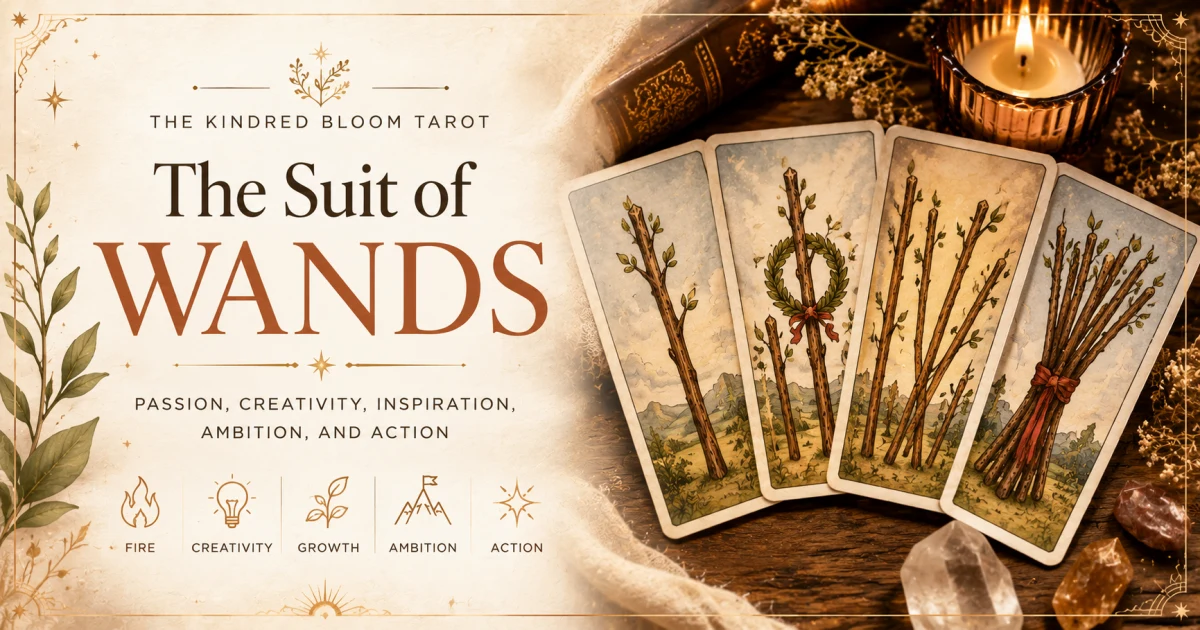
The Suit of Wands is associated with passion, creativity, inspiration, and action. Explore what Wands mean in tarot, where the suit came from, and how its fiery symbolism can help you understand the Minor Arcana.
When you first begin exploring the Minor Arcana, the Suit of Wands often feels full of movement. Its cards can show journeys, celebrations, competition, determination, and moments when something new is beginning to take shape.
Today, Wands are commonly associated with passion, creativity, inspiration, ambition, and action. But these meanings were not simply built into the earliest tarot cards. Like many parts of tarot, the suit has a much longer history, and its symbolism developed gradually over time.
Understanding both sides of the story can make the Wands easier to read. Instead of memorizing a list of keywords, we can begin with where the suit came from, then explore how it became the energetic and creative force many tarot readers recognize today.
What Is the Suit of Wands?
Wands is one of the four suits of the Minor Arcana, alongside Cups, Swords, and Pentacles. Like every Minor Arcana suit, it contains 14 cards: an Ace, cards numbered Two through Ten, and four Court Cards—the Page, Knight, Queen, and King.
In many modern tarot traditions, Wands represents the part of life connected with energy and movement. It can point toward creative ideas, motivation, personal ambitions, new projects, confidence, and the desire to turn inspiration into something real.
That doesn’t mean every Wands card is automatically positive. Fire can warm and illuminate, but it can also become difficult to control. In the same way, Wands can explore impatience, competition, exhaustion, frustration, or having more enthusiasm than direction.
Looking at both sides helps us understand the suit as something richer than simply “passion.”
Where Did the Suit of Wands Come From?
The history of Wands begins before the name Wands became common in English-language tarot.
Early European tarot decks inherited four suits from the playing-card traditions that already existed around them. In Italian cards, the suit corresponding to modern Wands was generally represented by batons or clubs. In later traditions such as the Tarot de Marseille, these long wooden objects remained an important visual feature of the suit.
This is an important distinction because the earliest tarot players were not necessarily looking at a baton and thinking of creativity, passion, or the element of fire. Tarot was originally created for card games, and the elaborate symbolic interpretations familiar to modern readers developed later.
The name Wands became especially familiar to English-speaking readers through twentieth-century occult tarot traditions and the enormous influence of the Rider-Waite-Smith Tarot.
So when we talk about the “meaning of Wands” today, we’re exploring a symbolic tradition that grew around a much older playing-card suit.
Why Is Wands Associated With Fire?
In modern tarot, the Suit of Wands is commonly associated with the classical element of Fire.
Fire provides a useful metaphor for understanding the suit. A small flame can become a source of warmth and light, just as a new idea can grow into a creative project. Fire moves, transforms, and requires fuel to continue burning. These qualities naturally complement themes such as enthusiasm, courage, ambition, and action.
This is why Wands often appears when something is beginning, growing, or demanding energy. It may describe the excitement of pursuing a new idea, the determination required to continue a difficult project, or the confidence needed to step into unfamiliar territory.
However, the association between Wands and Fire should be understood as part of later esoteric tarot traditions rather than the original purpose of the suit. Systems connecting tarot suits with the classical elements became especially influential through occult movements of the nineteenth and early twentieth centuries.
Knowing this doesn’t make the elemental association less useful. It simply helps us distinguish tarot history from tarot interpretation.
What Does Wands Represent in a Tarot Reading?
When Wands appear in a reading, they often draw attention to the question:
Where is your energy going?
Sometimes the answer is exciting. Wands may appear around a new project, a creative breakthrough, travel, personal development, or a goal that makes you feel genuinely motivated.
At other times, the suit can reveal a more complicated relationship with energy. You may be trying to do too much at once, competing with others, rushing forward without enough preparation, or carrying a responsibility that has become exhausting.
This is why it’s helpful not to reduce Wands to a single word such as “passion.” The suit is really about what happens when energy begins to move—where it comes from, what we do with it, and whether we can sustain it.
The individual card then gives that energy a particular shape.
How the Wands Change From Ace to King
One helpful way to study the Suit of Wands is to see the fourteen cards as connected rather than completely separate.
The numbered cards move from the Ace through Ten, while the Page, Knight, Queen, and King form the Court Cards. Each card explores the broader themes of the suit from a different perspective.
The Ace of Wands, for example, is often associated with the first spark of inspiration or possibility. As the numbers progress, the cards explore what can happen when that initial energy meets planning, expansion, competition, persistence, and responsibility.
The Court Cards add another layer, often representing different ways that Wands energy can be expressed through personality, behavior, roles, or situations.
You don’t need to memorize all fourteen cards at once. Understanding the character of the suit first gives you a foundation. When you later study each individual card, you can ask how that card changes, develops, or challenges the central themes of Wands.
What If Many Wands Appear in a Reading?
Sometimes a tarot spread contains several cards from the same suit. When many Wands appear together, the reading may be emphasizing themes related to activity, motivation, creativity, ambition, or personal drive.
This doesn’t automatically mean that something dramatic is about to happen. Instead, it can be useful to look at the overall pattern. Are the cards showing excitement and momentum? Competition? Too many responsibilities? A strong desire to move forward?
Context matters.
A group of Wands cards in a career reading may feel very different from the same cards appearing in a relationship or personal-growth reading. The surrounding cards, the question being asked, and the imagery within each card all contribute to the interpretation.
Rather than counting Wands and applying a fixed rule, notice the story they seem to be telling together.
How to Learn the Wands Cards
Learning the traditional meanings of the Wands cards gives you an important foundation for reading tarot. Each of the fourteen cards has themes that have developed through established tarot traditions, and becoming familiar with those meanings helps you understand how the cards relate to one another.
You don’t need to memorize everything perfectly at the beginning, but it is worth gradually learning the key meanings of each card. Start with the overall character of the Suit of Wands—energy, creativity, ambition, and action—then notice how those themes change as you move from the Ace through the Ten and into the Court Cards.
The imagery can deepen what you already know. Pay attention to the people, landscapes, movement, and repeated symbols in the cards, and consider how they support or add nuance to the traditional meanings. With practice, the meanings become more familiar, and you begin to recognize patterns across the suit rather than relying only on individual keywords.
Learning tarot is a combination of knowledge, observation, and practice. Building a strong foundation in traditional meanings gives you something reliable to return to, while experience gradually teaches you how those meanings can shift depending on the question, surrounding cards, and context of a reading.
Continue Exploring
The Suit of Wands gives us our first close look at how one Minor Arcana suit can develop its own character while remaining part of a larger system.
If you’d like to continue exploring, you may also be interested in:
- What Do the Four Tarot Suits Mean?
- Why Do Tarot Cards Have Four Suits?
- What Does the Suit of Cups Mean in Tarot?
Wands reminds us that inspiration is only the beginning. What matters next is how we choose to work with that spark—whether we nurture it, act upon it, or discover that our energy needs to move in a different direction.