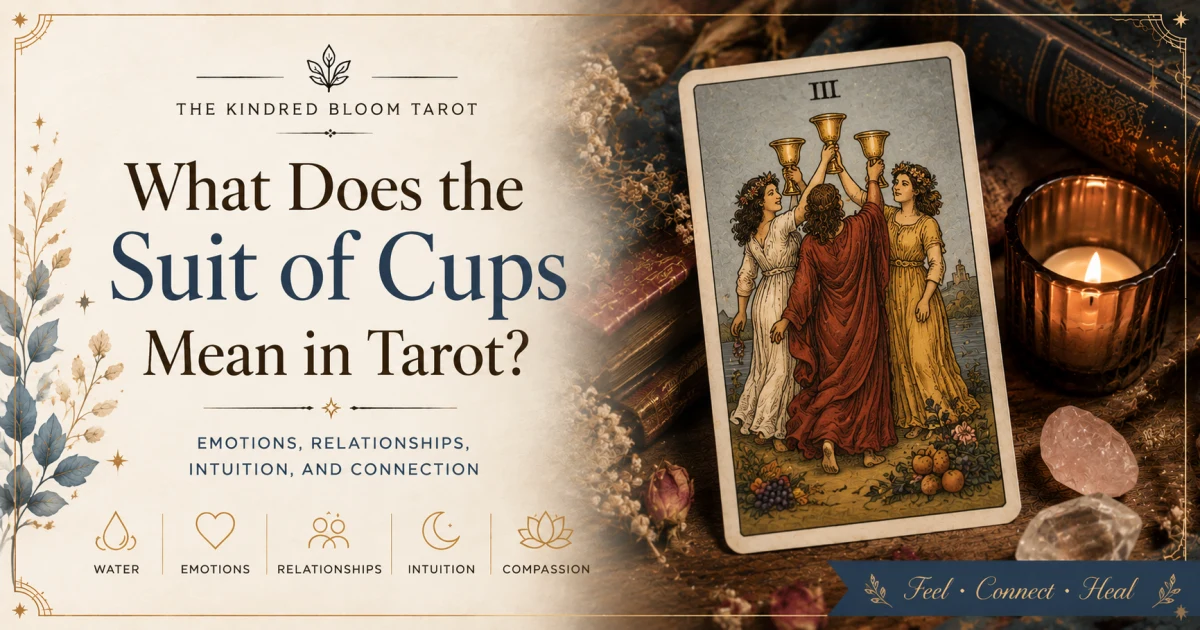
The Suit of Cups is associated with emotions, relationships, intuition, and our inner world. Explore what Cups mean in tarot, where the suit came from, and how its connection with water can help you understand the Minor Arcana.
Among the four suits of the Minor Arcana, Cups brings our attention to what we feel rather than simply what we do. Its cards often appear in questions about love and relationships, but the suit reaches much further than romance. Friendship, family, emotional fulfillment, intuition, disappointment, connection, and the way we relate to ourselves can all belong to the world of Cups.
Today, Cups are commonly associated with emotions, relationships, intuition, compassion, and creativity. The suit is also traditionally connected with the element of Water, an association that helps explain its fluid and emotional symbolism.
However, these meanings were not necessarily attached to Cups when tarot first appeared. The suit itself is centuries old, while many of the symbolic interpretations familiar to modern readers developed later.
Looking at both its history and symbolism can help us understand Cups as more than simply the “love suit” of tarot.
What Is the Suit of Cups?
Cups is one of the four suits of the Minor Arcana, alongside Wands, Swords, and Pentacles. It contains 14 cards: the Ace, cards numbered Two through Ten, and four Court Cards—the Page, Knight, Queen, and King.
In modern tarot readings, Cups generally describes our emotional and relational experiences. A Cups card may draw attention to how we feel about another person, but it can just as easily reflect our relationship with ourselves, our emotional needs, or the sense of connection and fulfillment we find in life.
This is why the suit contains both joyful and difficult cards. Cups can represent affection, celebration, friendship, and emotional abundance, but they can also explore grief, disappointment, emotional withdrawal, or the difficulty of letting something go.
The suit isn’t simply about feeling good. It explores the broader experience of having feelings and learning how to live with them.
Where Did the Suit of Cups Come From?
Like the other Minor Arcana suits, Cups has roots in the playing-card traditions that existed before tarot became associated with divination.
When tarot emerged in fifteenth-century Italy, the cards used four Latin suits: Cups, Coins, Swords, and Batons. Cups therefore did not begin as a special symbol created specifically to represent love or emotion. They were already part of the card-playing tradition from which tarot developed.
The cup symbol continued to appear in later European tarot traditions, including the Tarot de Marseille, and unlike Batons becoming Wands or Coins becoming Pentacles in many English-language decks, the name Cups remained relatively recognizable.
The symbolic meanings familiar to modern tarot readers developed much later. As tarot became increasingly connected with occult and esoteric traditions, writers and practitioners began assigning broader philosophical and elemental meanings to each suit.
That distinction is worth remembering: Cups are historically old, but many of the meanings we associate with them today are later interpretations.
Why Are Cups Associated With Water?
In many modern tarot systems, Cups correspond to the classical element of Water.
The connection is easy to visualize. A cup is a vessel designed to hold liquid, and water has long served as a powerful metaphor for feelings, intuition, depth, and change. It can be calm or turbulent, shallow or deep, contained or overflowing.
These qualities make Water a natural symbolic language for the emotional themes found throughout the Suit of Cups.
Imagine the difference between still water and a stormy sea. Both are water, yet they create completely different experiences. Emotions can behave in much the same way. They may bring peace and connection, or become overwhelming and difficult to navigate.
The Water correspondence, however, belongs primarily to later esoteric systems of tarot rather than the original fifteenth-century purpose of the cards. Elemental correspondences became particularly influential through nineteenth- and early twentieth-century occult traditions.
Understanding that history allows us to use the symbolism without mistaking a later interpretation for tarot’s original meaning.
What Does Cups Represent in a Tarot Reading?
When Cups appear in a tarot reading, they often invite us to consider how we feel and how those feelings influence our choices.
In a relationship reading, Cups may naturally point toward affection, emotional connection, vulnerability, or disappointment. In a career reading, however, the same suit might ask whether the work feels meaningful, whether relationships with colleagues are supportive, or whether a decision aligns with what you genuinely value.
Cups can also relate to intuition and the inner world. Sometimes a situation cannot be understood through logic or action alone. A Cups card may encourage greater awareness of feelings that have been overlooked or difficult to express.
This is why context matters so much. Seeing a Cups card does not automatically mean romance is involved. The broader question is often about emotional connection—with another person, an experience, a dream, or yourself.
Cups Represent More Than Romantic Relationships
Because Cups are closely associated with emotions and relationships, they often appear in readings about love and romantic connections. But romance is only one part of what this suit can represent.
Cups can also reflect friendship, family relationships, compassion, emotional fulfillment, grief, memories, creativity, and the relationship we have with ourselves. What connects these experiences is not necessarily love, but the emotional meaning they hold for us.
For example, a Cups card in a reading about moving to another country might reflect the feelings involved in leaving familiar people and places behind. In a creative reading, it might point toward imagination or an emotional connection with your work. In a reading about personal growth, it could draw attention to feelings or emotional patterns that deserve greater awareness.
Thinking of Cups as the suit of our emotional and relational world, rather than limiting it to romance, gives us a more flexible and accurate foundation for understanding the cards.
How the Cups Develop From Ace to King
The fourteen Cups cards can be easier to understand when we see them as parts of the same suit rather than fourteen unrelated meanings.
The Ace of Cups is traditionally associated with emotional beginnings, openness, and the potential for connection. As the numbered cards progress, the suit explores different experiences involving relationships, choices, celebration, disappointment, reflection, and emotional fulfillment.
The Court Cards—the Page, Knight, Queen, and King—add another dimension. They can represent people, qualities, roles, or ways of expressing the emotional character of Cups.
Not every Cups card follows a perfectly linear story, so it’s better not to treat the suit as a rigid sequence. Still, noticing how the same emotional themes appear in different forms can make the individual cards easier to understand and remember.
This is where learning the overall nature of a suit becomes useful: it gives every individual card a larger context.
What If Many Cups Appear in a Reading?
When several Cups appear together, emotions, relationships, or personal values may be especially important to the situation being explored.
That doesn’t necessarily mean the reading is positive or romantic. Look at what is happening within the cards. Do they suggest connection and celebration, or disappointment and withdrawal? Are emotions being expressed openly, or is someone struggling to understand what they feel?
A reading dominated by Cups may also suggest that the situation is being experienced primarily through an emotional lens.
As always, the question and surrounding cards matter. Rather than applying a fixed rule such as “many Cups mean love,” look for the pattern created by the cards together.
How to Learn the Cups Cards
Learning the traditional meanings of the Cups cards provides an important foundation. Becoming familiar with the central themes of each card helps you understand why certain interpretations appear repeatedly in tarot books, readings, and traditions.
Start by remembering the broader character of the suit: emotion, relationships, intuition, and connection. Then learn the key meanings of the individual cards and notice how each one develops, challenges, or expresses those themes differently.
The imagery can then deepen that knowledge. In the Rider-Waite-Smith Tarot, for example, pay attention to whether cups are full or empty, offered or ignored, standing upright or overturned. Notice the expressions and body language of the figures and the landscapes surrounding them. These details can add nuance to meanings you have already learned.
With time and practice, the traditional meanings become increasingly familiar. Rather than depending on a list of isolated keywords, you begin to understand why a particular interpretation makes sense within the larger language of the suit.
Learning tarot involves knowledge, observation, and experience working together. A solid foundation gives your interpretation structure, while practice helps that knowledge become more flexible and natural.
Continue Exploring
The Suit of Cups shows us how tarot can explore experiences that aren’t always visible from the outside. Feelings, relationships, memories, and personal values may be difficult to measure, but they can influence our choices just as strongly as external circumstances.
If you’d like to continue exploring the Minor Arcana, you may also be interested in:
- What Does the Suit of Wands Mean in Tarot?
- What Do the Four Tarot Suits Mean?
- What Does the Suit of Swords Mean in Tarot?
As we move from Cups into Swords, the focus begins to change, from the world of feelings and relationships toward thoughts, communication, decisions, and the challenges of the mind.